The Ads are making a bit more sense now...
There is a global commercial WiFi service that has good coverage in places like Hotels and Airports called Boingo. They aggregate services that are not branded under their own name, but if you have a Boingo account you can use the service. Last month they announced a deal to include FON in their network, more than doubling the number of access points to a few hundred thousand. This month they announced an annual flat rate plan for $39 per month. Very cool! Global WiFi access at a low flat rate.
I'm posting a series of updates at Millicomputing.com that describe a detailed design for an Enterprise server Millicluster. Its a radical improvement in terms of performance per watt and performance per dollar for some kinds of applications.
Monday, June 25, 2007


What the iPhone doesn't do, why not, and why I still want one...
There is a very nice posting on the iPhone at RoughlyDrafted, taking a thoughtful look at all the coverage, and pointing out double standards in many of the negative commentators who are putting down the iPhone for not being "enterprise ready".
Back in January, I wrote a summary of thoughts on the iPhone from the perspective of typical product development practices. That post got a lot of traffic, it seemed to be very popular in Germany, where there is a great tradition of quality product design (I can't think of a German designed product that isn't well engineered).
Overall, with the additional advance information that has been released so far I don't think I was too far off the mark. I did expect that support for Adobe Flash and Java would be included, but they both appear to be missing. This is going to be the biggest pain, as there are a lot of web sites that use Flash or Java applets. Given time I expect these issues will be addressed.
I talked about Minimum Marketable Features (MMF) which are described in a book called Software by Numbers, written by my good friend Mark Denne. Its a philosophy of development that optimizes product features by releases over time. Many of the iPhone's shortcomings are explained by an initial focus on the needs of people who have never used a "smartphone" before, (rather than a focus on the business market) and a close integration with other Apple products that support an "insanely great" combination of product features.
For integration with non-Apple products, there is a two pronged strategy. One is to provide basic file viewers for Microsoft Word and Excel documents that are common email attachments. The other approach is to leverage Google's web based application suite within the Safari browser, which now includes Word, Excel and Powerpoint, Gmail etc, and also integrate with the Google maps application on the iPhone itself.
For the question of whether the iPhone can be used in corporate environments, there are two issues - virtual private network (VPN) access to get at internal web sites, and email integration with Microsoft Exchange. There have been some hints that the standard MacOSX VPN functionality is included, and Apple states that syncing is supported with Outlook/Entourage contacts and calendars. For actual Exchange email access, the Exchange server would have to support IMAP or POP (most aren't setup this way) or the Outlook Web Access client could be used in the Safari browser on the iPhone.
Safari is key. It is not only the way to manipulate documents and corporate email, its also the designated "API" for new iPhone applications to be developed. Apple stated that Safari will have access to many of the internal functions of the iPhone, so that the primary programming language for developers becomes Javascript. For all the people with existing mobile applications this is a pain, as they want to have J2ME to get them ported quickly. However, the iPhone is a huge leap forward in user interfaces, and to provide the consistent look and feel that magnifies the ease of use, Apple are enforcing Safari as the only framework for extending the iPhone. This makes perfect sense as a product strategy. It has upset many developers, but the laser-like focus on ease of use greatly increases the iPhone's perceived value and total addressable market. More users will be willing to pay more, increasing Apple's sales. Later on, perhaps Apple will focus more on the "traditional" smartphone market, but for now they are simply going to redefine what that market is.
How many people have both iPods and cellphones in their pockets? This fall, how many students will turn up at college with an iPhone in their pocket?
My work machines are a MacBook Pro and a Blackberry. I'm building the homebrew myPhone design (more on that later), but I think I'm getting tempted by the user interface, I want an iPhone....
Back in January, I wrote a summary of thoughts on the iPhone from the perspective of typical product development practices. That post got a lot of traffic, it seemed to be very popular in Germany, where there is a great tradition of quality product design (I can't think of a German designed product that isn't well engineered).
Overall, with the additional advance information that has been released so far I don't think I was too far off the mark. I did expect that support for Adobe Flash and Java would be included, but they both appear to be missing. This is going to be the biggest pain, as there are a lot of web sites that use Flash or Java applets. Given time I expect these issues will be addressed.
I talked about Minimum Marketable Features (MMF) which are described in a book called Software by Numbers, written by my good friend Mark Denne. Its a philosophy of development that optimizes product features by releases over time. Many of the iPhone's shortcomings are explained by an initial focus on the needs of people who have never used a "smartphone" before, (rather than a focus on the business market) and a close integration with other Apple products that support an "insanely great" combination of product features.
For integration with non-Apple products, there is a two pronged strategy. One is to provide basic file viewers for Microsoft Word and Excel documents that are common email attachments. The other approach is to leverage Google's web based application suite within the Safari browser, which now includes Word, Excel and Powerpoint, Gmail etc, and also integrate with the Google maps application on the iPhone itself.
For the question of whether the iPhone can be used in corporate environments, there are two issues - virtual private network (VPN) access to get at internal web sites, and email integration with Microsoft Exchange. There have been some hints that the standard MacOSX VPN functionality is included, and Apple states that syncing is supported with Outlook/Entourage contacts and calendars. For actual Exchange email access, the Exchange server would have to support IMAP or POP (most aren't setup this way) or the Outlook Web Access client could be used in the Safari browser on the iPhone.
Safari is key. It is not only the way to manipulate documents and corporate email, its also the designated "API" for new iPhone applications to be developed. Apple stated that Safari will have access to many of the internal functions of the iPhone, so that the primary programming language for developers becomes Javascript. For all the people with existing mobile applications this is a pain, as they want to have J2ME to get them ported quickly. However, the iPhone is a huge leap forward in user interfaces, and to provide the consistent look and feel that magnifies the ease of use, Apple are enforcing Safari as the only framework for extending the iPhone. This makes perfect sense as a product strategy. It has upset many developers, but the laser-like focus on ease of use greatly increases the iPhone's perceived value and total addressable market. More users will be willing to pay more, increasing Apple's sales. Later on, perhaps Apple will focus more on the "traditional" smartphone market, but for now they are simply going to redefine what that market is.
How many people have both iPods and cellphones in their pockets? This fall, how many students will turn up at college with an iPhone in their pocket?
My work machines are a MacBook Pro and a Blackberry. I'm building the homebrew myPhone design (more on that later), but I think I'm getting tempted by the user interface, I want an iPhone....
Saturday, June 23, 2007
FON: World WiFi Domination?
Now if there ever was a company working on world domination, it would be FON. They aim to build a global network of Wifi hotspots by selling subsidized routers that have custom firmware. The routers have a private secure WPA based network for you to use, and a public network that has a signup page, for anyone else to use. There is also a control that limits how much bandwidth the public can use. They have a few hundred thousand users, and are now the largest WiFi network by far, but the location of their base stations is much more random and less useful than T-Mobile HotSpots.
The incentive in the short term is that you can get a high quality router at a very low price. FON has been giving routers away to seed markets and to surround Starbucks stores. The incentive in the longer term is that if you have a FON router at home, you can use any FON router you find on your travels for free.
I've had a FON router for some time. I met CEO Martin Varsavsky when he gave a talk at eBay last year, and got one of the initial Linksys units with custom firmware. When their own hardware solution came out it had a much nicer feature set, so I upgraded to La Fonera as they call it. I've been using it as my primary home router for about six months now, and its an excellent design. Its been much more reliable than the other low cost routers I've owned (Netgear and Linksys) and works as well as the much more expensive Apple Airport Express that I've had for a long time.
FON just released a booster antenna "La Fontenna", it is designed to give 6.5dB of extra signal strength and project further out than the standard antenna. The idea is that you mount it on the window facing the street, and it covers a larger area. I just got one, and while it seems to work fine, it doesn't appear to be giving me as much signal strength or range as I expected. I wandered around outside with my MacBook using iStumbler's WiFi monitoring widget to track signal strength, and it showed a bit more gain than my Airport. I think I need to experiment a bit more with positioning La Fontenna.
So next time you need a router, don't just buy a normal one, join Fon and support world domination!
The incentive in the short term is that you can get a high quality router at a very low price. FON has been giving routers away to seed markets and to surround Starbucks stores. The incentive in the longer term is that if you have a FON router at home, you can use any FON router you find on your travels for free.
I've had a FON router for some time. I met CEO Martin Varsavsky when he gave a talk at eBay last year, and got one of the initial Linksys units with custom firmware. When their own hardware solution came out it had a much nicer feature set, so I upgraded to La Fonera as they call it. I've been using it as my primary home router for about six months now, and its an excellent design. Its been much more reliable than the other low cost routers I've owned (Netgear and Linksys) and works as well as the much more expensive Apple Airport Express that I've had for a long time.
FON just released a booster antenna "La Fontenna", it is designed to give 6.5dB of extra signal strength and project further out than the standard antenna. The idea is that you mount it on the window facing the street, and it covers a larger area. I just got one, and while it seems to work fine, it doesn't appear to be giving me as much signal strength or range as I expected. I wandered around outside with my MacBook using iStumbler's WiFi monitoring widget to track signal strength, and it showed a bit more gain than my Airport. I think I need to experiment a bit more with positioning La Fontenna.
So next time you need a router, don't just buy a normal one, join Fon and support world domination!
Ads that don't make sense
For some reason the ad bar on this site has a fixation about the b-word. I just removed the word bl*g from the template in two places, and I'm avoiding saying it in this posting. I really think Google should be able to find something more interesting to show ads about, so lets see if this makes any difference....
Friday, June 22, 2007
Jobs at Netflix: Capacity/Performance and Storage Admin
Netflix is a great company to work for, there are lots of clever friendly and happy people here.
I just hired an engineer for my own group, but we have a lot more openings:
We are looking for a performance and scalability oriented Java/Oracle developer
Senior Performance and Scalability Engineer
http://jobs.netflix.com/DetailFlix.asp?flix1651
My good friend Ed Wustenhof just joined Netflix to manage the System Administrator group, he's got two open positions, a storage oriented one:
Sr Unix Administrator - Storage Focus
http://jobs.netflix.com/DetailFlix.asp?flix1699
and a Capacity Planning and Performance Tuning one that I've copied the full info for below.
Senior Unix Administrator - Capacity Planning & Performance Tuning
http://jobs.netflix.com/DetailFlix.asp?flix1698
RESPONSIBILITIES
Design, Plan, Deploy and Support all aspects of Netflix's server and storage environment with a focus on Performance Tuning & Capacity Planning.
The SA team at Netflix is a crucial component to the success of the day to day operations of the company. We are a highly motivated and capable team that is seeking a new member that can take a key role in the provisioning and support of our unix/linux servers while ensuring performance stays within thresholds.
Being the second line of support and subject matter expert, you will take individual responsibility for resolving system, storage and application issues reported via the Netflix Operations Center. You will be expected to resolve tactical issues while providing structural solutions. Your area of expertise is performance tuning and capacity planning.
Part of the position will require travel to and from the data center (15-20min or ~10 miles), sometimes multiple times/week. On-call responsibilities, night and weekend projects are also to be expected.
The candidate will often be the technical lead on short term projects. They will be the Subject Matter Expert with its associated responsibility. Some level of project planning and coordination of resources is to be expected. This includes vendor and contractor coordination.
We are looking for someone with the following technical experience:
•Deep experience of Unix with at least one of the following operating systems: AIX, Linux or Solaris.
•Expert in capacity planning and performance tuning.
•Strong experience in web based environments and supporting such architectures such as Java, Tomcat, Apache and other web applications.
•Knowledge of IBM enterprise/midrange systems and storage virtualization is a plus.
•Strong coordination and analytic skills.
•Project planning experience and the ability to manage multiple projects simultaneously.
•10+ years IT experience with at least 8 years as System Administrator.
•BS or MS degree in Computer science or equivalent experience.
Exposure to the following highly desirable:
•Experience with Symantec/Veritas product like VxVM and Netbackup
•Strong expertise with SAN-based storage/application required.
•Large Scale (5Tbyte +) Storage solutions deployment experience.
•Unix shell and Perl programming.
I just hired an engineer for my own group, but we have a lot more openings:
We are looking for a performance and scalability oriented Java/Oracle developer
Senior Performance and Scalability Engineer
http://jobs.netflix.com/DetailFlix.asp?flix1651
My good friend Ed Wustenhof just joined Netflix to manage the System Administrator group, he's got two open positions, a storage oriented one:
Sr Unix Administrator - Storage Focus
http://jobs.netflix.com/DetailFlix.asp?flix1699
and a Capacity Planning and Performance Tuning one that I've copied the full info for below.
Senior Unix Administrator - Capacity Planning & Performance Tuning
http://jobs.netflix.com/DetailFlix.asp?flix1698
RESPONSIBILITIES
Design, Plan, Deploy and Support all aspects of Netflix's server and storage environment with a focus on Performance Tuning & Capacity Planning.
The SA team at Netflix is a crucial component to the success of the day to day operations of the company. We are a highly motivated and capable team that is seeking a new member that can take a key role in the provisioning and support of our unix/linux servers while ensuring performance stays within thresholds.
Being the second line of support and subject matter expert, you will take individual responsibility for resolving system, storage and application issues reported via the Netflix Operations Center. You will be expected to resolve tactical issues while providing structural solutions. Your area of expertise is performance tuning and capacity planning.
Part of the position will require travel to and from the data center (15-20min or ~10 miles), sometimes multiple times/week. On-call responsibilities, night and weekend projects are also to be expected.
The candidate will often be the technical lead on short term projects. They will be the Subject Matter Expert with its associated responsibility. Some level of project planning and coordination of resources is to be expected. This includes vendor and contractor coordination.
We are looking for someone with the following technical experience:
•Deep experience of Unix with at least one of the following operating systems: AIX, Linux or Solaris.
•Expert in capacity planning and performance tuning.
•Strong experience in web based environments and supporting such architectures such as Java, Tomcat, Apache and other web applications.
•Knowledge of IBM enterprise/midrange systems and storage virtualization is a plus.
•Strong coordination and analytic skills.
•Project planning experience and the ability to manage multiple projects simultaneously.
•10+ years IT experience with at least 8 years as System Administrator.
•BS or MS degree in Computer science or equivalent experience.
Exposure to the following highly desirable:
•Experience with Symantec/Veritas product like VxVM and Netbackup
•Strong expertise with SAN-based storage/application required.
•Large Scale (5Tbyte +) Storage solutions deployment experience.
•Unix shell and Perl programming.
Tuesday, June 12, 2007
Using Occam to Simulate p2p Web Services
About a year ago I gave a paper at an IEEE E-Commerce conference that described how I used the latest pi-calculus enhanced version of the old Inmos Transputer language Occam to build a very efficient massively threaded simulator for large scale p2p web services that ran on my laptop.
I blogged this at the time, but The paper itself is subject to the rules IEEE sets out for peer-reviewed conference papers and you need to be a member or pay a fee to get it from http://doi.ieeecomputersociety.org/10.1109/CEC-EEE.2006.81
However, I wanted to share this more widely and have just posted a pdf of the presentation slides for my IEEE paper. Here are the first few slides, and a description of the Tools section:
Simulation of Skype Peer-to-peer Web Services Choreography Using Occam-Pi
Abstract
Complex web services are very difficult to test and verify before deployment on a large scale.
A semantically equivalent in-memory simulation can be built using Occam-pi that runs up to 100,000 nodes about a million times faster than real life.
Rapid protocol development and detailed behavioral analysis using simulation supports the development of robust services that can scale.
The implementation of a simulator that models centralized web services and application to application messaging over the Skype Peer to Peer network is described.
Overview
- The Landscape
- The Problem
- The Tools
- The Solution
- Implementation
- Running the Simulation
- Conclusion
- References
The Tools – Pi Calculus
- WS-BPEL, SSDL and WS-CDL are based on Pi-Calculus
- Pi-Calculus is based on Communicating Sequential Processes (CSP)
- Pi-Calculus provides a formal model of parallel message based computing
- Occam-Pi
- The Occam language is based on CSP, and has been extended to add the Pi-Calculus extensions to form the Occam-Pi language.
- The primary implementation of this language is known as KROC, the Kent Re-targetable Occam Compiler
- KROC is freely available from the University of Kent at Canterbury, UK
- Runs on Intel architecture Linux, MacOS X, and Microsoft Windows/Cygwin platforms. Older versions exist for SPARC, PPC etc.
The Tools – Occam Language Constructs
- The constructs that are used in Web Services choreography map directly to Occam language constructs
- The Occam language has direct support for sequential, parallel and alternate processing blocks, complex protocols, and channel based communications
- Occam-Pi adds more dynamic constructs to the language
- Mobile channels - pass a channel end over another channel
- Mobile processes - suspend a process, pass it over a channel and resume it in a new context
- Dynamic process forking with barrier synchronization
- Rigorous Occam-Pi Compile-time Checks
- Processes or expressions are not allowed to have any “side effects”
- Syntax and usage of all protocols, data and constructs is checked
- Occam is designed to allow very comprehensive static analysis
The Tools – Occam Runtime Characteristics
- There is no need to use XML message encoding or namespaces
- since the compiler can check that a protocol is being communicated correctly
- At runtime, the Occam-Pi language is fast small compiled code
- with its own threading model, in a single process
- The Occam-Pi runtime detects and reports deadlock
- including the line number in the code at which each process was stalled
- Occam-Pi is very efficient
- All communication takes place in a single address space at memory bus speeds
- Basic process creation takes 20 nanoseconds on an 800MHz PC
- Basic channel communications takes 70 nanoseconds
- Compared to typical web services transactions over the internet these transactions are about a million times faster
- The language is also very compact, and one hundred thousand to one million threads can be created within a 2 GByte address space.
- [Cygwin] “GNU + Cygnus + Windows”, http://www.cygwin.com/
- [GraphML] “Graph Modeling Language “, http://graphml.graphdrawing.org/
- [Hoare78] C. A. R. Hoare. “Communicating Sequential Processes.” Communications of the ACM 1978.
- [Hoare85] C. A. R. Hoare. Communicating Sequential Processes. Prentice Hall, 1985.
- [KROC]. “Kent Retargetable Occam Compiler” http://www.cs.kent.ac.uk/projects/ofa/kroc/
- [Occam2] Inmos Ltd, Occam 2 Reference Manual. Prentice Hall, 1988.
- [Milner99] Robin Milner, “Communicating and Mobile Systems: the Pi-Calculus”, Cambridge University Press, 1999.
- [Skype]. “Skype Developers API” https://developer.skype.com
- [SSDL] Webber et al. “Asynchronous Messaging between Web Services using SSDL.” IEEE Internet Computing Vol10, No1 2006.
- [WS-BPEL]. “OASIS Web Services Business Process Execution Language” http://www.oasis-open.org
- [WS-CDL] “Web Services Choreography Description Language”, http://www.w3.org
- [yEd] “Graph visualization and editing tool”, http://www.yworks.com/
Friday, June 08, 2007
Aftermath is finally released...
After many years of listening to this song evolve from an initial concept to its final released form, its now time to share it with the world and find out what everyone else thinks of it. Its a moving reaction to the events and aftermath of 911, sounds like nothing else, and has an odd but catchy hook.
Its available on Fractal's site at fractal.bebo.com and via the iJigg widget below.
Its available on Fractal's site at fractal.bebo.com and via the iJigg widget below.
Saturday, May 19, 2007
Orb Swarm Rolling Robot Video at Maker Faire
Update: this is part of the Orb Swarm project. They intend to build several orbs and take them to events like Burning Man.
Friday, May 18, 2007
Workplace Myths - Career Advice
Some very good career advice on Guy Kawasaki's blog today. The Nine Biggest Workplace Myths, by Penelope Trunk. I've spent a lot of time mentoring people and helping with career development and this is pretty much what I've been telling people for many years.
Its not easy to follow the advice, but it does give a clear vision of what to aim for, and how to know when you get there...
Its not easy to follow the advice, but it does give a clear vision of what to aim for, and how to know when you get there...
Thursday, May 17, 2007
See you at Techshop at Maker Faire this weekend
I've been using Techshop to make cases for my homebrew phone on their 3D Printer, and I signed up for annual membership since I have a few other projects to work on (e.g. TIG welding some modifications to my Fiat 124 Abarth Rally replica :-)
I'm going to be at Maker Faire in San Mateo this weekend, helping explain the 3D printer to attendees at the Techshop pavillion, and hanging out with Matt on the SVHMPC booth. I'm on duty from 2pm onwards both Saturday and Sunday for Techshop so I should be easy to find and I'd be happy to chat about how to make mobile phone cases or millicomputing or whatever.

I'm going to be at Maker Faire in San Mateo this weekend, helping explain the 3D printer to attendees at the Techshop pavillion, and hanging out with Matt on the SVHMPC booth. I'm on duty from 2pm onwards both Saturday and Sunday for Techshop so I should be easy to find and I'd be happy to chat about how to make mobile phone cases or millicomputing or whatever.
Wednesday, May 16, 2007
I'm hiring a senior engineer at Netflix
In my new role, I manage a small group and I have an open headcount for a senior engineer
The full job specification is at http://jobs.netflix.com/DetailFlix.asp?flix1642
Here's what we are looking for:
RESPONSIBILITIES:
The full job specification is at http://jobs.netflix.com/DetailFlix.asp?flix1642
Here's what we are looking for:
RESPONSIBILITIES:
- Designing and developing the Netflix web application and middle-tier architecture focused on personalization software.
- Full software life-cycle ownership of key strategic business logic from inception through production.
- Conceiving, articulating and implementing projects in coordination with technical and non-technical coworkers for product enhancement and improvement.
QUALIFICATIONS:
- Experience with high-traffic, highly scaling, multi-threaded software design.
- 7+ years of web application development experience. (Java a plus)
- Experience with Oracle or equivalent database system.
- Flexibility to shift priorities based on changing needs of the business.
- A Bachelors or Masters in Computer Science or equivalent engineering.
- Strong customer orientation, both internally and externally.
- Strategic thinking both technically and business-wise.
- Ability to execute successfully on business strategy.
- Self motivated / self starter.
- Personal drive to achieve world class software development.
- Desire to work in a fast-paced, evolving, growing, dynamic environment.
- Love of technical challenges and the sense of pride it brings to solve them.
- Ability to work well in a cross functional environment.
Friday, May 04, 2007
Netflix and Silverlight and Joost
Very interesting demo of Microsoft Silverlight as a Netflix application from MIX07.
This seems like a nice, high performance multiplatform way to build web based user interfaces. It should give Flash some competition...
I'm handing back eBay's Dell D600 with Windows XP and getting a MacBook when I start at Netflix, it will be nice to have XP running only when I need it, and when the Silverlight version of Netflix web video ships, it will support Mac.
Joost has also released a new beta build, however I don't have a machine I can run it on during this transition. They don't support my old PowerBook G4 yet....
This seems like a nice, high performance multiplatform way to build web based user interfaces. It should give Flash some competition...
I'm handing back eBay's Dell D600 with Windows XP and getting a MacBook when I start at Netflix, it will be nice to have XP running only when I need it, and when the Silverlight version of Netflix web video ships, it will support Mac.
Joost has also released a new beta build, however I don't have a machine I can run it on during this transition. They don't support my old PowerBook G4 yet....
Monday, April 30, 2007
Jobs at Netflix
A few people have asked me if there are interesting jobs available at Netflix. I haven't started there yet, but they do seem to be looking for senior developers who have a clue about performance.
Here are some job descriptions, let me know if you apply to them...
http://jobs.netflix.com/DetailFlix.asp?flix1449
http://jobs.netflix.com/DetailFlix.asp?flix1576
http://jobs.netflix.com/DetailFlix.asp?flix1440
Here are some job descriptions, let me know if you apply to them...
http://jobs.netflix.com
http://jobs.netflix.com
http://jobs.netflix.com
Friday, April 27, 2007
Leaving eBay to join Netflix
I recently gave notice to eBay and start at Netflix on May 7th. I've had a lot of fun working at eBay Research Labs, but I'm making a strategic move to a smaller company (about a tenth of the number of people as a technology organization) which makes it easier to take a broader role and develop skills and experience in new areas. I will be directing a few senior engineers who develop part of the Netflix web site as my primary role. Its an exciting new challenge!
Tuesday, April 24, 2007
Mobile Phones at Maker Faire
The Silicon Valley Homebrew Mobile Phone Club is going to be featured at Maker Faire this May 19/20th. One of my phone design pictures was used on the site :-)
I've also been continuing to develop the general purpose millicomputing concepts and have been documenting them on my companion blog. I have bought a Gumstix module for use in a phone, and I'm working on benchmarking it at the moment.
I've also been continuing to develop the general purpose millicomputing concepts and have been documenting them on my companion blog. I have bought a Gumstix module for use in a phone, and I'm working on benchmarking it at the moment.
Saturday, April 21, 2007
Load Average Differences Between Solaris and Linux
A lot of people monitor their servers using load average as the primary metric. Tools such as Ganglia colorize all the nodes in a cluster view using load average. However there are a few things that aren't well understood about the calculation and how it varies between Solaris and Linux.
For a detailed explanation of the algorithm behind the metric, Neil Gunther has posted a series of articles that show how Load Average is a time-decayed metric that reports the number of active processes on the system with a one, five and fifteen minute decay period.
The source of the number of active processes can be seen in vmstat as the first few columns, and this is where Solaris and Linux differ. For example, some Linux vmstat from a busy file server is shown below.
The first two columns show the number of processes that are in the run queue waiting for CPU time and in the blocked queue waiting for disk I/O to complete. These metrics are calculated in a similar manner in both Linux and Solaris, but the difference is that the load average calculation is fed by just the "r" column for Solaris, and by the "r" plus the "b" column for Linux. This means that a Linux based file server that has many disks could be running quite happily from a CPU perspective but show a large load average.
The logic behind the load average metric is that it should be a kind of proxy for responsiveness on a system. To get a more scalable measure of responsiveness, it is common to divide the load average by the number of CPUs in the system, since more CPUs will take jobs off the run queue faster. For disk intensive workloads on Linux, it may also make sense to divide the load average by the number of active disks, but this is an awkward calculation to make.
It would be best to take r/CPU count and b/active disk count then average this combination with a time decay and give it a new name, maybe the "slowed average" would be good?
For a detailed explanation of the algorithm behind the metric, Neil Gunther has posted a series of articles that show how Load Average is a time-decayed metric that reports the number of active processes on the system with a one, five and fifteen minute decay period.
The source of the number of active processes can be seen in vmstat as the first few columns, and this is where Solaris and Linux differ. For example, some Linux vmstat from a busy file server is shown below.
procs -----------memory---------- ---swap-- -----io---- --system-- ----cpu----
 r  b   swpd   free   buff  cache   si   so    bi    bo   in    cs us sy id wa
 4 43      0  32384 2993312 3157696  0    0  6662  3579 11345 7445  7 65  0 27
The first two columns show the number of processes that are in the run queue waiting for CPU time and in the blocked queue waiting for disk I/O to complete. These metrics are calculated in a similar manner in both Linux and Solaris, but the difference is that the load average calculation is fed by just the "r" column for Solaris, and by the "r" plus the "b" column for Linux. This means that a Linux based file server that has many disks could be running quite happily from a CPU perspective but show a large load average.
The logic behind the load average metric is that it should be a kind of proxy for responsiveness on a system. To get a more scalable measure of responsiveness, it is common to divide the load average by the number of CPUs in the system, since more CPUs will take jobs off the run queue faster. For disk intensive workloads on Linux, it may also make sense to divide the load average by the number of active disks, but this is an awkward calculation to make.
It would be best to take r/CPU count and b/active disk count then average this combination with a time decay and give it a new name, maybe the "slowed average" would be good?
Monday, April 16, 2007
SEtoolkit and XEtoolkit releases
The SEtoolkit was developed in 1993 by Rich Pettit, and I used it as a way to prototype many new tools and ideas over the years. Its a Solaris specific performance tool scripting language that supports very rapid development of new tools. The SEtoolkit has been widely deployed as the Solaris collector for the popular system performance monitor Orca. Rich gave up development of the SEtoolkit a few years ago, put the code into open source under GPL, and its now available via sourceforge, where it is being maintained by Dagobert Michelsen. A bug in the SEtoolkit was causing it to crash when used with complex disk subsystems, and this has now been fixed in the SE3.4.1 release (April 10th, 2007).
Meanwhile, Rich has been trying to make a multi-platform (Solaris, Windows, Linux, FreeBSD, OSX, HP-UX, AIX) version of SE for a long time, and finally gave up trying to implement his own language, and based his latest development, the XEtoolkit, on Java 5. The first full release XEtoolkit 1.0 came out on April 15th, 2007. The code is released and supported under both open source and commercial licenses, by Rich's new company - Captive Metrics. The GPL license allows full free use of the provided tools, and development of new and derived tools that are also contributed to the community. The commercial license allows custom XEtoolkit development for proprietary tools, with a higher level of support.
The XEtoolkit 1.0 release doesn't support HP-UX or AIX, but AIX support is coming soon. I encourage you to try it out, give Rich some feedback and make it worth his while to continue. He's one of the very best programmers and performance tool architects I've ever met....
Meanwhile, Rich has been trying to make a multi-platform (Solaris, Windows, Linux, FreeBSD, OSX, HP-UX, AIX) version of SE for a long time, and finally gave up trying to implement his own language, and based his latest development, the XEtoolkit, on Java 5. The first full release XEtoolkit 1.0 came out on April 15th, 2007. The code is released and supported under both open source and commercial licenses, by Rich's new company - Captive Metrics. The GPL license allows full free use of the provided tools, and development of new and derived tools that are also contributed to the community. The commercial license allows custom XEtoolkit development for proprietary tools, with a higher level of support.
The XEtoolkit 1.0 release doesn't support HP-UX or AIX, but AIX support is coming soon. I encourage you to try it out, give Rich some feedback and make it worth his while to continue. He's one of the very best programmers and performance tool architects I've ever met....
Thursday, April 12, 2007
myPhone 2.0 Case comes off the 3D printer

More pictures of the latest myPhone 2.0 case design.
This version has a deeper case, and was printed at a simple angle, the previous attempt ended up warping, so I hope these changes will keep it flat. It also has a slot in the bottom end to take an iPod connector, which carries power, USB, stereo line level output etc. an antenna mounting hole at the top, and a retaining clip design to hold the LCD in place.
This contains 2.6 cubic inches of ABS plastic, and used 1.4 cubic inches of support material, which costs about $40 in materials and took 8 hours to print at Techshop.
Wednesday, March 28, 2007
Low Power Microprocessors for General Purpose Computing
While researching devices for my home brew mobile phone, I've realized that the current generation of CPUs for mobile devices are actually seriously powerful, very low cost and use almost no power. The performance per watt and per dollar seems to be an order of magnitude better than the PC-class CPUs that are common in commodity servers nowadays. The absolute performance and memory capacity is lower, but is comparable to common PC hardware from a few years ago, and could be useful for more than running a high end phone or portable games machine. Devices such as the Marvel PXA270 and Freescale i.MX31 run at over 500MHz, some include floating point units, they support at least 128MB of RAM (a single chip), and a myriad of I/O interfaces, with Linux 2.6 support.
While the current mainstream CPUs were driven by the development of the home PC market, this generation is driven by the development of the mobile, battery powered device market, which is a very large. For example the worldwide cellphone market is something like a billion devices a year.
I think that there could be some interesting general purpose computer systems built from low power devices (CPUs that use less than one watt). I looked around but wasn't sure what to search for... I do know about the systems that are sold for embedded use, but they are typically configured using lower speed and lower memory options.
Does anyone know of vendors selling general purpose systems, or a category name for this space?
[Update: I asked around, and thought a while, and decided that this is interesting enough to have its own name "millicomputer" and its own blog "millicomputing"].
While the current mainstream CPUs were driven by the development of the home PC market, this generation is driven by the development of the mobile, battery powered device market, which is a very large. For example the worldwide cellphone market is something like a billion devices a year.
I think that there could be some interesting general purpose computer systems built from low power devices (CPUs that use less than one watt). I looked around but wasn't sure what to search for... I do know about the systems that are sold for embedded use, but they are typically configured using lower speed and lower memory options.
Does anyone know of vendors selling general purpose systems, or a category name for this space?
[Update: I asked around, and thought a while, and decided that this is interesting enough to have its own name "millicomputer" and its own blog "millicomputing"].
Thursday, March 01, 2007
The OpenMoko Story
Here is a link to the OpenMoko slide set presented at ETel. Worth a read, there is a lot of activity building around this platform at the OpenMoko community site.
Picture of myPhone
Here are the CAD pictures of the phone, I made the rear case cover translucent so that some of the parts inside can be seen. The big dark block is a Treo650 battery, the block in front of it is the Telit 862 GSM/GPS module that does all the phone stuff... Its 130mm long and 75mm wide, quite big, but thats a 3.7" 480x640 LCD, and its easier to fit off the shelf parts inside :-)


MyPhone Making Progress and ETel Conference
I'm at the O'Reilly ETel conference this week, lots of new and interesting things happening. I've met the OpenMoko people and held the phone (nice hardware, quite compact).
Several people from the SVHMPC are also attending, we have been showing off the cases I made a few weeks ago, and I've been spending way too long on a new and much cooler case design. I've posted my design including all the cad files (this is a completely open source project, including hardware designs) to a page on the Homebrew Mobile Wiki.
Thats the main reason there have been relatively few postings in the last week...
Several people from the SVHMPC are also attending, we have been showing off the cases I made a few weeks ago, and I've been spending way too long on a new and much cooler case design. I've posted my design including all the cad files (this is a completely open source project, including hardware designs) to a page on the Homebrew Mobile Wiki.
Thats the main reason there have been relatively few postings in the last week...
Joost sends out a batch of beta invites
I only got two, they are both already take and I don't have any spare, but several people are selling Joost invites on eBay for a few bucks...
Friday, February 16, 2007
Skype downloads approach 500 Million
In the next few days, Skype will pass the 500 million downloads mark. I seem to remember someone saying that Kazaa was the most downloaded program ever, and looking at the Kazaa home page, they currently show 389 Million. Skype is at 498 Million as I write this, and is downloading at almost a million a day. The download rate was over 1M a day when they made a new release available and existing users were getting updates. Compared to Kazaa, Skype is downloading every day, what Kazaa is downloading every week.
How are the competition doing? Vonage added a few hundred thousand users last quarter. Thats a few orders of magnitude away from being a competitor!
Of course, Kazaa is based on an earlier version of the P2P technology that powers Skype, and which is about to come to the world again via Joost. Joost just released a new beta for Windows, and their first beta for Intel based OSX. I still can't justify upgrading from my own Powerbook G4 (it just works) so I'll have to wait for them to backport to the older systems, and use my work laptop.
How are the competition doing? Vonage added a few hundred thousand users last quarter. Thats a few orders of magnitude away from being a competitor!
Of course, Kazaa is based on an earlier version of the P2P technology that powers Skype, and which is about to come to the world again via Joost. Joost just released a new beta for Windows, and their first beta for Intel based OSX. I still can't justify upgrading from my own Powerbook G4 (it just works) so I'll have to wait for them to backport to the older systems, and use my work laptop.
Monday, February 12, 2007
AMD Enhanced Power Now - Variable Cores and Clock Rates
There is an interesting article in The Register about the latest variant of AMD's enterprise power management system.
As I've mentioned before, in the interests of saving power, some enterprise server systems are varying their clock rates so that they end up showing a higher utilization at low load levels that you would expect. This non-linear relationship of load to utilization is one of the things I highlighted in my CMG06 paper called "Utilization is virtually useless as a metric".
The latest twist: in AMD's upcoming four core systems, individual cores will be stopped completely if there isn't enough work for them to do.
The effect on utilization metrics will depend upon how each operating system interacts with the power management capabilities...
For Solaris the so-called "idle loop" is actually quite busy. An idle CPU watches its neighbors to see if they have too many jobs on their run queues, and gets work by migrating processes that won't get to run soon to itself. Interrupts are also bound to individual CPUs, so that data structures don't have to migrate between caches at high interrupt rates.
It will be interesting to see how these technologies interact.
Adrian
As I've mentioned before, in the interests of saving power, some enterprise server systems are varying their clock rates so that they end up showing a higher utilization at low load levels that you would expect. This non-linear relationship of load to utilization is one of the things I highlighted in my CMG06 paper called "Utilization is virtually useless as a metric".
The latest twist: in AMD's upcoming four core systems, individual cores will be stopped completely if there isn't enough work for them to do.
The effect on utilization metrics will depend upon how each operating system interacts with the power management capabilities...
For Solaris the so-called "idle loop" is actually quite busy. An idle CPU watches its neighbors to see if they have too many jobs on their run queues, and gets work by migrating processes that won't get to run soon to itself. Interrupts are also bound to individual CPUs, so that data structures don't have to migrate between caches at high interrupt rates.
It will be interesting to see how these technologies interact.
Adrian
Wednesday, February 07, 2007
Embedded songs from iJigg
This is a very nice embeddable player from iJigg, below is Continuum from my friends in Fractal, and also Smuggled Mutation by Estradasphere, which is from Palace of Mirrors, one of my most-played CDs in recent history. Its so varied and well played its impossible to get bored by it.
Fractal on iJigg
Another music website, where users tag and vote for songs they like - kind of Digg for music. Worth a try, so I created an account and uploaded Fractal's title track from their first CD - Continuum.
What do you think?
Adrian
What do you think?
Adrian
New Joost Beta
They just released a new build, it fixes some problems and has some minor user interface enhancements. I left it running for a while and now I'm starting to run out of content that I want to watch... There are about 30 channels for beta testing. probably the most demanding are live music videos, Joost has fine sound quality and keeps up with very rapid on-screen action better than I would expect in full-screen mode on my Dell laptop. It becomes a bit more pixellated when its working hard to keep up, and the sound glitches to repeat a sub-second fragment now and again if it gets behind due to network slowdowns. On low action images, its very nice and clear.
In comparison, I've noticed that on my Slingbox TiVo, it does constant pitch sound stretching to slow down the display at the start of a show, thats how it sneakily builds up a buffer without making you wait.
The Joost folks are promising new content, an OSX version and an expansion of the beta program soon. I've had a few comments requesting beta invites, and I haven't had any to give. If and when I have any spare invites, I'll post it, so hold your comments...
In comparison, I've noticed that on my Slingbox TiVo, it does constant pitch sound stretching to slow down the display at the start of a show, thats how it sneakily builds up a buffer without making you wait.
The Joost folks are promising new content, an OSX version and an expansion of the beta program soon. I've had a few comments requesting beta invites, and I haven't had any to give. If and when I have any spare invites, I'll post it, so hold your comments...
Saturday, February 03, 2007
You can help search for Jim Gray
I met Jim last year when he gave a talk at eBay. His sailboat went missing, and a lot of people have collaborated to allow up to date satellite images to be posted on the web for anyone to take a look at and see if they can see anything that might be his boat.
My (ex-Sun DE) friend Geoff Arnold now works at Amazon, he blogged that they have configured a web service called Mechanical Turk to support parcelling out the work of looking at images. If you already have an Amazon.com account, then sign up for the service takes a couple of clicks.
I hunted through images for a while, and found a cargo ship, that's all :-(
Geoff's blog
Werner's blog
Search for Jim
Please take a look yourself and pass the Mechanical Turk search for Jim URL on...
My (ex-Sun DE) friend Geoff Arnold now works at Amazon, he blogged that they have configured a web service called Mechanical Turk to support parcelling out the work of looking at images. If you already have an Amazon.com account, then sign up for the service takes a couple of clicks.
I hunted through images for a while, and found a cargo ship, that's all :-(
Geoff's blog
Werner's blog
Search for Jim
Please take a look yourself and pass the Mechanical Turk search for Jim URL on...
Friday, February 02, 2007
Who needs a custom built Myphone?
The mainstream phone manufacturers are looking for hits in the mass market, and looking for large niches to broaden their market. However if you take a "long tail" viewpoint, everyone wants a slightly different phone, and many people have phones that are the least bad one they could find.
How about phones for people with poor eyesight? If you are over 50, can you read the small print on your phone's screen without reading glasses? I have a friend who has a medical condition that causes very poor eyesight, and sets her 17" laptop screen resolution very low so she can read it. She would like a phone that has just the applications she needs, big easy to find icons for them, and big fonts on a large screen for the address list and other applications. Hard to find in the shops, but easy to custom build.
How about phones for people with poor eyesight? If you are over 50, can you read the small print on your phone's screen without reading glasses? I have a friend who has a medical condition that causes very poor eyesight, and sets her 17" laptop screen resolution very low so she can read it. She would like a phone that has just the applications she needs, big easy to find icons for them, and big fonts on a large screen for the address list and other applications. Hard to find in the shops, but easy to custom build.
Thursday, February 01, 2007
Making a case for Myphone

I mean that in both senses of the phrase "making a case". I have produced a lump of plastic, and I have good reasons why I want to build my phone.
Here are the first parts I made, two copies of an LCD bezel with a rounded outside surface and a cutout to locate the LCD. The standing part is as it was made in the 3D printer, sideways on to get a smoother finish, and with additional "support material" that holds everything in place while the "model material" sets. The part lying flat is the same, but is face down and has the support material removed. The size is about 5" by 3" and the bezel is 0.1" thick. It took about 7 hours to print the pair of bezels, each contains 0.6 cubic inches of model material and the total including support material was about 1 cubic inch. The bezels cost $10 each to make at Techshop in Menlo Park ($100/month for membership, $10/cu inch to use the 3D printer).
This experiment went quite well, and the next step was to extend the design to form a complete top and bottom case that fit together. This was kicked off using black rather than white plastic, and lying flat, face down. This prints more quickly, but uses more support material to create the base. The base will give the phone a textured surface, which can be made shiny by dipping in acetone, and I'm hoping it will look cool, like a carbon fibre finish. Pictures of the design, cad files, and a photo of the 3D printer in action can be found at the SVHMPC Wiki, I'm updating them as work progresses. The case walls are thicker than they need to be, so the final design will use less plastic and cost less than the $40 I was charged to make this complete case.
The purpose of this build is to figure out where to put the contents, so I can mold support brackets into the design and make an attempt at a working prototype.
Why am I doing this? Some of us are attending the Emerging Telephony conference in March, and I want to have something to show. Also its fun to make things, fun to hang out at Techshop, I'm learning a lot from the 3D printer instructor, and in the end I will have a phone that evolves rather than being thrown away every few years. If I want more memory, a bigger LCD, or different trade offs in features/size/battery life, I don't have to start from scratch or accept someone else's set of compromises. That's why I call it my phone.
Friday, January 26, 2007
myPhone will be a TuxPhone
There is lots of interest and activity in the Silicon Valley Homebrew Mobile Phone Club right now centered around building a phone with a large touch screen. I'm calling it "myPhone", and TuxPhone is the generic name for the open software and hardware components we are using. The hardware design is based on components that are openly available with freely available spec sheets, we will make our schematics, design details and cad files freely available, and its quite likely that no two phones will be built the same way. If you want it thinner and lighter, go for fewer features, a smaller battery and tweak the cad file before making the case.
The size is driven primarily by the screen, and we've settled on the screen that is used by the Sony PSP, with a touchscreen overlay added. Its a 4.3" diagonal, and is widely available, low cost. We will include a standard GSM/EDGE module, so I can just pop the SIM card from my Treo into it, and we can add GPS, WiFi, Bluetooth, Accelerometer, SDcards or hard disks, whatever custom mix we feel like. The CPU and other parts will be based on Gumstix modules.
The size is driven primarily by the screen, and we've settled on the screen that is used by the Sony PSP, with a touchscreen overlay added. Its a 4.3" diagonal, and is widely available, low cost. We will include a standard GSM/EDGE module, so I can just pop the SIM card from my Treo into it, and we can add GPS, WiFi, Bluetooth, Accelerometer, SDcards or hard disks, whatever custom mix we feel like. The CPU and other parts will be based on Gumstix modules.
Friday, January 19, 2007
More on Open Phones
Thanks to a comment on my previous open phone post, I am reminded that I forgot to mention OpenMoko. This is a neat looking touch screen Linux phone that should be available in February 2007. I haven't seen one yet, although I have played with the Greenphone and I know someone who has ordered and received a Greenphone, so they are ahead by a couple of months.
In the homebrew mobile club, we are talking about making something with a physically bigger (perhaps 3.7" VGA) touch screen than the OpenMoko (2.8" VGA) or Greenphone (smaller QVGA), big enough to show a more usable keyboard. The existence of multiple open phone projects is great, since the nature of the open source community is that we can all share and reuse code for device drivers, user interface components and applications. We aren't building from scratch every time we want a new feature. In the meantime several of us will have Greenphone's, OpenMoko's and TuxPhone's to play with.
The big screen is pretty much the most expensive part. I like the concept of building a phone, keeping the screen and CPU for a long time, but do upgrades like replacing the GSM modem with a 3G one by performing electronic surgery inside the case.
In the homebrew mobile club, we are talking about making something with a physically bigger (perhaps 3.7" VGA) touch screen than the OpenMoko (2.8" VGA) or Greenphone (smaller QVGA), big enough to show a more usable keyboard. The existence of multiple open phone projects is great, since the nature of the open source community is that we can all share and reuse code for device drivers, user interface components and applications. We aren't building from scratch every time we want a new feature. In the meantime several of us will have Greenphone's, OpenMoko's and TuxPhone's to play with.
The big screen is pretty much the most expensive part. I like the concept of building a phone, keeping the screen and CPU for a long time, but do upgrades like replacing the GSM modem with a 3G one by performing electronic surgery inside the case.
Thursday, January 18, 2007
Joost and The Venice Project Beta Testing
I signed up for TVP's beta program a month or two ago, and got accepted recently, so I've been playing with it. A few days ago they launched under the name Joost, which I find amusing since I have a very good Dutch friend called Joost (pronounced yoast) and I'm not sure if I'm supposed to say it as yoast or juiced....
I've had a TiVo for years now, and Joost has a very nice user interface that works for me like a TiVo that I can run anywhere, and which has tens of terabytes of stored programs, not just the 30GB or whatever that I have inside my TiVo. The other thing that is better than TiVo is the finding experience. I was able to type "Lotus" into a search box, and find two episodes from "5th Gear" where they were track testing my favorite car. The content is largely European TV at present, and they have enough programs to keep beta testers happy for a while, but are going to need a lot more as the program launches.
The display quality is good, and there is a short delay when a program is first selected, especially if its one of the more obscure programs. The networking is something like a securely encrypted in-order bittorrent. You don't have to wait for the whole program to load before you start watching it.
I posted last year on disruptive innovation as it applies to the moving pictures industry, discussing the concept of a maturity model for innovation, evolution from the cinema to thepiratebay, and a more abstract maturity model. In the final part I made this statement:
Based on my own maturity model, Joost is nicely setup to be the end game for this market. That doesn't mean that we stop going to the cinema or watching YouTube, just that Joost could end up being "bittorrent for the masses", and be an order of magnitude bigger than everything else.
I've had a TiVo for years now, and Joost has a very nice user interface that works for me like a TiVo that I can run anywhere, and which has tens of terabytes of stored programs, not just the 30GB or whatever that I have inside my TiVo. The other thing that is better than TiVo is the finding experience. I was able to type "Lotus" into a search box, and find two episodes from "5th Gear" where they were track testing my favorite car. The content is largely European TV at present, and they have enough programs to keep beta testers happy for a while, but are going to need a lot more as the program launches.
The display quality is good, and there is a short delay when a program is first selected, especially if its one of the more obscure programs. The networking is something like a securely encrypted in-order bittorrent. You don't have to wait for the whole program to load before you start watching it.
I posted last year on disruptive innovation as it applies to the moving pictures industry, discussing the concept of a maturity model for innovation, evolution from the cinema to thepiratebay, and a more abstract maturity model. In the final part I made this statement:
The final phase in the evolution of a market occurs as the cost of replication and distribution of the product approaches zero. There is no end user cost to use the Internet to download a movie. A central utility such as YouTube can use a mixture of advertising and premium services (for a minority of power users) to offset their own costs. Peer to peer systems distribute the load so that there is no central site and no incremental cost in the system. The only service that is needed is some kind of search, so that peers can find each other's content to exchange it.I was talking about how bittorrent based video is inevitably going to dominate over centralized services like YouTube, and there have been reports that most of the traffic on the internet is bittorrent. The inconvenience of bittorrent is that it is basically an overnight batch job to get a program. Joost fixes the problems of bittorrent, while staying as close as possible to free distribution. Joost inserts a small number of short adverts that the Joost client figures out how to target to your interests. These are intended to be enough to pay for the central seeding servers, and to pay the content owners so good programs become available, without becoming intrusive enough to switch off the users.
Based on my own maturity model, Joost is nicely setup to be the end game for this market. That doesn't mean that we stop going to the cinema or watching YouTube, just that Joost could end up being "bittorrent for the masses", and be an order of magnitude bigger than everything else.
Tuesday, January 16, 2007
Template Update
I just realised that my blog wasn't displaying properly in Internet Explorer. I couldn't figure out why, so I upgraded to a fresh new Blogger.com template that has a lot more configurability, and dropped the ads etc back into it. The formatting is still a bit off, and it looks better in Flock/FireFox but at least the basic blocks are all in the right place now.
The archive of old posts is also easier to navigate with the new template.
The archive of old posts is also easier to navigate with the new template.
Build your own phone, any way you want it!
As an antidote to all the grumbling about the lack of an open developers approach to the Apple iPhone I'm going to talk about some projects that are building open phone platforms.
I'm a member of the Silicon Valley Homebrew Mobile Phone Club, and there are several projects in existence to create a free, open source, software stack and applications for mobile phones. The hardware parts are available off the shelf, so you can buy a complete open phone or use whatever parts you like. All you need is an enclosure, and you are on your way to whatever spec you wanted, with whatever applications you wanted.
Actually, if someone out there knows Autocad and wants to help design some enclosures, the assistance would be appreciated. The SVHMPC often meets at Techshop, where they have a 3D printer that can make anything that can be described by a CAD file in ABS plastic.
The phones use off the shelf GSM modems, that take a SIM card and deal with the network. They operate like any unlocked phone would work, and the GSM modem module prevents anything bad from happening to the network. The command set looks a lot like the old hayes modem AT codes, and Linux device drivers exist to manage some of the common ones. Some of the GSM modems include GPS location services as well, most of them are based on the relatively slow GPRS/EDGE standards for Internet connections.
My own ideal phone starts with a 3.7" VGA resolution touch screen and includes WiFi, bluetooth GPS and a 3G network, but I may have to put up with GPRS for now. The CPU is based on 400MHz ARM chips from Gumstix, and the parts list from the OpenCell project gives you some idea of what's available.
Its going to cost more than an iPhone, won't be as thin, and as cute, but I will be able to make it do whatever I want, and it will be runing as much of the standard Linux 2.6 distribution as I feel like.
I built my first three home computers up from bare PCBs, I still have my soldering iron, and I'm not afraid to use it :-)
I'm a member of the Silicon Valley Homebrew Mobile Phone Club, and there are several projects in existence to create a free, open source, software stack and applications for mobile phones. The hardware parts are available off the shelf, so you can buy a complete open phone or use whatever parts you like. All you need is an enclosure, and you are on your way to whatever spec you wanted, with whatever applications you wanted.
Actually, if someone out there knows Autocad and wants to help design some enclosures, the assistance would be appreciated. The SVHMPC often meets at Techshop, where they have a 3D printer that can make anything that can be described by a CAD file in ABS plastic.
The phones use off the shelf GSM modems, that take a SIM card and deal with the network. They operate like any unlocked phone would work, and the GSM modem module prevents anything bad from happening to the network. The command set looks a lot like the old hayes modem AT codes, and Linux device drivers exist to manage some of the common ones. Some of the GSM modems include GPS location services as well, most of them are based on the relatively slow GPRS/EDGE standards for Internet connections.
My own ideal phone starts with a 3.7" VGA resolution touch screen and includes WiFi, bluetooth GPS and a 3G network, but I may have to put up with GPRS for now. The CPU is based on 400MHz ARM chips from Gumstix, and the parts list from the OpenCell project gives you some idea of what's available.
Its going to cost more than an iPhone, won't be as thin, and as cute, but I will be able to make it do whatever I want, and it will be runing as much of the standard Linux 2.6 distribution as I feel like.
I built my first three home computers up from bare PCBs, I still have my soldering iron, and I'm not afraid to use it :-)
Monday, January 15, 2007
What the iPhone doesn't do (yet) and thoughts on why not.
There has been a lot of commentary, complaints and opinions on the iPhone. I haven't seen much discussion of its features and strategy from the perspective of the realities of product development. In my opinion, what Apple have done is the right set of strategic and tactical moves for the first product in a new family. What was announced and shown is not the final feature set for the initial device and it does not include the full vision of the product.
Lets look at the timing of the announcement. As a new entrant in the mobile phone marketplace, the correct strategy is to pre-announce. There is no existing product from Apple to cannibalize, and there is only partial overlap with the iPod market. The announcement was made after the holiday shopping season, and the timing is setup to get a volume ramp in place for the 2007 holiday shopping season. The initial launch is based on the minimum marketable features (MMF) required to address the Apple oriented consumer marketplace. Rather than wait until the full feature set is ready or create low quality solutions for a wide feature set, the Apple strategy is to develop a small number of features to an extremely high level of quality and integration, and focus on the needs of their core market of existing OSX and iPod users.
Lets look at disclosure related issues. For a phone to be released as a product it has to go through FCC testing that takes a month or two, and the FCC process is relatively open. All the new phones are scooped by Engadget Mobile before they turn up in stores. For the big splash product announcement, it needed to be scheduled before Apple turns over an iPhone to the FCC test process. In order to keep details on the product quiet for as long as possible, it is also much easier to do the initial launch before completing negotiations with key third party application developers like Adobe and Microsoft. I've heard that there is no Adobe Flash support in the device at present, and there is a clear need to support Microsoft Office at some point in the future. These omissions are easily fixed, its just a matter of time.
New models in the iPod range are announced when they are basically in stock in the stores. If you take the iPhone package, and remove the phone parts, keeping the iTunes music and video functionality, and WiFi/web connectivity, you are left with a very nice looking wide-screen networked iPod. Its main issue would be the relatively small capacity flash, so that could be increased, or a hard disk could possibly be crammed into the package. I would not expect anything like this to be announced until it is completely ready and in-stock, but if it exists, it could end up being released this summer around the same time as the iPhone actually ships. Since it isn't a phone, its outside the Cingular agreement, but adding a WiFi only VOIP client like iChat or Skype would create a product that competes with the Sony Mylo.
During the demo's no-one tried to show the iPhone's camera, this indicates to me that it isn't finished, and I hear elsewhere that they are still working on video capture. For use as a video-phone, the camera is on the wrong side, you can't see the display while you are on-camera. This makes it seem less likely that a full iChat function will be included in the initial package.
Apple is getting a lot of criticism for its locked down and controlled approach to third party software on the iPhone, and lack of a developers program. Developer support falls outside the minimum marketable features required for initial launch into the consumer marketplace. By taking full control of the product, Apple can make sure that very high quality standards are in place, and that applications integrate with the iPhone experience. The reality of product development also makes it hard to build a stable developer API until the product is finished, so I fully expect a phased developer program. The initial phase included applications like Google Maps and Cingular Visual Voicemail from development partners (and I expect some kind of GPS location service to appear in the product soon - perhaps even in the initial release). The second phase will be a closed private developer program including big partners like Microsoft and Adobe. The third phase will start to open up to the Apple developer community, with stable public APIs and developer tools. Extensibility is a MMF for the professional/consumer (prosumer) and enterprise marketplaces, along with Microsoft Office support. This may take a year or so to arrive, its inevitable, but I can see why its not a feature of the initial product launch.
There has also been a lot of grumbling about Cingular and the lack of 3G service. Apple have dropped hints that they will support 3G sooner rather than later. My guess is that 3G is considered an MMF for the European and Asian markets, so I wouldn't be surprised if the models launched in those markets in late 2007 and 2008 included 3G support, and as Cingular's own 3G network continues to roll out over the USA the timing would make sense here as well. The real alternative to Cingular for Apple would be to setup their own Mobile Virtual Network Operator (MVNO) like Helio or Virgin Mobile. This is a big complicated thing to do without any experience, so my guess is that they decided that the highest priority was to get the product launched with a big network partner like Cingular, and to decide later on whether it is worth creating an MVNO for a less compromised product. So when the exclusivity arrangement with Cingular expires, they may well focus on their own MVNO services.
So thats my opinion, as someone who has developed products and strategies in the past and understands the compromises, but with no inside information on their actual plans. My own plan is to avoid the initial release, and see what the product looks like for the Xmas 2007 shopping season.
Lets look at the timing of the announcement. As a new entrant in the mobile phone marketplace, the correct strategy is to pre-announce. There is no existing product from Apple to cannibalize, and there is only partial overlap with the iPod market. The announcement was made after the holiday shopping season, and the timing is setup to get a volume ramp in place for the 2007 holiday shopping season. The initial launch is based on the minimum marketable features (MMF) required to address the Apple oriented consumer marketplace. Rather than wait until the full feature set is ready or create low quality solutions for a wide feature set, the Apple strategy is to develop a small number of features to an extremely high level of quality and integration, and focus on the needs of their core market of existing OSX and iPod users.
Lets look at disclosure related issues. For a phone to be released as a product it has to go through FCC testing that takes a month or two, and the FCC process is relatively open. All the new phones are scooped by Engadget Mobile before they turn up in stores. For the big splash product announcement, it needed to be scheduled before Apple turns over an iPhone to the FCC test process. In order to keep details on the product quiet for as long as possible, it is also much easier to do the initial launch before completing negotiations with key third party application developers like Adobe and Microsoft. I've heard that there is no Adobe Flash support in the device at present, and there is a clear need to support Microsoft Office at some point in the future. These omissions are easily fixed, its just a matter of time.
New models in the iPod range are announced when they are basically in stock in the stores. If you take the iPhone package, and remove the phone parts, keeping the iTunes music and video functionality, and WiFi/web connectivity, you are left with a very nice looking wide-screen networked iPod. Its main issue would be the relatively small capacity flash, so that could be increased, or a hard disk could possibly be crammed into the package. I would not expect anything like this to be announced until it is completely ready and in-stock, but if it exists, it could end up being released this summer around the same time as the iPhone actually ships. Since it isn't a phone, its outside the Cingular agreement, but adding a WiFi only VOIP client like iChat or Skype would create a product that competes with the Sony Mylo.
During the demo's no-one tried to show the iPhone's camera, this indicates to me that it isn't finished, and I hear elsewhere that they are still working on video capture. For use as a video-phone, the camera is on the wrong side, you can't see the display while you are on-camera. This makes it seem less likely that a full iChat function will be included in the initial package.
Apple is getting a lot of criticism for its locked down and controlled approach to third party software on the iPhone, and lack of a developers program. Developer support falls outside the minimum marketable features required for initial launch into the consumer marketplace. By taking full control of the product, Apple can make sure that very high quality standards are in place, and that applications integrate with the iPhone experience. The reality of product development also makes it hard to build a stable developer API until the product is finished, so I fully expect a phased developer program. The initial phase included applications like Google Maps and Cingular Visual Voicemail from development partners (and I expect some kind of GPS location service to appear in the product soon - perhaps even in the initial release). The second phase will be a closed private developer program including big partners like Microsoft and Adobe. The third phase will start to open up to the Apple developer community, with stable public APIs and developer tools. Extensibility is a MMF for the professional/consumer (prosumer) and enterprise marketplaces, along with Microsoft Office support. This may take a year or so to arrive, its inevitable, but I can see why its not a feature of the initial product launch.
There has also been a lot of grumbling about Cingular and the lack of 3G service. Apple have dropped hints that they will support 3G sooner rather than later. My guess is that 3G is considered an MMF for the European and Asian markets, so I wouldn't be surprised if the models launched in those markets in late 2007 and 2008 included 3G support, and as Cingular's own 3G network continues to roll out over the USA the timing would make sense here as well. The real alternative to Cingular for Apple would be to setup their own Mobile Virtual Network Operator (MVNO) like Helio or Virgin Mobile. This is a big complicated thing to do without any experience, so my guess is that they decided that the highest priority was to get the product launched with a big network partner like Cingular, and to decide later on whether it is worth creating an MVNO for a less compromised product. So when the exclusivity arrangement with Cingular expires, they may well focus on their own MVNO services.
So thats my opinion, as someone who has developed products and strategies in the past and understands the compromises, but with no inside information on their actual plans. My own plan is to avoid the initial release, and see what the product looks like for the Xmas 2007 shopping season.
iPhone and Treo at MacWorld
 I went to MacWorld to check out the Apple iPhone. I think that it is even more impressive in person than I was expecting. Its smaller and much thinner than I imagined from looking at pictures, and watching the live on-stage demos made it clear just how much of a step forward in usability this is for a mobile device.
I took the picture above using my Treo650 of someone else taking a picture with a Treo650, so the size can easily be compared. I was embarrased to get the Treo out anywhere near the iPhone, it just felt wrong. The overall width and length of the device is similar, but the Treo is about twice as thick. I tried to take a picture edge-ways to show how thin the iPhone is, but the Treo camera is a crappy low resolution one and the iPhone is so thin it effectively disappeared in the photo.
Tuesday, January 09, 2007
Apple iPhone Unanswered Questions...
Like everyone else, I think it looks great. The big difference between Apple and other vendors for just about everything they make is craftsmanship, everything else looks sloppy in design and execution in comparison.
So the questions, they really are around whether this is really a pocket OSX machine or a locked down phone that happens to use some parts of OSX.
Anyway, next year's Xmas present request list will have one of these on it!
[Update...]
As an existing Treo650 user, the discussion on the iPhone at TreoCentral is very interesting. They imply that the CPU is an ARM architecture with an additional graphics processor, and that the iPhone is closed and controlled so you can't add applications to it. We'll see how long that lasts, either Apple will open it up or the hackers will have a lot of fun working out how to crack the design, just like they did for the games consoles, TiVo etc.
So the questions, they really are around whether this is really a pocket OSX machine or a locked down phone that happens to use some parts of OSX.
- What CPU does it use? Can it run unmodified OSX applications, or do they have to be downsized and ported to a new CPU (Xscale/ARM is what Treo's use)
- How much memory is there for running applications? The 8GB Flash is basically filesystem space, so there must be some RAM as well.
- Is it open for more applications to be loaded? For example Firefox, Skype, Slingplayer, OSX Terminal, whatever..... or is it locked down?
- What is the model for developers to extend the platform?
Anyway, next year's Xmas present request list will have one of these on it!
[Update...]
As an existing Treo650 user, the discussion on the iPhone at TreoCentral is very interesting. They imply that the CPU is an ARM architecture with an additional graphics processor, and that the iPhone is closed and controlled so you can't add applications to it. We'll see how long that lasts, either Apple will open it up or the hackers will have a lot of fun working out how to crack the design, just like they did for the games consoles, TiVo etc.
Sunday, January 07, 2007
Going Solar? Get a weather station...
There's nothing line a 36 hour power outage (a tree fell and took the power lines with it) to make you think about where your energy comes from. We could get a generator, but it would only be used for a few days a year. If we get Solar power, it pays for itself over time and we would get daytime power at least....
We have a very sunny high altitude microclimate, on top of the Santa Cruz mountains with a south facing roof. It seems ideal, but the economics are quite dependent on how much Sun we actually get. We called up some local solar power companies to get an idea of what would be involved, but in the short term we decided that it would be good to measure our local weather.
I've been using the Weather Underground web site for a while, to track actual local conditions such as wind speed at a station a few miles away. This site contains all you need to know about setting up your own station, and there is plenty of low cost hardware and software to do it.
I think the amount of technology available for the price is amazing. I picked the Oregon Scientific WMR100 wireless weather station. It comes with a full set of sensors for temperature, humidity, barometric pressure, rainfall, wind speed and direction, that connect to the base station via wireless. It has a USB connection for uploading to a PC. List price is over $200, but I bought it on eBay for $129.99+18 shipping, which was the best overall deal at the time.
I plan to add the optional UV sensor to get an indication of Sunlight (the UV sensor for this model is not yet available, I got an answer that it should be out in a couple of months), and monitor two temperature sensors, one in the shade, and one in full sunlight. I should be able to figure out which days are clear and sunny, and for how long.
[Update]
It arrived, I corrected a few details about the product features above, and I've assembled it and got the sensors to connect over the wireless, ready to install outside. Its nicely made, everything seems to work fine.
We have a very sunny high altitude microclimate, on top of the Santa Cruz mountains with a south facing roof. It seems ideal, but the economics are quite dependent on how much Sun we actually get. We called up some local solar power companies to get an idea of what would be involved, but in the short term we decided that it would be good to measure our local weather.
I've been using the Weather Underground web site for a while, to track actual local conditions such as wind speed at a station a few miles away. This site contains all you need to know about setting up your own station, and there is plenty of low cost hardware and software to do it.
I think the amount of technology available for the price is amazing. I picked the Oregon Scientific WMR100 wireless weather station. It comes with a full set of sensors for temperature, humidity, barometric pressure, rainfall, wind speed and direction, that connect to the base station via wireless. It has a USB connection for uploading to a PC. List price is over $200, but I bought it on eBay for $129.99+18 shipping, which was the best overall deal at the time.
I plan to add the optional UV sensor to get an indication of Sunlight (the UV sensor for this model is not yet available, I got an answer that it should be out in a couple of months), and monitor two temperature sensors, one in the shade, and one in full sunlight. I should be able to figure out which days are clear and sunny, and for how long.
[Update]
It arrived, I corrected a few details about the product features above, and I've assembled it and got the sensors to connect over the wireless, ready to install outside. Its nicely made, everything seems to work fine.
Slingbox-ing my TiVo
As I mentioned before, we got a Slingbox AV this Xmas, and I'm quite impressed. It was easy to setup, has been no trouble since, and now we can watch and control our TiVo from anywhere. The main use we have is to watch programs we have saved on our TiVo from anywhere in the house, and it runs a full TV resolution feed that uses a few Mbit/s to support this on our WiFi based laptop's. When running on a work PC laptop (Dell Inspiron with XP) the performance was very smooth, however on my three year old Apple Powerbook G4 I'm down on CPU power and running a beta-version of the Sling player that seems to need some more tuning. If I kill just about everything else on the Mac, it plays fairly well, but the picture keeps stalling if anything else is running.
I'm hoping that they will do some more tuning to fix this in the final release for the Mac...
I'm hoping that they will do some more tuning to fix this in the final release for the Mac...
Wednesday, December 27, 2006
Skype 3.0.0.190 is now in general release for Windows, amongst all the changes mentioned in the Skype Garage post is this little gem:
This adresses an interesting issue. Unlike most network addressing schemes, skype connects to a username, and there is nothing to stop a user running skype on many machines as the same user. When app2app messaging connects to a user, you get an array of streams that connect you to all the endpoints for that user.
However, in the past you could not make a connection to yourself, and now you can. So if you connect to your own username you will get back an array of streams to your other instances. This could become quite useful for keeping all kinds of things synchronized across multiple machines.
change: API: application can connect to oneself
This adresses an interesting issue. Unlike most network addressing schemes, skype connects to a username, and there is nothing to stop a user running skype on many machines as the same user. When app2app messaging connects to a user, you get an array of streams that connect you to all the endpoints for that user.
However, in the past you could not make a connection to yourself, and now you can. So if you connect to your own username you will get back an array of streams to your other instances. This could become quite useful for keeping all kinds of things synchronized across multiple machines.
Saturday, November 25, 2006
Processing vxstat to read into R
I got bored with my iostat data, and found some interesting looking vxstat logs to browse with the Cockcroft Headroom Plot. To get them into a regular format I wrote a short Awk script that is shown below. It skips the first record, adds a custom header and drops the time field into the first column.
It turns a file that looks like this:
into
This can easily be read into R and plotted using
One of the files I tried was quite long, half a million lines. It loaded into R in fifteen seconds, and the subsequent analysis operations didn't take too long. Try that with a spreadsheet... :-)
# process vxstat file into regular csv format
BEGIN { skipping=1; printf("time,vol,reads,writes,breads,bwrites,tread,twrite\n"); }
NR < 4 {next}   # skip header
NF > 0 && skipping==1 {next} # skip first record of totals since boot
NF == 0 {skipping=0}
NF == 5 {time=$0}
NF == 8 {printf("%s,%s,%s,%s,%s,%s,%s,%s\n",time,$2,$3,$4,$5,$6,$7,$8);}
It turns a file that looks like this:
                        OPERATIONS           BLOCKS        AVG TIME(ms)
TYP NAME              READ     WRITE      READ     WRITE   READ  WRITE

Mon May 01 19:00:01 2000
vol home             88159    346799  17990732   3680604   13.7   15.6
vol local            64308    103869   3848746    410899    6.0   22.0
vol orahome          80240    208372  18931823    886870   11.9   21.1
vol rootvol         336544    537741  21325442   8566302    4.8  323.1
vol swapvol          32857       339   4199304     58160   13.8   22.5
vol usr             396221    174834  11766646   2872832    3.5  547.6
vol var             316340   1688518  25138480  19275428   11.1   53.7

Mon May 01 19:00:31 2000
vol home                 1        28         4       129   10.0   34.3
vol local                0         2         0         8    0.0  330.0
vol orahome              4        20        24        88   10.0   84.0
vol rootvol              0        80         0       720    0.0    9.4
vol swapvol              0         0         0         0    0.0    0.0
vol usr                  0         1         0        16    0.0   20.0
vol var                  4       235        54      2498   15.0   13.7

... and so on
into
% awk -f vx.awk < vxstat.out
time,vol,reads,writes,breads,bwrites,tread,twrite
Mon May 01 19:00:31 2000,home,1,28,4,129,10.0,34.3
Mon May 01 19:00:31 2000,local,0,2,0,8,0.0,330.0
Mon May 01 19:00:31 2000,orahome,4,20,24,88,10.0,84.0
Mon May 01 19:00:31 2000,rootvol,0,80,0,720,0.0,9.4
Mon May 01 19:00:31 2000,swapvol,0,0,0,0,0.0,0.0
Mon May 01 19:00:31 2000,usr,0,1,0,16,0.0,20.0
Mon May 01 19:00:31 2000,var,4,235,54,2498,15.0,13.7
... and so on
This can easily be read into R and plotted using
> vx <- read.csv("~/vxstat.csv", header=T)
> vxhome <- vx[vx$vol=="home",]
> chp(vxhome$reads,vxhome$treads)
One of the files I tried was quite long, half a million lines. It loaded into R in fifteen seconds, and the subsequent analysis operations didn't take too long. Try that with a spreadsheet... :-)
Slingbox for Xmas
What new toys can we get this Xmas? I already have the stuff I need. I'd like a phone with Wifi and 3G network speeds and a touch screen, but my Treo 650 is OK until something better comes along. I'm curious to see what Apple may come up with next year, in the much rumoured iPhone.
I've had a Tivo since 1999, and I'd like to be able to view the programs elsewhere in the house or further afield. The Slingbox does this, lets me control the Tivo remotely and stream the programs to a Windows or OSX laptop. The Slingbox AV was $179 list price on their web site, but I had a look on shopping.com and found it for sale from an out of state vendor for $140 with free shipping and no tax. So that's going to be the new toy this Xmas....
I've had a Tivo since 1999, and I'd like to be able to view the programs elsewhere in the house or further afield. The Slingbox does this, lets me control the Tivo remotely and stream the programs to a Windows or OSX laptop. The Slingbox AV was $179 list price on their web site, but I had a look on shopping.com and found it for sale from an out of state vendor for $140 with free shipping and no tax. So that's going to be the new toy this Xmas....
Thursday, November 23, 2006
Cockcroft Headroom Plot - Part 3 - Histogram Fixes
I found that I had some scaling issues with the histograms that needed fixing. Ultimately this made the code look a lot more complex, but it now deals with scaling the plot and the histogram with a fixed zero origin on both axes. I think its important to maintain the zero origin for a throughput vs. response time plot.
The tricky part is that the main plot is automatically oversized from its data range by a few percent, and the units used in the histogram are completely different. A histogram with 6 bars is scaled to have the bars at unit intervals and is 6 wide plus the width of the bars etc. After lots of trial and error, I made the main plot use the maximum bucket size of the histogram as its max value, and artificially offset the histograms by what looks like about the right amount. The plot below uses fixed data as a test. You can see that the first bar includes two points, thats due to the particular algorithm used by R. Some alternative histogram algorithms are available, but this one seems to be most appropriate to throughput/response time data.
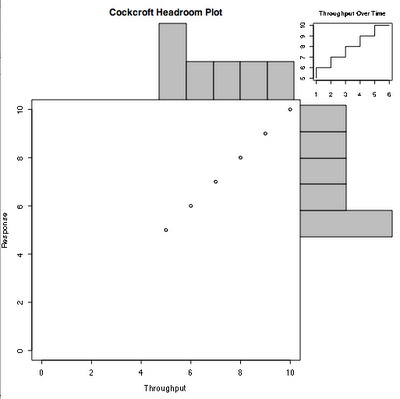
The updated code follows.
The tricky part is that the main plot is automatically oversized from its data range by a few percent, and the units used in the histogram are completely different. A histogram with 6 bars is scaled to have the bars at unit intervals and is 6 wide plus the width of the bars etc. After lots of trial and error, I made the main plot use the maximum bucket size of the histogram as its max value, and artificially offset the histograms by what looks like about the right amount. The plot below uses fixed data as a test. You can see that the first bar includes two points, thats due to the particular algorithm used by R. Some alternative histogram algorithms are available, but this one seems to be most appropriate to throughput/response time data.
> chp(5:10,5:10)

The updated code follows.
chp <- function(x,y,xl="Throughput",yl="Response",tl="Throughput Over Time",
ml="Cockcroft Headroom Plot") {
       xhist <- hist(x,plot=FALSE)
       yhist <- hist(y, plot=FALSE)
       xbf <- xhist$breaks[1]                          # first
       ybf <- yhist$breaks[1]                          # first
       xbl <- xhist$breaks[length(xhist$breaks)]       # last
       ybl <- yhist$breaks[length(yhist$breaks)]       # last
       xcl <- length(xhist$counts)                     # count length
       ycl <- length(yhist$counts)                     # count length
       xrange <- c(0,xbl)
       yrange <- c(0,ybl)
       nf <- layout(matrix(c(2,4,1,3),2,2,byrow=TRUE), c(3,1), c(1,3), TRUE)
       layout.show(nf)
       par(mar=c(5,4,0,0))
       plot(x, y, xlim=xrange, ylim=yrange, xlab=xl, ylab=yl)
       par(mar=c(0,4,3,0))
       barplot(xhist$counts, axes=FALSE,
               xlim=c(xcl*0.03-xbf/((xbl-xbf)/(xcl-0.5)),xcl*0.97),
               ylim=c(0, max(xhist$counts)), space=0, main=ml)
       par(mar=c(5,0,0,1))
       barplot(yhist$counts, axes=FALSE, xlim=c(0,max(yhist$counts)),
               ylim=c(ycl*0.03-ybf/((ybl-ybf)/(ycl-0.5)),ycl*0.97),
               space=0, horiz=TRUE)
       par(mar=c(2.5,1.7,3,1))
       plot(x, main=tl, cex.axis=0.8, cex.main=0.8, type="S")
}
Monday, November 20, 2006
Cockcroft Headroom Plot - Part 2 - R Version
I kept tweaking the code, and came up with a prettier version, that also has a small time series view of the throughput in the top right corner.
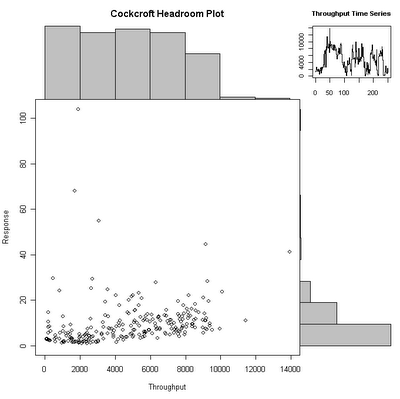
The code for this is
I also made a wrapper function that steps through the data over time in chunks.
To run this smoothly on windows, I had to disable double buffering using
and close the graphics window so that a new one opens with the new option.
The data is displayed using the same calls as described in Part 1. The next step is to try some different data sets and work on detecting saturation automatically.

The code for this is
chp <- function(x,y,xl="Throughput",yl="Response",tl="Throughput Time Series", ml="Cockcroft Headroom Plot") {
       xhist <- hist(x,plot=FALSE)
       yhist <- hist(y, plot=FALSE)
       xrange <- c(0,max(x))
       yrange <- c(0,max(y))
       nf <- layout(matrix(c(2,4,1,3),2,2,byrow=TRUE), c(3,1), c(1,3), TRUE)
       layout.show(nf)
       par(mar=c(5,4,0,0))
       plot(x, y, xlim=xrange, ylim=yrange, xlab=xl, ylab=yl)
       par(mar=c(0,4,3,0))
       barplot(xhist$counts, axes=FALSE, ylim=c(0, max(xhist$counts)), space=0, main=ml)
       par(mar=c(5,0,0,1))
       barplot(yhist$counts, axes=FALSE, xlim=c(0,max(yhist$counts)), space=0, horiz=TRUE)
       par(mar=c(2.5,1.5,3,1))
       plot(x, main=tl, cex.axis=0.8, cex.main=0.8, type="S")
}
I also made a wrapper function that steps through the data over time in chunks.
> chp.step <- function(x, y, steps=10, secs=1.0) {
    xl <- length(x)
    step <- xl/steps
    for(n in 0:(steps-1)) {
        Sys.sleep(secs)
        chp(x[(1+n*step):min((n+1)*step,xl)],y[(1+n*step):min((n+1)*step,xl)])
    }
}
To run this smoothly on windows, I had to disable double buffering using
> options("windowsBuffered"=FALSE)
and close the graphics window so that a new one opens with the new option.
The data is displayed using the same calls as described in Part 1. The next step is to try some different data sets and work on detecting saturation automatically.
Sunday, November 19, 2006
The Cockcroft Headroom Plot - Part 1 - Introducing R
I've recently written a paper for CMG06 called "Utilization is Virtually Useless as a Metric!". Regular readers of this blog will recognize much of the content in that paper. The follow-on question is what to use instead? The answer I have is to plot response time vs. throughput, and I've been thinking about a very specific way to display this kind of plot. Since I'm feeling quite opinionated about this I'm going to call it a "Cockcroft Headroom Plot" and I'm going to try and construct it using various tools. I will blog my way through the development of this, and I welcome advice and comments along the way.
The starting point is a dataset to work with, and I found an old iostat log file that recorded a fairly busy disk at 15 minute intervals over a few days. This gives me 250 data points, which I fed into the R stats package to look at. I'll also have a go at making a spreadsheet version.
The iostat data file starts like this:
I want the second line as a header, so save it (my command line is actually on OSX, but could be Solaris, Linux or Cygwin on Windows)
% head -2 iostat.txt | tail -1 > header
I want the c1t5d0 disk, but don't want the first line, since its the average since boot, and want to add back the header
% grep c1t5d0 iostat.txt | tail +2 > tailer
% cat header tailer > c1t5.txt
Now I can import into R as a space delimited file with a header line. R doesn't allow "/" or "%" in names, so it rewrites the header to use dots instead. R is a script based tool with a command line and a very powerful vector/object based syntax. A "data frame" is a table of data object like a sheet in a spreadsheet, it has names for the rows and columns, and can be indexed.
> c1t5 <- read.delim("c1t5.txt",header=T,sep="")
> names(c1t5)
[1] "r.s" "w.s" "kr.s" "kw.s" "wait" "actv" "wsvc_t" "asvc_t" "X.w" "X.b" "device"
I only want to work with the first 250 data points so I subset the data frame by indexing the rows with an array (1:250) that selects the rows I want and leaving the column selector blank.
> io250 <- c1t5[1:250,]
The first thing to do is summarize the data, the output is too wide for the blog so I'll do it in chunks by selecting columns.
Looks like a nice busy disk, so lets plot everything against everything (pch=20 sets a solid dot plotting character)
> plot(io250[,1:10],pch=20)
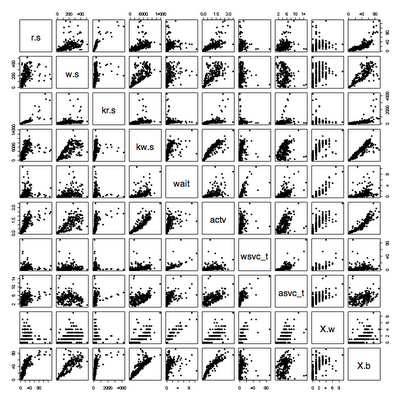 The throughput is either reads+writes or KB read+KB written, the response time is wsvc_t+asvc_t since iostat records time taken waiting to send to a disk as well as time spent actively waiting for a disk.
To save typing, I attach to the data frame so that the names are recognized directly.
> attach(io250)
> plot(r.s+w.s, wsvc_t+asvc_t)
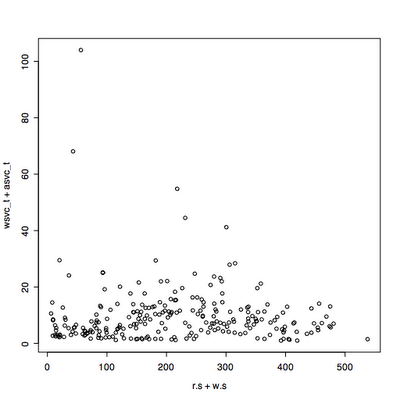 This looks a bit scattered, because there is a mixture of average I/O sizes that varies during the time period. Lets look at throughput in KB/s instead.
> plot(kr.s+kw.s,wsvc_t+asvc_t)
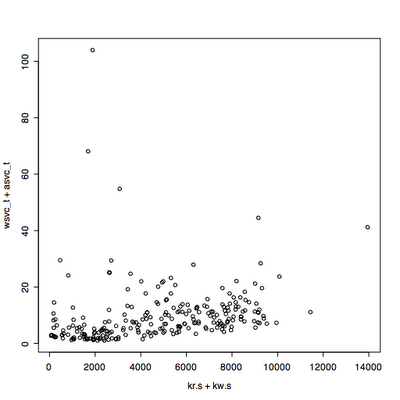 That looks promising, but its not clear what the distribution of throughput is over the range. We can look at this using a histogram.
> hist(kr.s+kw.s)
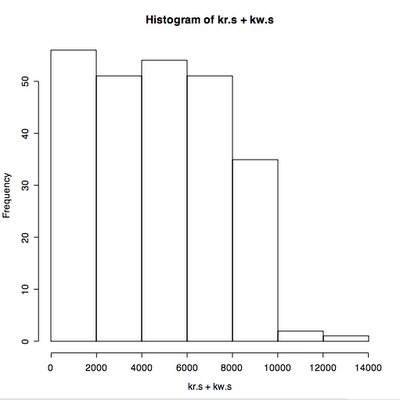
We can also look at the distribution of response times.
> hist(wsvc_t+asvc_t)
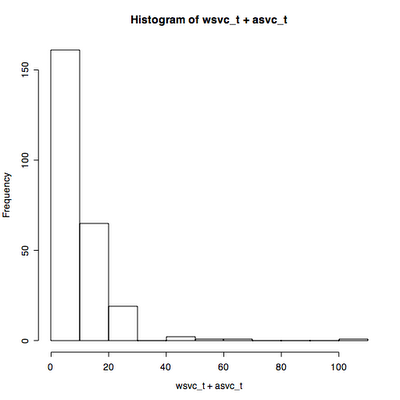 The starting point for the thing that I want to call a "Cockcroft Headroom Plot" is all three of these plots superimposed on each other. This means rotating the response time plot 90 degrees so that its axis lines up with the main plot. After looking around in the manual pages I eventually found an example that I could use as the basis for my plot. It needs some more cosmetic work but I defined a new function chp(throughput, response) shown below.
The result of running chp(kr.s+kw.s,wsvc_t+asvc_t)is close...
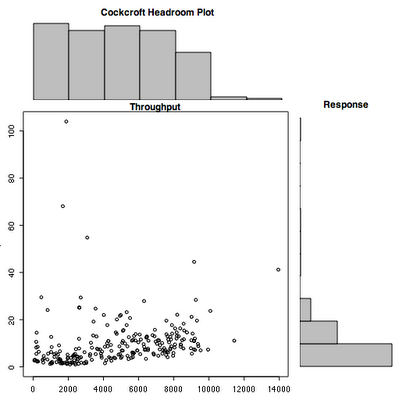
That's enough to get started.
The starting point is a dataset to work with, and I found an old iostat log file that recorded a fairly busy disk at 15 minute intervals over a few days. This gives me 250 data points, which I fed into the R stats package to look at. I'll also have a go at making a spreadsheet version.
The iostat data file starts like this:
                    extended device statistics
 r/s  w/s   kr/s   kw/s wait actv wsvc_t asvc_t  %w  %b device
14.8 78.4  183.0 2446.3  1.7  0.6   18.6    6.6   1  21 c1t5d0
 0.0  0.0    0.0    0.0  0.0  0.0    0.0    5.0   0   0 c0t6d0
...
I want the second line as a header, so save it (my command line is actually on OSX, but could be Solaris, Linux or Cygwin on Windows)
% head -2 iostat.txt | tail -1 > header
I want the c1t5d0 disk, but don't want the first line, since its the average since boot, and want to add back the header
% grep c1t5d0 iostat.txt | tail +2 > tailer
% cat header tailer > c1t5.txt
Now I can import into R as a space delimited file with a header line. R doesn't allow "/" or "%" in names, so it rewrites the header to use dots instead. R is a script based tool with a command line and a very powerful vector/object based syntax. A "data frame" is a table of data object like a sheet in a spreadsheet, it has names for the rows and columns, and can be indexed.
> c1t5 <- read.delim("
> names(c1t5)
[1] "r.s" "w.s" "kr.s" "kw.s" "wait" "actv" "wsvc_t" "asvc_t" "X.w" "X.b" "device"
I only want to work with the first 250 data points so I subset the data frame by indexing the rows with an array (1:250) that selects the rows I want and leaving the column selector blank.
> io250 <- c1t5[1:250,]
The first thing to do is summarize the data, the output is too wide for the blog so I'll do it in chunks by selecting columns.
> summary(io250[,1:4])
      r.s              w.s             kr.s             kw.s
 Min.   :  1.80   Min.   :  1.8   Min.   :  13.5   Min.   :   38.5
 1st Qu.: 10.30   1st Qu.: 87.1   1st Qu.: 107.4   1st Qu.: 2191.7
 Median : 18.90   Median :172.4   Median : 182.8   Median : 4279.4
 Mean   : 22.85   Mean   :187.5   Mean   : 290.1   Mean   : 4448.5
 3rd Qu.: 28.88   3rd Qu.:274.6   3rd Qu.: 287.4   3rd Qu.: 6746.6
 Max.   :130.90   Max.   :508.8   Max.   :4232.3   Max.   :13713.1
> summary(io250[,5:8])
      wait             actv            wsvc_t           asvc_t
 Min.   : 0.000   Min.   :0.0000   Min.   : 0.000   Min.   : 1.000
 1st Qu.: 0.000   1st Qu.:0.3250   1st Qu.: 0.400   1st Qu.: 3.125
 Median : 0.600   Median :0.8000   Median : 2.550   Median : 4.700
 Mean   : 1.048   Mean   :0.9604   Mean   : 5.152   Mean   : 4.634
 3rd Qu.: 1.300   3rd Qu.:1.5000   3rd Qu.: 6.350   3rd Qu.: 5.700
 Max.   :10.600   Max.   :3.5000   Max.   :88.900   Max.   :15.100
> summary(io250[,9:10])
      X.w             X.b
 Min.   :0.000   Min.   : 2.00
 1st Qu.:0.000   1st Qu.:20.00
 Median :1.000   Median :39.50
 Mean   :1.428   Mean   :37.89
 3rd Qu.:2.000   3rd Qu.:55.00
 Max.   :9.000   Max.   :92.00
Looks like a nice busy disk, so lets plot everything against everything (pch=20 sets a solid dot plotting character)
> plot(io250[,1:10],pch=20)
 The throughput is either reads+writes or KB read+KB written, the response time is wsvc_t+asvc_t since iostat records time taken waiting to send to a disk as well as time spent actively waiting for a disk.
To save typing, I attach to the data frame so that the names are recognized directly.
> attach(io250)
> plot(r.s+w.s, wsvc_t+asvc_t)
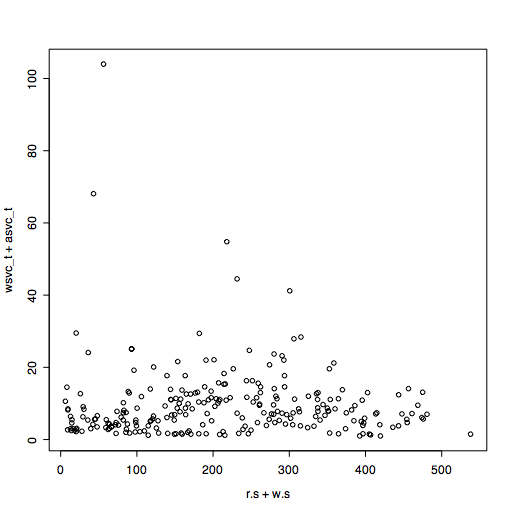 This looks a bit scattered, because there is a mixture of average I/O sizes that varies during the time period. Lets look at throughput in KB/s instead.
> plot(kr.s+kw.s,wsvc_t+asvc_t)
 That looks promising, but its not clear what the distribution of throughput is over the range. We can look at this using a histogram.
> hist(kr.s+kw.s)
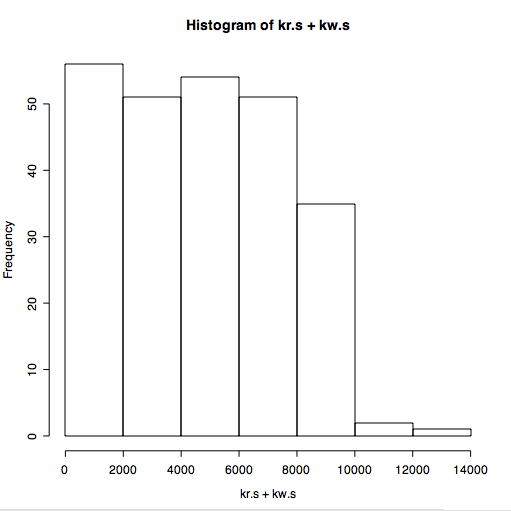
We can also look at the distribution of response times.
> hist(wsvc_t+asvc_t)
 The starting point for the thing that I want to call a "Cockcroft Headroom Plot" is all three of these plots superimposed on each other. This means rotating the response time plot 90 degrees so that its axis lines up with the main plot. After looking around in the manual pages I eventually found an example that I could use as the basis for my plot. It needs some more cosmetic work but I defined a new function chp(throughput, response) shown below.
> chp <- function(x,y,xl="Throughput",yl="Response",ml="Cockcroft Headroom Plot") {
   xhist <- hist(x,plot=FALSE)
   yhist <- hist(y, plot=FALSE)
   xrange <- c(0,max(x))
   yrange <- c(0,max(y))
   nf <- layout(matrix(c(2,0,1,3),2,2,byrow=TRUE), c(3,1), c(1,3), TRUE)
   layout.show(nf)
   par(mar=c(3,3,1.5,1.5))
   plot(x, y, xlim=xrange, ylim=yrange, main=xl)   par(mar=c(0,3,3,1))
   barplot(xhist$counts, axes=FALSE, ylim=c(0, max(xhist$counts)), space=0, main=ml)
   par(mar=c(3,0,1,1))
   barplot(yhist$counts, axes=FALSE, xlim=c(0, max(yhist$counts)), space=0, main=yl, horiz=TRUE)
}
The result of running chp(kr.s+kw.s,wsvc_t+asvc_t)is close...

That's enough to get started.
ps3 Marketplace Research on eBay

Over at Data Mining there is some interesting info on ps3's.
However, there is no need to do manual scraping of
eBay, here is a screenshot from the marketplace research function
that is bundled with my eBay store subscription. For $2.99 for 2 days
access anyone can get at this.
http://pages.ebay.com/marketpl
Skype on Solaris
http://blogs.sun.com/darren/entry/skype_1.3.0.53_on_solaris_via
Solaris has a Linux compatible subsystem called BrandZ for running Linux binaries that don't have Solaris builds (like Skype). Darren figured out how to get the Linux build of Skype to run on Opensolaris.
Thanks to Alec for pointing this out.
Saturday, November 11, 2006
10 Things to Know About Skype Ap2Ap Programming
I also posted this on the Skype Developer Wiki
The ap2ap capability is an interesting new network computing paradigm but it is not like a conventional network.
The ap2ap capability is an interesting new network computing paradigm but it is not like a conventional network.
- end nodes are addressed by skype name, which addresses a person, not a computer
- people can login to skype multiple times, so addressable endpoints are not unique
- skype can go online/offline at will, so there is a concept of "presence" that needs to be managed
- you can only make ap2ap connections to your buddy list or people who you have chatted to "recently"
- both ends of an ap2ap connection have to choose a unique string used to identify their conversation or protocol
- if you quit and restart skype, the first login can persist for a while, so you can get multiple ap2ap connections from a single user, although the ghosts of your previous connections cannot respond to a message. I think is is because you connect to a different supernode each time, and the first one isn't sure if you have really gone away yet
- messages have to be sent as text, so binary objects have to be converted first using something like base64
- the network can behave differently each time you use it, and this non-determinism makes testing difficult
- relayed connections are limited to about 3KB/s, direct ones can run at several MB/s over a LAN
- Skype4Java is cross-platform, but the maximum message size is about 64KB on windows and 16KB on OSX/Linux, and there are several bugs and limitations in the older version of the API library that is used by Skype 2.0 and earlier releases. Use Skype 2.5 or later for the best performance and stability
Monday, October 30, 2006
Bloglines, OPML, Blogger and Flock
I aggregate 50 or so blog feeds using Bloglines, its a very useful way to keep track of infrequent blogs in particular, and it strips off the adverts and other decoration from the power bloggers.
I just did some tidying up of my blog list, exported it in OPML format and uploaded it to http://share.opml.org/
This is an interesting way to contribute to the "Top 100" blogs list on that site, and it also has some useful features like seeing who else reads the same blogs, and who has the most similar list of blogs.
I seem to have added to the "long tail" since many of the blogs I read were new to the site, so I'm the only reader. My blog had one other reader "Ian" (hello!) who has a very long list of blogs, that I may poke around in if I get some free time...
Meanwhile, Flock is working well as my cross-platform browser. I'm writing blog entries with it, although I did lose an entry I was writing a week or so ago, when I upgraded Flock and didn't save an almost complete entry first. The new version of Flock appears to automatically save entries every few minutes, but I hate re-writing things, so that entry may not be re-created for a while.
Flock seems to have some issues writing entries to blogger.com at the moment. I'm not using the updated blogger.com, but Flock fails to write the blog entry most of the time, then randomly works. I gave up and used cut and paste to post this entry directly....
I just did some tidying up of my blog list, exported it in OPML format and uploaded it to http://share.opml.org/
This is an interesting way to contribute to the "Top 100" blogs list on that site, and it also has some useful features like seeing who else reads the same blogs, and who has the most similar list of blogs.
I seem to have added to the "long tail" since many of the blogs I read were new to the site, so I'm the only reader. My blog had one other reader "Ian" (hello!) who has a very long list of blogs, that I may poke around in if I get some free time...
Meanwhile, Flock is working well as my cross-platform browser. I'm writing blog entries with it, although I did lose an entry I was writing a week or so ago, when I upgraded Flock and didn't save an almost complete entry first. The new version of Flock appears to automatically save entries every few minutes, but I hate re-writing things, so that entry may not be re-created for a while.
Flock seems to have some issues writing entries to blogger.com at the moment. I'm not using the updated blogger.com, but Flock fails to write the blog entry most of the time, then randomly works. I gave up and used cut and paste to post this entry directly....
Pandora Prog Channel
I've been trying Pandora on and off for Internet music for a while, and attended a talk by CEO Tim Westergren last week, which got me to try it again. They are continuously improving their algorithms for choosing music, and I was trying to make a channel that would serve me interesting new music alongside some of my favourite experimental "Prog Rock" bands. It seems to be working much better, and I keep tuning the channel by skipping tracks that I don't like and giving thumbs up to the ones I do. The nice thing is you can listen to my channel, even though you don't get exactly the same songs as I do, there should be an interesting mix of King Crimson, Zappa, Estradasphere, and many other bands playing music you won't hear often. Its easy to make your own channel (it takes less training to make a more mainstream channel) and its the best way I've found to discover completely new music.
http://www.pandora.com/?sc
Enjoy...
Blogged with Flock
Sunday, October 08, 2006
CMG06 Conference - Reno December 3-8
As usual I'll be attending the Computer Measurement Group conference in Reno Nevada this December. I've attended every year since 1994, and its the place where I get an update on the state of the art in Performance Management, and get to mingle with my friends and peers who work on Capacity Planning.
This year I'm presenting three times:
- Sunday morning 3 hour seminar on Capacity Planning with Free and Bundled Tools. This is a repeat of last years talk, presented jointly with Mario Jauvin, who covers the Windows OS and Networking related areas. I cover Solaris, Linux and the system oriented tools.
- Wednesday morning conference paper titled "Utlization is Virtually useless as a Metric!". Regular readers of this blog will recognize much of the content of this paper, which gathers together all the ways in which your measurements can be corrupted by virtualization.
- Thursday morning I'm giving a 3 hour training course called the Unix/Linux CMG Quick Start Course, which is part of a new feature for CMG and is based on the training classes in performance tuning that I have given for many years.
technorati tags:cmg, solaris, performance, capacity, training, seminar, linux
Blogged with Flock
Monday, September 04, 2006
Updated Ad Setup
I just changed to the flash based ad sidebar. It lets you pick different keywords without reloading the page by clicking on the top tab.
I also continued to focus on Technology Books, picking some specific categories to try and exclude the certification and training books that I find less interesting. I then excluded Microsoft and mcse as keywords, and ended up with Cisco certification so I excluded them as well, and it looks like a more reasonable selection now.
Blogged with Flock
Sunday, September 03, 2006
Comments on Web Traffic
This blog gets about 50 visitors a day, and most new visitors arrive as the result of a google search for my name, Thumper/ZFS or the SE toolkit. There is a very small number of yahoo and msn searches. The other main source of traffic is the Sun Community blogging site, which links to Sun Alumni's blogs including this one. A few weeks ago I got a lot of traffic from Sun, and I think I traced it back to a blog entry from Jonathan Schwartz, who talked about his General Counsel's blog, and Mike Dillon the GC mentioned the Sun Community blog site. This doubled my traffic for a week or two.
The other recent change is that I stopped showing adverts from ctxbay, which was created by an eBay developer as a side project, won a prize, but never really worked well enough to be useful. I've replaced them with the official eBay in-house AdContext system, which is being beta tested. AdContext looks at your page content, and matches keywords it with popular items from eBay. It can be configured to exclude certain keywords (in my case I exclude "Adrian", which was causing problems for ctxbay), and you can choose certain categories or stores to pick items from. I've picked Technology Books and some Storage hardware categories. I'm going to experiment with different formats and constraints, to see how well it works.
There are three formats, text only, pictures (which I started with) and flash (which scrolls multiple adds into the same amount of screen space). I'll switch it to flash when I get around to it...
technorati tags:sun, thumper, traffic
Blogged with Flock
Subscribe to:
Posts (Atom)