Sunday, November 24, 2013

Free Communication is Disrupting Hierarchies

Jeff Jarvis recently blogged:
I doubt the net’s creators realized how subversive it was to connect anyone to anyone, bypassing the institutions that mediated those connections: from media to government, universities to retailers. These institutions are now circling wagons to protect their prerogatives: copyright for media, secrecy for government.

Somewhat related discussions are taking place at the Defrag conference and on blogs talking about corporate organizations and government surveillance.

However this is nothing new, over centuries there has been a gradual reduction in the cost of communication between people, which has caused social changes, disrupted old industries, created new industries and led to political revolutions. The end point that we have reached in the last few years is that the cost of communication is now zero. There is no incremental cost for me to send a tweet that is delivered to thousands of people a few seconds later. If the tweet contains novel ideas or information that people want to share, then in a few seconds, millions of people could see it. With about 10,000 direct followers my own twitter mention reach was in the millions last week.


When I see an industry or organization that was built on assumptions that are no longer true, I expect to see disruption follow, and opportunities to create new industries and organizations. The assumption that communication is expensive is baked into our world. The new industries and organizations that take advantage of this change are emerging now.

To see how subversive this is, we need to look at some history. Every step in the reduction of communication cost has enabled changes that have been resisted by the hierarchy, led to revolutions, and in most cases have been co-opted and controlled by the elite.

The ability to control, coordinate and influence a large group of people depends upon effective communication. Early examples include the creation of sea-going ships and roads to sustain empires, from the Romans to the British Empire as examples. The leaders of these empires could gather information via messengers and send out decrees to manage at a distance, by using a coordinated hierarchical communication network. The cost of communication for the workers was prohibitive, so all information trickled down through the local authorities, whether civil, military or religious. The only low cost communication took place within the local village.

Most workers were illiterate, and taking England in the middle ages as an example, a series of disruptions were caused by the invention of the printing press. The loss of control that resulted caused major problems for authorities, and allowed ideas to spread in new ways.

As cities got bigger, local communication got faster, newsletters and newspapers started to spread ideas more quickly and the creation of postal services brought the cost of peer to peer communication down far enough that everyone could communicate over larger distances. Governments co-opted these new mechanisms, regulating the news, running the postal services. The industrial revolution created commercial entities with their own hierarchies of control and communication. The ability of ideas to spread rapidly and reach many people allowed groups to self-organize, leading to political upheaval. Revolution was enabled by the ability to spread ideas outside the incumbent ruler's hierarchy of communication and control.

Today we live in societies where effectively everyone is literate, connected and mobile. However we still have the same hierarchical institutions that were developed hundreds of years ago. Governments to manage the hierarchies of society, Companies to manage the hierarchies of commerce, Religions to manage the hierarchies of belief, Universities to manage the hierarchies of education.

These hierarchies still have value, they continue to represent ownership and have responsibilities but they no longer have control. They were sustained in the past by imposing their will on people, and carefully managed what information people are exposed to. The hierarchies are now very large and deeply nested, so rather than a small ruling elite and a large peasant population, there are very many levels in the middle, which makes many of us have a vested interest in the continuation of parts of the hierarchies.

We are now all connected by a series of relatively flat peer to peer networks. Facebook for a curated network of family, friends and interest groups, twitter for real-time news and a much more dense ad-hoc interconnection of interests, email for direct communication, and many other services. The "Arab Spring", the "Occupy Movement" and other recent political revolutions were able to find and coordinate large numbers of people extremely rapidly (hours or days) without forming a hierarchy first.

The new world is a blend of hierarchies with many peer to peer links that reach across and between the old hierarchies. The problem for the elite leaders is that they are used to having control, owning the flow of information and managing deeply nested organizations. In this new world, the leaders have ownership, responsibility, influence but much less control, they control and manage a small part of the flow of information, and their organizations are flatter and less well defined. At the extreme there are organizations like Github, which are figuring out how to make an emergent self organizing structure work. To scale a flat organization there needs to be a very strong sense of culture and unity of purpose. I think Netflix has found a productive balance between a hierarchy of responsibility for aspects of the business and freedom at each level to self organize the delivery of what the business needs. Broad and open communication across the business, and many skip-level one-on-one meetings flattens the organization and minimizes "politics".

Looking beyond business, Religion only really works if you don't think too hard about any other variant of religion. Religions all claim to be true, but claim different incompatible and incoherent things, so that exposure to ideas such as the Outsider Test for Faith causes deep problems for the faithful. Religion in general is being disrupted by science and free communication, and polarization into atheism and reactionary fundamentalism is one of the outcomes in society.

Education is based on the communication of skills and information from teachers to students, and the big institutions of education are being disrupted. They no longer control the flow of education, and the costs are increasing beyond the ability of the students to repay them, so companies like Coursera and the Khan Academy are building alternatives. For software developers, the body of code you own and contributed to on github matters far more than where (or even if) you studied. The state of the art isn't being created and taught in University research departments any more, the commercial ecosystems that form around technologies are where the bleeding edge of innovation is being disseminated to new recruits.

These disruptions are on the way, but change tends to occur rapidly when a tipping point is reached rather than gradually. A point made by Nicholas Taleb in his discussion of Black Swan events, is that its easier to point out that a change could happen and plan for what to do next, than to predict when exactly it will come. So like a cartoon Wily Coyote who has run off a cliff, we ignore the change until we look down and realize that nothing is holding us up.


Thursday, September 05, 2013

Performance Testing of NetflixOSS for the Cloud Prize


Where is everyone? I've been writing blogging and tweeting about performance and capacity planning for many years, so I thought I was connected to one or two performance folks....

When we setup the NetflixOSS cloud prize I created a category just for you:

Best Contribution to Performance Improvements
New performance testing tools, results of performance tests and performance oriented bugs. Since this may be aggregated across many pull requests, they should be listed and documented in the Submission.

While there are some interesting contestants in other categories, I've seen very little activity in this one.

There's $10K cash and $5K of AWS credits waiting for someone to do enough work to claim them!

It takes a bit of resource to run tests, so I also have a $100 AWS gift card that I will pass on to the first person to make an entry in this category, regardless of whether they win the prize or have generated any useful data at that point. Make a valid submission to the Cloud Prize by forking the github repo, editing the Submission.md file to describe your entry, entering your details (email/address etc) in the Mailchimp form, and then post a comment here claiming the $100 AWS card, and I'll mail it to you.

After the first one, if you make a case for having generated lots of good data, I'll get some more $100 AWS cards.

Here's some performance project ideas.

  • Run throughput and latency stress tests on the Zuul API gateway on various instance types
  • Run stress tests for sizing data against other service level projects - Eureka, Edda, Ice, etc.
  • Make the cass_jmeter project better in some way
  • Analyze the code paths in Astyanax and find ways to make it run faster and use less memory
Go for it, only a few days left. Contest ends at midnight Pacific time Sunday Sept 15th.

Best wishes
Adrian

Sunday, April 07, 2013

Tutorials and Training on Cloud Architecture and NetflixOSS

There are two places that I'm giving in-depth training on cloud architecture and NetflixOSS this year.

On May 22nd-23rd at Gluecon 2013 in Broomfield Colorado I'm giving one of the opening keynote talks that introduces the concepts of a Cloud Native Architecture, then spending all afternoon on a tutorial to go into the details of how to get there and how to use NetflixOSS tools as an on-ramp to accelerate the process.

For people in Europe, I'm teaching at a summer school on "Software for the Cloud and Big Data" September 8th-14th in Italy. It's organized by ETH Zurich. I'll be giving six one-hour talks over a week, and there are seven other speakers.

LASER 2013 banner

When I get back from LASER, it will be time to start evaluating nominations for the NetflixOSS Cloud Prize, and these are both opportunities to figure out how to build a strong entry.

Tuesday, March 26, 2013

Comment on How Netflix Is Ruining Cloud Computing


I wrote a long comment response to how-netflix-is-ruining-cloud-computing on Information Week, but they don't seem in a hurry to post it. Luckily I saved a copy so here it is:


There should be a http://techblog.netflix.com post in the next day or so that will give more context to the Cloud Prize and clarify most of the points above. However I will address some of the specific issues here.

Cloud 1.0 vs. 2.0?
I would argue that the way most people are doing cloud today is to forklift part of their existing architecture into a cloud and run a hybrid setup. That's what I would call Cloud 1.0. What Netflix has done is show how to build much more agile green field native cloud applications, which might justify being called Cloud 2.0. The specific IaaS provider used underneath, and whether you do this with public or private clouds is irrelevant to the architectural constructs we've explained.

Outages
The outages that have been mentioned were regional, they didn't apply to Netflix operations in Europe for example. Our current work is to build tooling for multi-regional support on AWS (East cosat/West coast), including the DNS management that was mentioned. This removes the failure mode with the least effort and disruption to our existing operations.

Portability
Other cloud vendors have a feature set and scale comparable to AWS in 2008-2009. We're still waiting for them to catch up. There are many promises but nothing usable for Netflix itself. However there is demand to use NetflixOSS for other smaller and simpler applications, in both public and private clouds, and Eucalyptus have demonstrated Asgard, Edda and Chaos Monkey running, and will ship soon in Eucalyptus 3.3. There are signs of interest from people to add the missing features to OpenStack, CloudStack and Google Compute so that NetflixOSS can also run on them.

Edda
You've completely missed the point of Edda. It does three important things. 1) if you run at large scale your automation will overload the cloud API endpoint, Edda buffers this information and provides a query capability for efficient lookups. 2) Edda stores a history of your config, it's a CMDB that can be used to query for what changed. 3) Edda cross integrates multiple data sources, the cloud API, our own service registry Eureka, Appdynamics call flow information and can be extended to include other data sources.

AMInator
If you want to spin up 500 identical instances, having them each run Chef or Puppet after they boot creates a failure mode dependency on the Chef/Puppet service, wastes startup time, and if anything can go wrong with the install you end up with an inconsistent set of instances. By using AMInator to run Chef once at build time, there is less to go wrong at run time. It also makes red/black pushes and roll-backs trivial and reliable.

Cloud Prize
The prize includes a portability category. It's a broad category and might be won by someone who adds new language support to NetflixOSS (Erlang, Go, Ruby?) or someone who makes parts of NetflixOSS run on a broader range of IaaS options. The reality is that AWS is actually dominating cloud deployments today, so contributions that run on AWS will have the greatest utility by the largest number of people. The alternatives to AWS are being hyped by everyone else, and are showing some promise, but have some way to go.

We hope that NetflixOSS provides a useful driver for higher baseline functionality that more IaaS APIs can converge on, and move from 2008-era EC2 functionality to 2010-era EC2 functionality across more vendors. Meanwhile Netflix itself will be enjoying the benefits of 2013 AWS functionality like RedShift.

Wednesday, January 16, 2013

The IT swamp draining manual for anyone who is neck deep in alligators

I've spent the last year or so reviewing Gene Kim's new book - the Phoenix Project and encouraging him to get it finished. It came out this week, is the top business book on Amazon as I write this, and I got a nice back-cover quote shown below with Gene's actual finger in the photo.


Many years ago someone gave me a copy of The Goal, which is the inspiration for The Phoenix Project. In both cases the book is a novel about a company that is dysfunctional and on the verge of going out of business. The lead character is dropped into the job of figuring out how to dig their way out of the problem, and in the case of The Phoenix Project, the company fumbles its way from legacy enterprise where IT isn't regarded as central to their success, into the modern world of agile development practices and DevOps deployments where IT becomes a competitive advantage.

Don't just read it, give copies of it to your friends in management. It should be on every CxO's bookshelf.

Tuesday, January 01, 2013

Looking back at 2012, with pointers to 2013

A collection of things that seem to have pivoted in 2012.

Mobile Bandwidth Greater than Fixed Bandwidth

I've been talking about LTE and the growth in mobile since 2008, but I started 2012 with a Verizon iPhone 4 which maxed out at 2Mbit/s over 3G and at home in the mountains I would get less than 1Mbit/s. I ended 2012 with a Verizon iPhone 5 which is about ten times faster at home, I regularly see 8-9Mbits/s, and the best speed I have seen anywhere so far was in downtown Los Gatos at over 50Mbit/s. My home fixed wire Internet is a 3Mbit/s DSL that has neighborhood congestion at peak times. I now find it works better to have WiFi turned off on my iPhone at home.

This is one of those pivotal changes, similar to the change from having predominantly fixed wire telephone service at home, to having many people use mobile phones exclusively. It costs more, but if you already have a high bandwidth connection to your phone with a high data cap because you use it a lot, why pay to also have a low bandwidth connection to your house? Bandwidth caps and data usage plans will slow the switchover, but the writing is on the wall.

Cutting The Cable/Satellite TV Feed

In 2013 we finally turned off our TiVo and shut down our DirecTV account. We weren't using it enough to make it worth while. For some of the sports events (Laurel follows the Stanford Cardinals), we go to a sports bar to watch, which is more fun anyway. Everything else that we have time to watch, we can watch online, and we get all our news updates from Twitter, RSS feeds and Facebook posts. By the time it's on TV or in a newspaper, it's already old news.

The TV has an AppleTV connected to it, which gets almost all the usage. We watch a few things on laptops, and sometimes I connect a laptop to the TV. I also stream music from my iPhone to the AppleTV because I can't get Pandora or Spotify on it. Come on Apple, where's the AppleTV App Store? Maybe that's a 2013 thing.

The Netflix Open Source Cloud Platform Got Traction

We started the year with a handful of disconnected projects, and ended it with a large chunk of the platform on Github, and some high profile users. Most people are still picking it up piecemeal but in 2013 we plan to get the whole thing put together as an installable bundle. This is the Alan Kay approach, "The best way to predict the future is to invent it".  Netflix has been out in front of the industry in terms of cloud adoption, inventing the future. Next we make it easier for others to join us in that future, and have some ideas for how to drive adoption to new heights.

Netflix Cloud Architecture Presentations

I was going to list all the talks I gave, but there are too many, so go see the slides I posted at http://www.slideshare.net/adrianco. Highlights were QConSF, QConLondon, Gluecon in Colorado, GOTO in Aarhus and of course AWS Re:Invent in Las Vegas. The impact of these talks grew through the year, reaching a peak at Re:Invent, where we had lots of speakers and attention to the way the Netflix cloud and open source story was bringing value to the company and reaching out into the technical community. A big thanks to everyone who came to my talks, and all the other Netflix speakers who have been out there broadening the story. It's almost impossible to write an article or do a presentation about cloud without mentioning Netflix. In 2013 there will be even more talks, I focus on local and US based events that are strongly developer oriented like QConGluecon, and GOTO. We will definitely be back at AWS Re:Invent next November.

The Concept of Anti-Fragility Took Off

Nassim Taleb's latest book crystallizes the way I tend to approach things and gives it a name. The Netflix cloud architecture is anti-fragile, we run "Chaos Monkey's" continuously to try and break it, and that makes it stronger. The Netflix culture is anti-fragile, it's decentralized with as little process and rules as possible and a lot of local autonomy. Netflix management is not afraid of change or of being first to do something and tends to navigate disruptive transitions well. From the outside this can look chaotic or confusing, but it works, and recovers well from missteps, which are always going to happen. If you're not failing occasionally you aren't trying hard enough, and you are missing opportunities. Getting stronger through failure is the basis of anti-fragility. Avoiding failure at all costs (as many people try to do) makes you brittle and vulnerable to unexpected Black Swan events that will have a much bigger impact.

Cloud, Open Source, SaaS and the End of Enterprise Computing

Taleb makes the point that big companies become increasingly fragile as they lose agility and the ability to move with the markets, and we are seeing that play out in the Enterprise Computing space. There is still money to be made from the late adopter customers, but the trend is clearly towards development using exclusively open source tools, with applications and infrastructure delivered as a service. There is zero revenue for traditional Enterprise Computing vendors in this model. The current interest in building out private cloud infrastructure is real and will continue to support traditional vendors into 2013, but it's a short term investment. At best you end up with a much better automated datacenter, but it isn't elastic and it has far fewer features than AWS, so it's going to be marginalized over time. At worst, you discover just how hard it is to run a reliable private cloud based on immature software, with incompatible upgrade paths, and it turns out to be much more expensive to run.

The Enterprise Computing vendors haven't been able to build a public cloud  that competes with AWS on scale, price or features, and AWS is now focused on building everything their customers need to take the next generation of application investment out of the datacenter, so the high margin revenue is going to gradually go away for the traditional vendors.

The most interesting development in 2012 was the re-launch of Google as a public cloud infrastructure vendor, and the mini-price-war between AWS and Google over instance and storage costs makes it clear where the real action is. During 2013 we will see if Google manages to invest heavily and execute well enough to build up a big user base.  In mobile, as I predicted years ago, we are now in an iPhone vs. Android battle that is wiping out everyone else. I personally think in 2014 we will likely see a similar effect as the scale, features and price point of AWS and Google clouds make everyone else irrelevant. The only question in my mind is whether AWS runs away with this on their own, or Google manages to get some traction as the alternative.

Note to sales reps (who won't listen), I'm not interested in anything to do with datacenters, private cloud, or other public clouds in 2013. I'm only interested in SaaS apps, things that run on AWS, and interesting open source projects.

Solar Powered Electrics Cars Are For Real Now

We drive our Nissan Leaf all the time, it's fun to drive and the first car we pick for most trips, adding up to almost 1000 miles a month. The marginal cost of running the car is near zero. New tires and a cabin air filter at 15K miles is all the maintenance it needs. We have an excess of solar power generation that added up to $500 in unused electricity over the year. At 10c/KWh and 3.5KWh/mile that's plenty for us run a second electric car before we start paying for the power, and there are a lot more choices coming in 2013. There are many charging stations around the Bay Area, lots of other people running Leafs, and the Tesla Model S got car of the year awards. It takes a test drive to realize what fun it is to have instant torque and no gear shifts. This is a case of the future being unevenly distributed. If you don't live in California, it's a bit further out, but it's coming.

A friend recently got a quote for Solar Power installation which was about half what we paid two years ago, and we got a good deal then. Prices have dropped fast and are much lower than most people think. If you don't already have solar panels on your roof, you should get them. If you don't use enough electricity to justify solar panels, get an electric car as well, and save at the gas pump.

Global Warming Arrived in the USA in 2012

The well funded Merchants of Doubt (read the book) managed to confuse and suppress public discussion of global warming in the USA for the last few years, but the effects just became too obvious this year and it broke through, creating the scenarios that James Hansen warned of in Storms of My Grandchildren. The arctic ice cap melt continues to accelerate, seas are warming and rising, drought and record heat hit most of the USA, and everything wrapped up with Hurricane Sandy, pushing the topic onto the front page. The dice are all loaded now, and 2013 is already rolling those dice as the drought continues and the Mississippi river is empty. I've been saying for the last few years that if you own property at sea level, you should find someone who doesn't believe in global warming to sell it to, because it's going to become increasingly uninsurable and end up as worthless as the houses along the New Jersey shoreline that were swept away.

The Republican party is still in denial, a combination of funding from big oil companies and an inability to accept or admit that their demonized Al Gore could have been right all along. In 2013 it will be interesting to see how they deal with losing the election, and perhaps there will be a split into a group of Republicans that see the path to re-election in 2014 as needing to accept reality by voting for some Global Warming related legislation, versus the hard core that are trying to pray their way out. The current battle is over stopping the Keystone XL pipeline that would move the dirtiest kind of tar oil from Alberta Canada to Texas. It may be symbolic, but if KXL is stopped, the tide will have turned. Carbon needs to be left in the ground. For 2013, I'm going to try and re-balance my 401K retirement accounts to divest from oil companies. Many students are now pressuring their colleges to divest from oil as well.

Twitter and Snapchat

Personally, 2012 was an excellent year for me, I've made lots of new friends and learned a lot by being active on twitter, ending the year with about 6500 followers. I joked on twitter that I posted my new years resolutions for 2013 to Snapchat, but you missed them. If you don't know what Snapchat is for, ask a teenager. You'll probably hear a lot more about it in 2013, then, when their parents figure it out and join too, the teens will be onto the next thing....


Monday, November 26, 2012

Lots of Netflix talks at AWS Re:Invent


[Update: here's video's of these talks http://techblog.netflix.com/2012/12/videos-of-netflix-talks-at-aws-reinvent.html along with slides]

There is a Netflix booth in the expo center, we will be talking about our open source tools from http://netflix.github.com and collecting resumes from anyone interested in joining us.

Date/Time
Presenter
Topic
Wed 8:30-10:00
Reed Hastings
Keynote with Andy Jassy
Wed 1:00-1:45
Coburn Watson
Optimizing Costs with AWS
Wed 2:05-2:55
Kevin McEntee
Netflix’s Transcoding Transformation
Wed 3:25-4:15
Neil Hunt / Yury I.
Netflix: Embracing the Cloud
Wed 4:30-5:20
Adrian Cockcroft
High Availability Architecture at Netflix
Thu 10:30-11:20
Jeremy Edberg
Rainmakers – Operating Clouds
Thu 11:35-12:25
Kurt Brown
Data Science with Elastic Map Reduce (EMR)
Thu 11:35-12:25
Jason Chan
Security Panel: Learn from CISOs working with AWS
Thu 3:00-3:50
Adrian Cockcroft
Compute & Networking Masters Customer Panel
Thu 3:00-3:50
Ruslan M./Gregg U.
Optimizing Your Cassandra Database on AWS
Thu 4:05-4:55
Ariel Tseitlin
Intro to Chaos Monkey and the Simian Army

Friday, November 16, 2012

Cloud Outage Reports

The detailed summaries of outages from cloud vendors are comprehensive and the response to each highlights many lessons in how to build robust distributed systems. For outages that significantly affected Netflix, the Netflix techblog report gives insight into how to effectively build reliable services on top of AWS. I've included some Google and Azure outages here because they illustrate different failure modes that should be taken into account. Recent AWS and Azure outage reports have far more detail than Google outage reports.

I plan to collect reports here over time, and welcome links to other write-ups of outages and how to survive them. My naming convention is {vendor} {primary scope} {cause}. The scope may be global, a specific region, or a zone in the region. In some cases there are secondary impacts with a wider scope but shorter duration such as regional control planes becoming unavailable for a short time during a zone outage.

This post was written while researching my AWS Re:Invent talk.
Slides: http://www.slideshare.net/AmazonWebServices/arc203-netflixha
Video: http://www.youtube.com/watch?v=dekV3Oq7pH8


November 18th, 2014 - Azure Global Storage Outage

Microsoft Reports


January 10th, 2014 - Dropbox Global Outage

Dropbox Report


April 20th, 2013 - Google Global API Outage

Google Report


February 22nd, 2013 - Azure Global Outage Cert Expiry

Azure Report


December 24th, 2012 - AWS US-East Partial Regional ELB State Overwritten

AWS Service Event Report

http://aws.amazon.com/message/680587/

Netflix Techblog Report

http://techblog.netflix.com/2012/12/a-closer-look-at-christmas-eve-outage.html


October 26th, 2012 - Google AppEngine Network Router Overload

Google Outage Report


October 22, 2012 - AWS US-East Zone EBS Data Collector Bug

AWS Outage Report

Netflix Techblog Report


June 29th 2012 - AWS US-East Zone Power Outage During Storm 

AWS Outage Report

Netflix Techblog Report


June 13th, 2012 - AWS US-East SimpleDB Region Outage

AWS Outage Report


February 29th, 2012 - Microsoft Azure Global Leap-Year Outage

Azure Outage Report


August 17th, 2011 - AWS EU-West Zone Power Outage

AWS Outage Report


April 2011 - AWS US-East Zone EBS Outage

AWS Outage Report

Netflix Techblog Report

http://techblog.netflix.com/2011/04/lessons-netflix-learned-from-aws-outage.html


February 24th, 2010 - Google App Engine Power Outage

Google Forum Report


July 20th, 2008 - AWS Global S3 Gossip Protocol Corruption

AWS Outage Report


Friday, October 26, 2012

What's a Distinguished Engineer?

A recent post by John Allspaw on what it means to be a senior engineer reminded me of something I put together years ago while I was a Distinguished Engineer at Sun. One question from senior engineers looking at their career path was what did it take to become a Distinguished Engineer?

Although Sun is no more, across the industry, there are engineers who are "distinguished" and the title is used in a few places. At Sun, there were between 50 and 100 people in the role, who were mostly director level individual contributors, although there were also Sun Fellows who were VP level, and some were also line managers.

I boiled it down into a few questions.

First I made a list of the names of all the Sun Distinguished Engineers and Fellows, and the first question was "how many of these names do you recognize, and know what they did". The intent is to get a baseline level of understanding of what might be expected. The list included people who invented software languages and frameworks that lots of people use, microprocessor architects, and fundamental researchers in security and networking. There were also CTOs of companies that Sun had acquired, and a few like me who mostly got in through writing books that everyone else had read.

The next question is "how many of these people know who you are?". If you think you did do something special, we would expect that the existing Distinguished Engineers would have heard of it. Since at Sun the way to become a DE involved having the existing DE and Fellows vote for you, this was critical.

The final question was "how many DE and Fellows are hanging around your cube on a regular basis waiting to talk to you?". This shows that you are the go-to person for something that matters.

Translating this into a broader context, more current questions for being distinguished might be "Do the top conferences invite you to speak?", "How many of the other invited speakers and conference organizers do you know?" and "how many know you?". The other dimension of what you did to deserve it is nowadays a mixture of open source projects that lots of people use, or key ideas shared through books or blogs.

Here's the original slide from 2002, how many of these names do you know, what did they do then and where are they now?


Sunday, September 02, 2012

Solar Power Update - Annual Costs


I've blogged before about our solar power installation and we just completed our first full year where we didn't change anything, so we have a clear baseline of how much we generated and used, which I will describe in this post.

Our system is a grid tied net metering setup. This means that we generate more electricity than we use during the day and run the meter backwards in the summer, then use (cheaper) electricity at night and in the winter from the grid. Once a year our PG&E bill is netted out and we pay the difference. Last year our total electric bill was about $500 but during the year we changed everything by adding a second solar array, a Nissan Leaf electric car and a heat pump for heating and cooling. This year, with a consistent setup for the entire period, our bill was negative, so we didn't owe PG&E anything. However, this didn't mean that PG&E paid us the difference, because the payback rule is based on how many KWh you generate rather than how much you would have paid for it. In our case, although our net bill was -$495, we used 610 KWh more than we generated for the whole year. The details of our PG&E bill are shown at the end of this post.

In effect, we could have used another $495 worth of electricity for free. Going into next year, we will set the heat pump to work harder at lower temperatures before it switches over to propane, which will reduce our carbon footprint and save us some propane costs. For some of last winter we used propane when the outside temperature fell below 45F, and at some point we reduced that to 40F. Unfortunately the controller setting we have is in increments of 5F, and I'm doubtful that we can pump heat out of air at 35F, but it's worth a try. We already converted our other appliances from propane to electric, and other than the heat pump our major consumers are a large tank electric water heater, induction range, clothes dryer, hot tub and well pump.

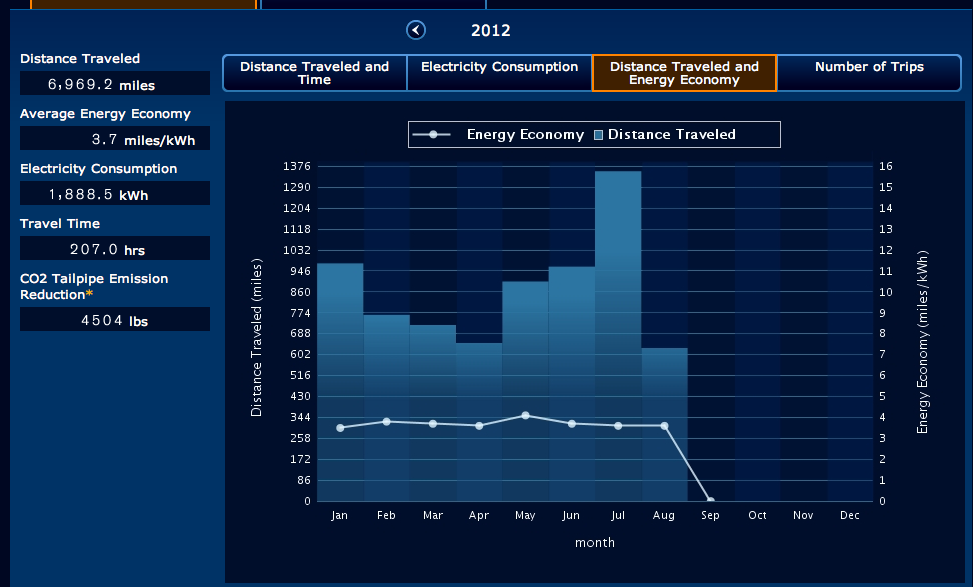
We did around 11,000 miles in the Nissan Leaf in the last year, but estimate that about a third of our charging was at work, as Laurel's commute is far enough to be an easy one way run, but requires a charge to get home again up the hill (we live at 2400ft, and she works at sea level!). She can take the car pool lane with the "white sticker" that pure electric cars get, which saves a lot of time, but running at high speed on the freeway uses a lot more power than around town. When I get to use the Leaf my commute is much closer and I don't bother charging it at work. Our long term average consumption is 3.7 miles/KWh, which is worse than most Leaf owners because of the freeway miles, hill climbing and "having fun". We don't pay for charging at work, and the marginal cost of electricity at home is zero because we are generating a negative net bill for the year, so we only use the "ECO" driving style if we are pushing the limits of its range on an unusual trip. The Leaf is the first car we pick for drives in its range, it's entertaining to drive as well as having extremely low running costs. All it needs for maintenance is tires, there is no engine oil to change, and the brakes wear very slowly due to electric regeneration. Here's the year so far as recorded by the Leaf's "Carwings" system.


The PG&E tariff we are on is called E6 Net Energy Metering, it has three rates for the summer, and two rates in the winter. The rules and rates are described in these documents at the PG&E web site: Rules http://www.pge.com/tariffs/tm2/pdf/ELEC_SCHEDS_NEM.pdf and Rates http://www.pge.com/tariffs/tm2/pdf/ELEC_SCHEDS_E-6.pdf
The rate that PG&E will pay us for any extra KWh we generate is about 3 cents/KWh as described in this document http://www.pge.com/includes/docs/pdfs/shared/solar/AB920_RateTable.pdf
Our base overnight rate that we pay is around 10 cents/KWh, the afternoon rate is around 28 cents/KWh, this is why we can generate hundreds of dollars in a negative bill while using hundreds of KWh.

Our solar setup is in two arrays that I described on my blog before, the total summer peak output is about 10KW, and we get up to 70KWh per day. In the winter this drops to about 40KWh per day, and clouds and rainy days greatly reduce the output. We're in a sunny spot on top of the mountains, and the monthly output from the 6.5KW array is shown in the plots below since we turned it on in April 2011. The other array adds about half this amount. Our annual true-up period runs from the beginning of September to the end of August.


PG&E send us a bill every month for about $11 of connection fees and taxes, and the current running total. Our final bill for the last year is shown below. Solar costs were described in a previous post.


Saturday, June 16, 2012

Cloud Application Architectures: GOTO Aarhus, Denmark, October

Thanks to an invite via Michael Nygard, I ended up as a track chair for the GOTO Aarhus conference in Denmark in early October. The track subject is Cloud Application Architectures, and we have three speakers lined up. You can register with a discount using the code crof1000.

We are starting out with a talk from the Citrix Cloudstack folks about how to architect applications on open portable clouds. These implement a subset of functionality but have more implementation flexibility than public cloud services. [Randy Bias of Cloudscaling was going to give this talk but had to pull out of the trip due to other commitments].

To broaden our perspective somewhat, and get our hands dirty with real code, the next talk is a live demonstration by Ido Flatow, Building secured, scalable, low-latency web applications with the Windows Azure Platform.
In this session we will construct a secured, durable, scalable, low-latency web application with Windows Azure - Compute, Storage, CDN, ACS, Cache, SQL Azure, Full IIS, and more. This is a no-slides presentation!
Finally I will be giving my latest update on Globally Distributed Cloud Applications at Netflix.
Netflix grew rapidly and moved its streaming video service to the AWS cloud between 2009 and 2010. In 2011 the architecture was extended to use Apache Cassandra as a backend, and the service was internationalized to support Latin America. Early in 2012 Netflix launched in the UK and Ireland, using the the combination of AWS capacity in Ireland and Cassandra to create a truly global backend service. Since then the code that manages and operates the global Netflix platform is being released as a series of open source projects at netflix.github.com (Asgard, Priam etc.). The platform is structured as a large scale PaaS, strongly leveraging advanced features of AWS to deploy many thousands of instances. The platform has primary language support for Java/Tomcat with most management tools built using Groovy/Grails and operations tooling in Python. Continuous integration and deployment tooling leverages Jenkins, Ivy/Gradle, Artifactory. This talk will explain how to build your own custom PaaS on AWS using these components.

There are many other excellent speakers at this event, which is run by the same team as the global series of  QCon conferences, unfortunately, the cloud track runs at at the same time as Michael Nygard and Jez Humble on Continuous Delivery and Continuous Integration, however I'm doing another talk in the NoSQL track, (along with Martin Fowler and Coda Hale). Running Netflix on Cassandra in the Cloud.
Netflix used to be a traditional Datacenter based architecture using a few large Oracle database backends. Now it is one of the largest cloud based architectures, with master copies of all data living in Cassandra. This talk will discuss how we made the transition, how we automated and open sourced Cassandra management for tens of clusters and hundreds of nodes using Priam and Astyanax, backups, archiving and performance and scalability benchmarks.

I'm looking forward to meeting old friends, getting to know some new people, and visiting Denmark for the first time.  See you there!

Sunday, April 29, 2012

It's not obvious how to be insanely simple

three books that I read recently resonated with me and fitted together so I'm going to try to make sense of them in a blog post rather than in a series of cryptic tweets.

My son (who is a product manager at eBay) told me about the most recent publication:
Insanely Simple: The Obsession That Drives Apple's Success by Ken Segall

At the Defrag conference last year I saw Duncan Watts present and recently finished reading his book Everything Is Obvious: Once You Know The Answer

I also recently watched Sam Harris give his talk on Free Will, and then read the book.

The connection starts with Free Will, which explains what is really going in our heads, along with Everything is Obvious which explains how our minds work collectively and interact with the real world these two books are the "Missing Manuals" for our brains. It's hard enough to figure out what is going on in the world and how best to navigate it, but it's doubly hard when you don't realize how your subconscious is pulling the strings and how common sense is confusing everyone around you.

Inside your head, the conscious thread of thoughts that you hear are post rationalizing decisions that your subconscious mind has already made. Feeding yourself a broad range of information with an open mind, connecting to your intuition and letting the power of your subconscious find the right patterns and responses lets you make faster and better decisions.

In society, we are surrounded by common sense explanations that we use to post rationalize the events around us and which are fed to us by the media, historians, politicians and our friends. Duncan deconstructs common sense to show that these explanations are mirages driven by our inner need to find a narrative and cause for effects that are essentially random co-incidences with far less significance than we assume. He then explains what un-common sense looks like and how to question the received wisdom and have better strategies for getting things done successfully.

I'm not going to summarize the whole book but there is a very useful section that should be read by anyone doing "big data analytics" that sets out the kind of things that are know-able and what (and why) other things will always remain un-knowable and impossible to predict. The advice I distilled from the discussion of strategy is that there is so much randomness in the outcome of business decisions that you cannot reliably evaluate the difference between a good strategy and a poor strategy. If you are able to get ever more detailed data about what happened you become more convinced in the value of your analysis, but the predictions you make about what to do next don't get any better. This is a counter-intuitive outcome (i.e. it violates common sense), so please read the book, which explains why you shouldn't be trusting your common sense in the first place.

The positive things we can do to overcome random outcomes really resonated with me, as they put into words several of the things I've been doing for many years, which have in some sense given me a better way to understand what's going on and get stuff done. They also describe many of the ways that Netflix figures out how to build it's products.

The first thing I do when I hear something like A caused B is a reflex reaction, I flip it around in my head, take the devils advocate position, look at the situation from a few different angles. This can be quite annoying in "polite company" as I tend to question received wisdom and common sense assertions, however I usually find a missing piece of information that could falsify the assertion, and ask the question. It could be as simple as asking exactly what time A and B happened, since if B turned out to happen before A then the assertion is clearly false. In statistics and physics this is codified as asserting the null hypothesis. (I'm the son of a statistician and I have a Physics degree...).

At Netflix we always try to construct parallel "A/B" tests of our hypotheses, like the double blind tests used in clinical trials of new medicines. We take a large number of new customers and give them a range of different experiences for long enough to measure a difference in their responses. This is the only way to reliably tell whether a new feature works, and it often goes against the common sense of what we expect and what many customers and industry analysts helpfully suggest we should be doing. As Duncan explains we can usually figure out what factors will affect an outcome, but we are extremely poor judges of how to weight those factors, even with post rationalization of what we saw happen, and all we can do is bias the statistics in a preferred direction. A recurring example is the suggestion that Netflix should allow half-stars in its movie ratings, but it turns out that given more fine grain choice fewer people rate movies, and the reduction in the number of data points out-weighs the increased accuracy. We can post rationalize why this occurs as an example of giving people too much choice, but we don't have to rationalize it, we just measured it.

In the discussion of strategy Duncan talks about creating a set of strategies that cover many scenarios, and using scenario planning to build more flexible and fuzzy strategies which are more likely to work under a range of random external influences. By putting yourself in the path of possible good randomness and avoiding bad outcomes, you can "make your own luck". By detecting problems early and having the flexibility to adapt your strategy you can run around the problems that will randomly come your way. If instead you concentrate on coming up with the best possible strategy or assuming that previous success was due to strategy rather than random outcomes you are building a brittle future that is likely to disappoint you.

The final point I will lift from Duncan's discussion of uncommon sense is that speed of execution and iteration is another fine way to cheat the chance events that will derail your plans. Long term detailed plans are a waste of time. This is one of the foundations of agile development, where rapid iteration of product features lets you discover what your users actually do with your product, as opposed to what you thought they would do or what they say they will do.

This leads to the Insanely Simple book, which talks about Apple's approach to product design, with particular emphasis on branding and marketing since Ken Segall was the guy who came up with the i in iMac and has many other fascinating stories. One reason I like working at Netflix is that for agile web services, product ideas can be built and tested in a week or a month, and fixed in minutes. For Apple they work on products for years and need to have them work perfectly when they are released. This gives them two big problems, since its hard to iterate and hard to test ideas and products in advance. Their solution seems to be that they allow better ideas to form and develop, take bigger risks and make decisions faster than their competition, which helps stay ahead of the market. The Insanely Simple design philosophy is based on the idea that its easy to listen to all those great common sense ideas about features your product has to have, but if you learn to ignore the common sense and give the customers a simple and distilled experience you will reach beyond the people who want a complicated product and find a much bigger market of people who were waiting for a simple way to get something done. Apple's competitors are so bogged down in committees and approval processes, and helpful common sense advice from customers that they are unable to release simple products.

A key example from the book is that Apple has had many award winning advertising campaigns, "Think Different", "PC and Mac" and the iPod silhouette, and none of them were test marketed in advance. Their competitors make less risky adverts after getting broad internal consensus, take much longer to get them to market and fail to understand that the success of an advert is a randomized event (with lots of useless common sense post rationalizations) so the test market response is a very poor predictor of success. It's more important to be bold, different and go big. For example Apple only advertised Think Different on the back cover of magazines, which costs far more but has a much bigger impact than inside pages.

From these three books I've found some useful focus on how to approach things, but they also give me some backup to explain to others why I think some things are important. A key part of what I have been doing for Netflix is looking out into the future of cloud and related technologies and developing a portfolio of fuzzy strategies and options. They don't all work out, but by having a well instrumented but loosely coordinated architecture that doesn't have central control and strict processes we can iterate rapidly, adopt (and discard) interesting new technologies as they come along. We can all have more fun and less frustration making Netflix Insanely Simple, and ignore all the bad common sense advice and analyst opinions that swirl around everything we do.

I'm planning a complete re-write of my cloud architecture tutorial for Gluecon in May, that will be a great opportunity to discuss these things in person over a few beers, and now is a good time to sign up to attend - you can get a 10% discount with code spkr12.

Monday, March 19, 2012

Ops, DevOps and PaaS (NoOps) at Netflix

There has been a sometimes heated discussion on twitter about the term NoOps recently, and I've been quoted extensively as saying that NoOps is the way developers work at Netflix. However, there are teams at Netflix that do traditional Operations, and teams that do DevOps as well. To try and clarify things I need to explain the history and current practices at Netflix in chunks of more than 140 characters at a time.

When I joined Netflix about five years ago, I managed a development team, building parts of the web site. We also had an operations team who ran the systems in the single datacenter that we deployed our code to. The systems were high end IBM P-series virtualized machines with storage on a virtualized Storage Area Network. The idea was that this was reliable hardware with great operational flexibility so that developers could assume low failure rates and concentrate on building features. In reality we had the usual complaints about how long it took to get new capacity, the lack of consistency across supposedly identical systems, and failures in Oracle, in the SAN and the networks, that took the site down too often for too long.

At that time we had just launched the streaming service, and it was still an experiment, with little content and no TV device support. As we grew streaming over the next few years, we saw that we needed higher availability and more capacity, so we added a second datacenter. This project took far longer than initial estimates, and it was clear that deploying capacity at the scale and rates we were going to need as streaming took off was a skill set that we didn't have in-house. We tried bringing in new ops managers, and new engineers, but they were always overwhelmed by the fire fighting needed to keep the current systems running.

Netflix is a developer oriented culture, from the top down. I sometimes have to remind people that our CEO Reed Hastings was the founder and initial developer of Purify, which anyone developing serious C++ code in the 1990's would have used to find memory leaks and optimize their code. Pure Software merged with Atria and Rational before being swallowed up by IBM. Reed left IBM and formed Netflix. Reed hired a team of very strong software engineers who are now the VPs who run developer engineering for our products. When we were deciding what to do next Reed was directly involved in deciding that we should move to cloud, and even pushing us to build an aggressively cloud optimized architecture based on NoSQL. Part of that decision was to outsource the problems of running large scale infrastructure and building new datacenters to AWS. AWS has far more resources to commit to getting cloud to work and scale, and to building huge datacenters. We could leverage this rather than try to duplicate it at a far smaller scale, with greater certainty of success. So the budget and responsibility for managing AWS and figuring out cloud was given directly to the developer organization, and the ITops organization was left to run its datacenters. In addition, the goal was to keep datacenter capacity flat, while growing the business rapidly by leveraging additional capacity on AWS.

Over the next three years, most of the ITops staff have left and been replaced by a smaller team. Netflix has never had a CIO, but we now have an excellent VP of ITops Mike Kail (@mdkail), who now runs the datacenters. These still support the DVD shipping functions of Netflix USA, and he also runs corporate IT, which is increasingly moving to SaaS applications like Workday. Mike runs a fairly conventional ops team and is usually hiring, so there are sysadmin, database,, storage and network admin positions. The datacenter footprint hasn't increased since 2009, although there have been technology updates, and the over-all size is order-of-magnitude a thousand systems.

As the developer organization started to figure out cloud technologies and build a platform to support running Netflix on AWS, we transferred a few ITops staff into a developer team that formed the core of our DevOps function. They build the Linux based base AMI (Amazon Machine Image) and after a long discussion we decided to leverage developer oriented tools such as Perforce for version control, Ivy for dependencies, Jenkins to automate the build process, Artifactory as the binary repository and to construct a "bakery" that produces complete AMIs that contain all the code for a service. Along with AWS Autoscale Groups this ensured that every instance of a service would be totally identical. Notice that we didn't use the typical DevOps tools Puppet or Chef to create builds at runtime. This is largely because the people making decisions are development managers, who have been burned repeatedly by configuration bugs in systems that were supposed to be identical.

By 2012 the cloud capacity has grown to be order-of-magnitude 10,000 instances, ten times the capacity of the datacenter, running in nine AWS Availability zones (effectively separate datacenters) on the US East and West coast, and in Europe. A handful of DevOps engineers working for Carl Quinn (@cquinn - well known from the Java Posse podcast) are coding and running the build tools and bakery, and updating the base AMI from time to time. Several hundred development engineers use these tools to build code, run it in a test account in AWS, then deploy it to production themselves. They never have to have a meeting with ITops, or file a ticket asking someone from ITops to make a change to a production system, or request extra capacity in advance. They use a web based portal to deploy hundreds of new instances running their new code alongside the old code, put one "canary" instance into traffic, if it looks good the developer flips all the traffic to the new code. If there are any problems they flip the traffic back to the previous version (in seconds) and if it's all running fine, some time later the old instances are automatically removed. This is part of what we call NoOps. The developers used to spend hours a week in meetings with Ops discussing what they needed, figuring out capacity forecasts and writing tickets to request changes for the datacenter. Now they spend seconds doing it themselves in the cloud. Code pushes to the datacenter are rigidly scheduled every two weeks, with emergency pushes in between to fix bugs. Pushes to the cloud are as frequent as each team of developers needs them to be, incremental agile updates several times a week is common, and some teams are working towards several updates a day. Other teams and more mature services update every few weeks or months. There is no central control, the teams are responsible for figuring out their own dependencies and managing AWS security groups that restrict who can talk to who.

Automated deployment is part of the normal process of running in the cloud. The other big issue is what happens if something breaks. Netflix ITops always ran a Network Operations Center (NOC) which was staffed 24x7 with system administrators. They were familiar with the datacenter systems, but had no experience with cloud. If there was a problem, they would start and run a conference call, and get the right people on the call to diagnose and fix the issue. As the Netflix web site and streaming functionality moved to the cloud it became clear that we needed a cloud operations reliability engineering (CORE) team, and that it would be part of the development organization. The CORE team was lucky enough to get Jeremy Edberg (@jedberg - well know from running Reddit) as its initial lead engineer, and also picked up some of the 24x7 shift sysadmins from the original NOC. The CORE team is still staffing up, looking for Site Reliability Engineer skill set, and is the second group of DevOps engineers within Netflix. There is a strong emphasis on building tools too make as much of their processes go away as possible, for example they have no run-books, they develop code instead,

To get themselves out of the loop, the CORE team has built an alert processing gateway. It collects alerts from several different systems, does filtering, has quenching and routing controls (that developers can configure), and automatically routes alerts either to the PagerDuty system (a SaaS application service that manages on call calendars, escalation and alert life cycles) or to a developer team email address. Every developer is responsible for running what they wrote, and the team members take turns to be on call in the PagerDuty rota. Some teams never seem to get calls, and others are more often on the critical path. During a major production outage con call, the CORE team never make changes to production applications, they always call a developer to make the change. The alerts mostly refer to business transaction flows (rather than typical operations oriented Linux level issues) and contain deep links to dashboards and developer oriented Application Performance Management tools like AppDynamics which let developers quickly see where the problem is at the Java method level and what to fix,

The transition from datacenter to cloud also invoked a transition from Oracle, initially to SimpleDB (which AWS runs) and now to Apache Cassandra, which has its own dedicated team. We moved a few Oracle DBAs over from the ITops team and they have become experts in helping developers figure out how to translate their previous experience in relational schemas into Cassandra key spaces and column families. We have a few key development engineers who are working on the Cassandra code itself (an open source Java distributed systems toolkit), adding features that we need, tuning performance and testing new versions. We have three key open source projects from this team available on github.com/Netflix. Astyanax is a client library for Java applications to talk to Cassandra, CassJmeter is a Jmeter plugin for automated benchmarking and regression testing of Cassandra, and Priam provides automated operation of Cassandra including creating, growing and shrinking Cassandra clusters, and performing full and incremental backups and restores. Priam is also written in Java. Finally we have three DevOps engineers maintaining about 55 Cassandra clusters (including many that span the US and Europe), a total of 600 or so instances. They have developed automation for rolling upgrades to new versions, and sequencing compaction and repair operations. We are still developing our Cassandra tools and skill sets, and are looking for a manager to lead this critical technology, as well as additional engineers. Individual Cassandra clusters are automatically created by Priam, and it's trivial for a developer to create their own cluster of any size without assistance (NoOps again). We have found that the first attempts to produce schemas for Cassandra use cases tend to cause problems for engineers who are new to the technology, but with some familiarity and assistance from the Cloud Database Engineering team, we are starting to develop better common patterns to work to, and are extending the Astyanax client to avoid common problems.

In summary, Netflix stil does Ops to run its datacenter DVD business. we have a small number of DevOps engineers embedded in the development organization who are building and extending automation for our PaaS, and we have hundreds of developers using NoOps to get their code and datastores deployed in our PaaS and to get notified directly when something goes wrong. We have built tooling that removes many of the operations tasks completely from the developer, and which makes the remaining tasks quick and self service. There is no ops organization involved in running our cloud, no need for the developers to interact with ops people to get things done, and less time spent actually doing ops tasks than developers would spend explaining what needed to be done to someone else. I think that's different to the way most DevOps places run, but its similar to other PaaS enviroments, so it needs it's own name, NoOps. [Update: the DevOps community argues that although it's different, it's really just a more advanced end state for DevOps, so lets just call it PaaS for now, and work on a better definition of DevOps].

Friday, March 16, 2012

Cloud Architecture Tutorial

I presented a whole day tutorial at QCon London on March 5th, and presented subsets at an AWS Meetup, a Big Data / Cassandra Meetup and a Java Meetup the same week. I updated the slides and split them into three sections which are hosted on http://slideshare.net/adrianco along with all my other presentations. You can find many more related slide decks at http://slideshare.net/Netflix and other information at the Netflix Tech Blog.

The first section tells the story of why Netflix migrated to cloud, how we think about choosing AWS as our cloud supplier and what features of the Netflix site were moved to the cloud over the last three years.


The second section is a detailed explanation of the globally distributed Java based Platform as a Service (PaaS) we built, the open source components that we depend on, and the open source projects that we have started to share at http://netflix.github.com.


The final section talks about how we run these PaaS services in the cloud, and includes details of our million writes per second scalability benchmark.


If you would like to see these slides presented in person, I'm teaching a half day cloud architecture tutorial at Gluecon in Broomfield Colorado in May 23-24th. I hope to see you there...

Thursday, January 19, 2012

Thoughts on SimpleDB, DynamoDB and Cassandra

I've been getting a lot of questions about DynamoDB, and these are my personal thoughts on the product, and how it fits into cloud architectures.

I'm excited to see the release of DynamoDB, it's a very impressive product with great performance characteristics. It should be the first option for startups and new cloud projects on AWS. I also think it marks the turning point on solid state disks, they will be the default for new database products and benchmarks going forward.

There are a few use cases where SimpleDB may still be useful, but DynamoDB replaces it in almost all cases. I've talked about the history of Netflix use of SimpleDB before, but it's relevant to the discussion on DynamoDB, so here goes.

When Netflix was looking at moving to cloud about three years ago we had an internal debate about how to handle storage on AWS. There were strong proponents for using MySQL, SimpleDB was fairly new, and other alternatives were nascent NoSQL projects or expensive enterprise software. We started some pathfinder projects to explore the two alternatives and decided to port an existing MySQL app to AWS, while building a replication pipeline that copied data out of our Oracle datacenter systems into SimpleDB to be consumed in the cloud. The MySQL experience showed that we would have trouble scaling, and SimpleDB seemed reliable, so we went ahead and kept building more data sources on SimpleDB, with large blobs of data on S3.

Along the way we put memcached in front of SimpleDB and S3 to improve read latency. The durability of SimpleDB is its strongest point, we have had Oracle and SAN data corruption bugs in the Datacenter over the last few years, but never lost or corrupted any SimpleDB data. The limitations of SimpleDB are its biggest problem. We worked around limits on table size, row and attribute size, and per-request overhead caused by http requests needing to be authenticated for every call.

So the lesson here is that for a first step into NoSQL, we went with a hosted solution so that we didn't have to build a team of experts to run it, and we didn't have to decide in advance how much scale we needed. Starting again from scratch today, I would probably go with DynamoDB. It's a low "friction" and developer friendly solution.

Late in 2010 we were planning the next step, turning off Oracle and making the cloud the master copy of the data. One big problem is that our backups and archives were based on Oracle, and there was no way to take a snapshot or incremental backup of SimpleDB. The only way to get data out in bulk is to run "SELECT * FROM table" over HTTP and page the requests. This adds load, takes too long, and costs a lot because SimpleDB charges for the time taken in SELECT calls.

We looked at about twenty NoSQL options during 2010, trying to understand what the differences were, and eventually settled on Cassandra as our candidate for prototyping. In a week or so, we had ported a major data source from SimpleDB to Cassandra and were getting used to the new architecture, running benchmarks etc. We evaluated some other options, but decided to take Cassandra to the next stage and develop a production data source using it.

The things we liked about Cassandra were that it is written in Java (we have a building full of Java engineers), it is packed full of state of the art distributed systems algorithms, we liked the code quality, we could get commercial support from Datastax, it is scalable and as an extra bonus it had multi-region support. What we didn't like so much was that we had to staff a team to own running Cassandra for us, but we retrained some DBAs and hired some good engineers including Vijay Parthasarathy, who had worked on the multi-region Cassandra development at Cisco Webex and who recently became a core committer on the Apache Cassandra project. We also struggled with the Hector client library, and have written our own (which we plan to release soon). The blessing and a curse of Cassandra is that it is an amazingly fast moving project. New versions come fast and furiously, which makes it hard to pick a version to stabilize on, however the changes we make turn up in the mainstream releases after a few weeks. Saying "Cassandra doesn't do X" is more of a challenge than a statement. If we need "X" we work with the rest of the Apache project to add it.

Throughout 2010 the product teams at Netflix gradually moved their backend data sources to Cassandra, we worked out the automation we needed to do easy self service deployments and ended up with a large number of clusters. In preparation for the UK launch we also made changes to Cassandra to better support multi-region deployment on EC2, and we are currently running several Cassandra clusters that span the US and European AWS regions.

Now that DynamoDB has been released, the obvious question is whether Netflix has any plans to use it. The short answer is no, because it's a subset of the Cassandra functionality that we depend on. However that doesn't detract from the major step forward from SimpleDB in performance, scalability and latency. For new customers, or people who have outgrown the scalability of MySQL or MongoDB, DynamoDB is an excellent starting point for data sources on AWS. The advantages of zero administration combined with the performance and scalability of a solid state disk backend are compelling.

Personally my main disappointment with DynamoDB is that it doesn't have any snapshot or incremental backup capability. The AWS answer is that you can extract data into EMR then store it in S3. This is basically the same answer as SimpleDB, it's a full table scan data extraction (which takes too long and costs too much and isn't incremental). The mechanism we built for Cassandra leverages the way that Cassandra writes immutable files to get a callback and compress/copy them to S3 as they are written, it's extremely low overhead. If we corrupt our data with a code bug and need to roll back, or take a backup in production and restore in test, we have all the files archived in S3.

One argument against DynamoDB is that DynamoDB is on AWS only, so customers could get locked in, however it's easy to upgrade applications from SimpleDB, to DynamoDB and to Cassandra. They have similar schema models, consistency options and availability models. It's harder to go backwards, because Cassandra has more features and fewer restrictions. Porting between NoSQL data stores is trivial compared to porting between relational databases, due to the complexity of the SQL language dialects and features and the simplicity of the NoSQL offerings. Starting out on DynamoDB then switching to Cassandra when you need more direct control over the installation or Cassandra specific features like multi-region support is a very viable strategy.

As early adopters we have had to do a lot more pioneering engineering work than more recent cloud converts. Along the way we have leveraged AWS heavily to accelerate our own development, and built a lot of automation around Cassandra. While SimpleDB has been a minor player in the NoSQL world DynamoDB is going to have a much bigger impact. Cassandra has matured and got easier to use and deploy over the last year but it doesn't scale down as far. By that I mean a single developer in a startup can start coding against DynamoDB without needing any support and with low and incremental costs. The smallest Cassandra cluster we run is six m1.xlarge instances spread over three zones with triple replication.

I've been saying for a while that 2012 is the year that NoSQL goes mainstream, DynamoDB is another major step in validating that move. The canonical CEO to CIO conversation is moving from 2010: "what's our cloud strategy?", 2011: "what's our big data strategy?" to 2012: "what's our NoSQL strategy?".