Showing posts with label solarcity. Show all posts

Sunday, September 02, 2012

Solar Power Update - Annual Costs


I've blogged before about our solar power installation and we just completed our first full year where we didn't change anything, so we have a clear baseline of how much we generated and used, which I will describe in this post.

Our system is a grid tied net metering setup. This means that we generate more electricity than we use during the day and run the meter backwards in the summer, then use (cheaper) electricity at night and in the winter from the grid. Once a year our PG&E bill is netted out and we pay the difference. Last year our total electric bill was about $500 but during the year we changed everything by adding a second solar array, a Nissan Leaf electric car and a heat pump for heating and cooling. This year, with a consistent setup for the entire period, our bill was negative, so we didn't owe PG&E anything. However, this didn't mean that PG&E paid us the difference, because the payback rule is based on how many KWh you generate rather than how much you would have paid for it. In our case, although our net bill was -$495, we used 610 KWh more than we generated for the whole year. The details of our PG&E bill are shown at the end of this post.

In effect, we could have used another $495 worth of electricity for free. Going into next year, we will set the heat pump to work harder at lower temperatures before it switches over to propane, which will reduce our carbon footprint and save us some propane costs. For some of last winter we used propane when the outside temperature fell below 45F, and at some point we reduced that to 40F. Unfortunately the controller setting we have is in increments of 5F, and I'm doubtful that we can pump heat out of air at 35F, but it's worth a try. We already converted our other appliances from propane to electric, and other than the heat pump our major consumers are a large tank electric water heater, induction range, clothes dryer, hot tub and well pump.

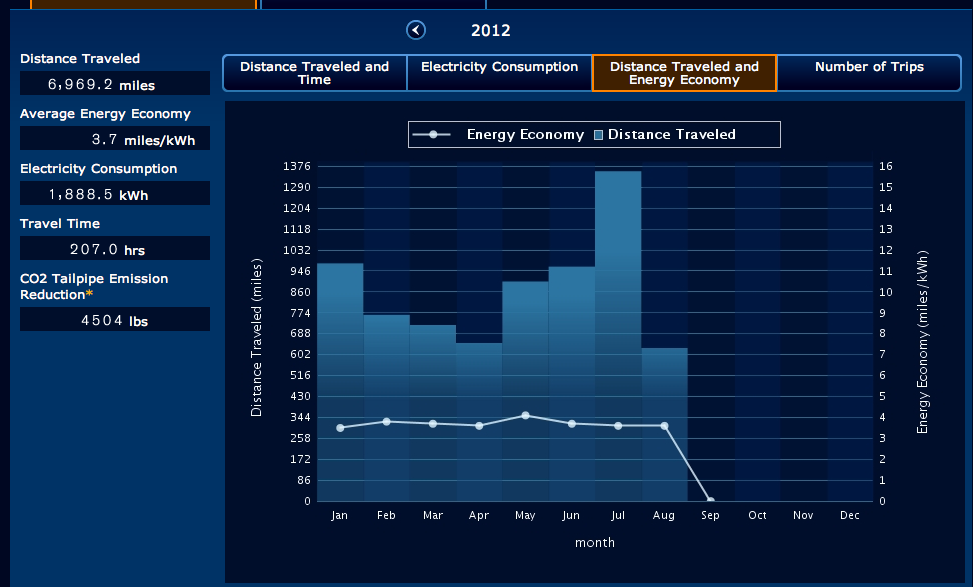
We did around 11,000 miles in the Nissan Leaf in the last year, but estimate that about a third of our charging was at work, as Laurel's commute is far enough to be an easy one way run, but requires a charge to get home again up the hill (we live at 2400ft, and she works at sea level!). She can take the car pool lane with the "white sticker" that pure electric cars get, which saves a lot of time, but running at high speed on the freeway uses a lot more power than around town. When I get to use the Leaf my commute is much closer and I don't bother charging it at work. Our long term average consumption is 3.7 miles/KWh, which is worse than most Leaf owners because of the freeway miles, hill climbing and "having fun". We don't pay for charging at work, and the marginal cost of electricity at home is zero because we are generating a negative net bill for the year, so we only use the "ECO" driving style if we are pushing the limits of its range on an unusual trip. The Leaf is the first car we pick for drives in its range, it's entertaining to drive as well as having extremely low running costs. All it needs for maintenance is tires, there is no engine oil to change, and the brakes wear very slowly due to electric regeneration. Here's the year so far as recorded by the Leaf's "Carwings" system.


The PG&E tariff we are on is called E6 Net Energy Metering, it has three rates for the summer, and two rates in the winter. The rules and rates are described in these documents at the PG&E web site: Rules http://www.pge.com/tariffs/tm2/pdf/ELEC_SCHEDS_NEM.pdf and Rates http://www.pge.com/tariffs/tm2/pdf/ELEC_SCHEDS_E-6.pdf
The rate that PG&E will pay us for any extra KWh we generate is about 3 cents/KWh as described in this document http://www.pge.com/includes/docs/pdfs/shared/solar/AB920_RateTable.pdf
Our base overnight rate that we pay is around 10 cents/KWh, the afternoon rate is around 28 cents/KWh, this is why we can generate hundreds of dollars in a negative bill while using hundreds of KWh.

Our solar setup is in two arrays that I described on my blog before, the total summer peak output is about 10KW, and we get up to 70KWh per day. In the winter this drops to about 40KWh per day, and clouds and rainy days greatly reduce the output. We're in a sunny spot on top of the mountains, and the monthly output from the 6.5KW array is shown in the plots below since we turned it on in April 2011. The other array adds about half this amount. Our annual true-up period runs from the beginning of September to the end of August.


PG&E send us a bill every month for about $11 of connection fees and taxes, and the current running total. Our final bill for the last year is shown below. Solar costs were described in a previous post.


Wednesday, February 16, 2011

Solar Power - More panels on the garage roof

The SolarCity installation team arrives.


Product specification on a panel, 210W peak output, Silicon by Kyocera made in Mexico.


Fronius inverter installed inside the garage, wired to the distribution panel shown next to it.

Mounting rails on the garage roof.

Closeup of how the rails mount on the shingles.

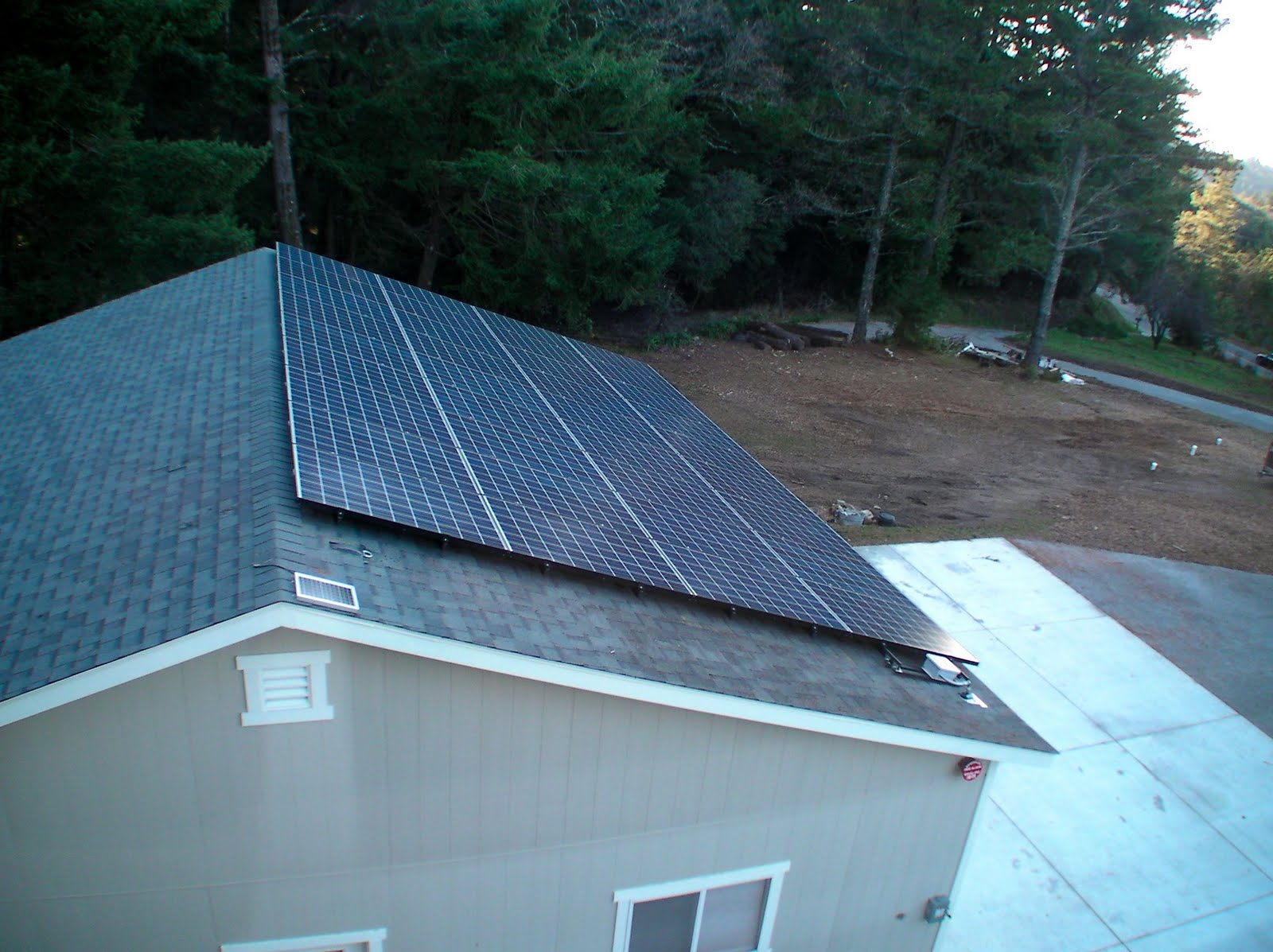
All the panels in place, four rows of nine panels, 36 x 210W = 7560W DC, after the inverter this works out to about 6.5KW delivered AC power.

View from the front of the garage early in the morning.

It's all wired in, we are waiting for inspection and approval before we can turn it on. The same monitoring system is used as was installed for my previous solar installation on the house roof. This time we leased the panels, there are several options, from no money down to buying the whole thing up front. I've opted for an initial payment of $10K, and $90/month fixed for the duration of the lease (20 years). I don't pay anything until its turned on.

We currently generate about two thirds of our usage of electricity. The extra panels should triple the generated capacity, so we will generate about twice what we use in the short term. That evens out when we start charging a Nissan Leaf (delivery due in April), and change out our propane furnace for a heat pump and air conditioner (hopefully in time to cool us this summer).

A useful side effect is that the garage itself will be a lot cooler inside during the summer, as the panels shade the roof.

Monday, December 27, 2010

Solar Power - More panels and Nissan Leaf

Solar City will triple our solar power output in February, and we just ordered a Leaf, which they say is deliverable in the April-July timeframe.

We are adding 6.5KW of net delivered AC capacity (gross is about 7.5KW DC) to the garage roof. This time we are leasing it, and there are several options for how much downpayment vs. recurring payment to make.

There was a power cut last night for about two hours, and the automatic generator that runs off our propane tank kicked in after about 20 seconds. When the power came back, there wasn't a glitch, everything kept running. That was the first real test. We have a Generac 17KW unit that powers most of the house. With hindsight, it would have been better to get the 20KW generator that can power a whole 200Amp distribution panel rather than routing individual circuits. The extra cost would be offset by a simpler installation. We hope to replace the propane furnace with a heat pump at some point, then the generator will be the only thing running on propane, and since our solar system is grid-tied, it needs to work well to keep an all electric house going.

We were originally looking a geothermal heat pumps, but the extra cost of digging wells to get a more efficient heat pump is not cost effective versus adding extra solar panels to make up the difference. In climates where it is colder and there is less solar irradiance available, it makes more sense to use geothermal.

During 2010 we generated about 60% of the electricity we consumed, and also greatly reduced our propane consumption by switching appliances from propane to electric. In 2011 we should be almost 100% solar powered electric, and reduce our gasoline usage as well.

Sunday, September 26, 2010

Solar Power - The Year in Review

For our full story on solar click here.

We installed Solar panels in August 2009, and they were turned on during September. We have now had a whole year of power which is shown below. The time-of-use metering means that we get paid much more for the power we generate in the afternoon than the power we use overnight, so the "zero point" for billing is different than that for power consumption. PG&E recently sent us our annual bill, which was about $500. Added to the monthly bills for basic service this comes to about $700 for the whole year. Our previous electricity bill was about $2000 a year. Since we changed our hot water, clothes dryer and range from propane to electric, we saved over $1000 in propane cost as well. That puts payback at around ten years at todays prices, given the likelihood of increased propane and electricity prices over time, actual payback would be earlier than that.

The panels have got a lot of dust on them (the roof is too high to get at easily to clean them), so aren't running at peak efficiency, the best day we saw was around 28KWh, with a lot of days of 26-27 KWh through the summer. The totals for each month are shown in the screenshots below.


Since we have built a new garage, we now have a lot more roof area. So we are now looking to add another 4KW of panels, and to swap out our propane furnace for a heat pump that will give us heating and cooling (yay - its hot today...) sometime next spring. Then the only use for propane will be the emergency generator. It should also make the garage a bit cooler in the summer by shading half of the roof with panels.

Friday, March 19, 2010

Solar Power - Spring Equinox Update

Spring is here, and we just had a few clear days, shown below. The sunrise and sunset are about 12 hours apart. We installed the system just before the fall equinox, so we now have a good calibration of the output levels through the least sunny part of the year, from now on it will be interesting to track the output as we go to the longest day.

Actual average output over the last 200 or so days is about 14.3 KWh/day. Yesterday was 22.5 KWh, and at the winter solstice low point it was 16 KWh on a clear day as previously blogged.

Thursday, December 24, 2009

Solar Power - Winter Solstice and New Ducting Update

I've previously shared the first few months of output from our solar system, we turned it on at the start of September, and on a clear day we were getting around 24KWh. As the days got shorter and the Sun got lower in the sky, the clear day output dropped off, and earlier this week we hit the winter solstice, the shortest day. Wednesday was a clear day, and we generated about 16KWh, as shown in the plot below.


We have also seen the benefit of our E6-time of use rate plan. We generate electricity during the week while we are mostly out of the house at the highest rate, and use it at the cheapest rate. So we continue to be net consumers of electricity, generating between 50% and 70% of what we use, but our electricity bill is basically zero at this point. In addition, PG&E just gave us a rebate of $67 due to lower energy costs, so the standing charge of $11.50/month is zeroed out for almost six months.

We converted our gas appliances to electric, for heating water, drying clothes and cooking, and currently only use gas for the furnace that heats the house. We looked into replacing the furnace with a ground source heat pump (GSHP) but got wildly varying designs and costs from everyone we talked to so have postponed that idea. The one thing everyone agreed on was that our ducting was sub-standard, with insufficient flow for A/C and barely enough for the furnace, and it was poorly constructed using the lowest quality materials.

So we have just replaced the ducts throughout the house, changing the configuration to include separate zones for upstairs and downstairs, adding a new return path from upstairs and one extra outlet. The ducts are insulated to R8, rather than R4.2, so they don't lose heat, and they have fewer leaks and a properly designed balance of air flow into each room. This is done using something called a Manual-J calculation, and there is also an independent analysis service that verifies that everything is working correctly. The main effect of this is that we will use less propane, and have much better control over temperature upstairs. We often want to heat the bedrooms without wanting to heat downstairs to the same level, and we now have a thermostat in the main bedroom for upstairs, as well as one downstairs.

I'm planning to blog some more about GSHP options, its quite complicated....

Monday, October 05, 2009

Solar Power - High and low usage and costs for the first month

The solar array continues to generate over 20KWh on a clear day, but our daily consumption varies a lot. On Sunday we were running the washing machine, dryer, pumping water from the well for a few hours, watching TV and baking/cooking/dish-washing for seven people, and we hit an all time high using almost 50KWh.


The next day, running pretty close to the minimum possible, we used about 13 KWh.


Our total generation for the month of September was about 700 KWh. The output is dropping as the day gets shorter and the sun gets lower, so our 4.2KW system peaked at about 3.4KW at the start of the month, after a rain shower cleaned the panels and the air we saw a peak of 3.7KW for a short period of one day, then it dropped back to 3.3KW and it ended the month at 3.2KW. The daily output on a clear day was 26KWh at the start of September and 24KWh at the end.

Our approximate total consumption for september was 1100 KWh, and since we are on the time-of-use E6 rate the net metering subtracted the 700 we generated and broke down the rest as -100 KWh at peak time (1-7pm), and 500 KWh mid and off-peak. We were billed $11.50 which is the base level for PG&E, and a total of $17 for 400 KWh was added to the annual accumulation.

In a year's time the net for the year is due to get settled. The very complex details are available from PG&E, but basically instead of costing us on a sliding scale of 11c-38c per KWh, the solar array keeps us at the bottom end of the scale and at the E6 rate it costs 8c off peak, 14c mid peak, and while we are running the meter backwards at peak PG&E pay us 30c per KWh. So our typical electric bill of $250 was reduced to $28.

I have been asked about the payback time for the installation. This is part of the calculation that the vendor sales-rep makes for your particular situation. In my case we made it much more complex by replacing the roof shingles, shutting down our use of propane, buying new appliances and increasing our use of electricity. However If we ignore all that and average $200/month savings, then after all the rebates the solar system installation of about $20K has a payback time of less than 8 years on a naive calculation. If we take into account a 5% interest rate on the installation cost it's more like 12 years, and if we assume that electricity costs would rise over that time it's somewhere in-between. I'm also assuming that the value of the house has gone up.

Friday, September 25, 2009

Solar Power - Monitoring Consumption

We finally got Solarcity to install the consumption monitor, and we are now figuring out what the various bumps in the graph correlate to in terms of appliances. The first graph shows consumption on a hot day, with a portable room A/C unit left on all day. There is a characteristic bump in the morning that seems to correlate to re-heating hot water after showers, and random bumps during the day that are probably the hot tub cycling on to filter and maintain water temperature.


Another day where we didn't leave the A/C unit on shows much lower consumption. One of the common psychological effects of measuring something is a compulsion to optimize it, so we are now challenging ourselves to try and reduce consumption...

Since we are now on a time-of-use meter, the cost of electricity at nights and weekends is very low, and the cost in the afternoons during the week is high, but that is when we are generating more than we are using, so in $ terms, the meter is running backwards at high speed, and forwards slowly. This also makes it very hard to calculate the cost savings.


Total generation for the month is looking good. We turned on the system right at the start of the month, so the lifetime total includes a week or so before the output monitoring started to log data, and you can see the last few days of consumption data. We have had typical (for us) weather, sunny from the start of the day most days. We drive down into the clouds each morning. The drop off a few weeks ago was a cloudy spell that included about 0.25in of rain, enough to make sure the solar panels are nice and clean. There is a slow downward trend in the daily output, since the days are getting shorter and the Sun is lower in the sky every day. It's around the equinox at the moment. Over-all, I'm happy with how much energy we are getting, I expected to get longer effective days than most people, and it looks as if we will be generating about 600 KWh this month, our typical consumption has been around 1000 KWh.

Sunday, September 06, 2009

Solar Power - Monitoring Output


The SolarCity web based monitoring system didn't work at first, there was a problem with the data-logging board in the inverter but they were helpful and sent someone round to fix it. So now we can track how much power we are generating. The graph updates every 15 minutes, and it reports the amount of power every half hour, so when it shows 1.7 KWh that is equivalent to 3.4KW averaged over 30 minutes. So far the highest peak instantaneous output reported on the Inverter is about 4.2KW.

We are still waiting for the energy consumption metering to be added, which puts a second line on the same graph.

The day shown was a typical day up here on top of the mountain, it was cloudy elsewhere, but we had basically clear sky all day. and generated over 25KWh.

Sunday, August 30, 2009

Solar Power - "City" Inspection

We passed last week (we live outside the city, so it was actually Santa Clara County), and how have another 12 days for PG&E to put in a new time-of-use power meter and bless the installation so we can turn it on.

It took a bit of prodding for SolarCity to get the inspections setup, at least that's the way it seemed. After the install, they sent me an email saying please pay the invoice, but they hadn't sent me an invoice. I waited a few days then asked them if they were going to send me one, then they sent it. After they get paid they are supposed to schedule the inspection. They say it can take a month or so to complete the inspections. After a week or two I emailed and asked when the inspection might happen, and a few days later it was scheduled for the following week. They sent someone to wait at my house for the inspector, so we didn't need to be there, other than making sure they had access to the basement where the inverter is installed.

The ground source heat pump is taking a bit longer than hoped. The supplies have been hard to source on the West Coast, it seems that there are relatively few GSHP installations in California so far. I'm hoping to get the detailed planning approval and install done in the coming week.

Wednesday, July 29, 2009

Solar Power - Installation Day 4

All the panels are on the roof, the trench has been re-filled, the wiring is done, it was tested and span the meter backwards. Next step is inspections that can take a few weeks before we can turn it on for real....

I installed the Solarcity Internet monitoring system base station by plugging it into a spare Ethernet port on my DSL modem. It flashed some lights that told me that it had connected to Solarcity successfully, then started scanning to find the monitored devices. It talks to the inverter to track how much power is being generated, and I will have an optional consumption monitor that tells me how much power the house is using. I have to wait for the install to be complete before I can see any output on the solarcity.com web site.
Also, they were out of stock of the consumption monitor, so it will need to be added on later, but it doesn't affect the operation of the system.

I have also figured out the Ground Source Heat Pump, I'm going for a vertical well based installation, its a 3-ton A/C unit and heater made by Carrier that hooks up to my existing propane furnace ducting, and includes a water heater that replaces my propane hot water tank. It exchanges heat with the ground using three 200ft deep wells, and for every KW of electricity it uses, it pumps around 4KW of heat in or out of the house. This is over twice as efficient as a conventional air based A/C unit. It costs more, but there is a 30% federal tax credit on the full price, just like the solar power installation, thanks to Obama's stimulus package (this credit started in February 2009). I'm hoping to have enough solar power to zero out the running costs, we will see how that goes over time.

Tuesday, July 28, 2009

Solar Power - Installation Day 3

Today about half the panels were put in place on the roof, and a lot of wiring was put in place.

Here are the installers starting to put panels in place in the morning.


In the evening the lowest row of 20 are in place, and about half of the next row. There will be a total of 60 panels when it's done.


Here is the underside of a panel, in a shipping rack on the truck.


A closeup of the panel's specification label, as I mentioned before, its a Cadmium Telluride CdTe thin film technology panel from First Solar. Each panel is rated at 75W, and the total installation is rated at 4.5KW.

Solar Power - Installation Day 2

More mounting hardware is now on the roof, the brackets that hold the panels to the rails are now in place. Since the PG&E meter isn't mounted on the house itself, they also had to dig a trench. Tomorrow a county planning dept. inspector will come by to make sure everything is to code.

I also got an email from PG&E today, informing me that they know I have solar being installed and will schedule an appointment to do their own verification and turn the system on, once the hardware is in place.

One subtlety, since I also want to connect a generator for when we get power cuts (I'm on top of the Santa Cruz mountains) we had to decide what order to wire everything together. The sequence is

PG&E service meter - Solar Power system - Generator - House breaker panel

The generator is only wired into a subset of the house circuits, so it is looped into the house breaker panel. When installed, it will have a sensor that can tell whether there is any incoming power from PG&E, and if not, it fires up after 20 seconds or so.

The solar power system detects the PG&E power, synchronizes to the 60Hz phase and adds its own power by providing a few volts more than PG&E, to get the power to flow into the system. If PG&E goes away, the solar system also shuts down, then the generator detects no power, isolates the downstream components and takes over powering the house.

At one point I looked at having batteries rather than a generator, but it is a lot less efficient, they don't last very long and they are far more expensive. A 6KW battery system with inverter was around $10K, while I can get a 8KW propane generator for $2K, and I'm thinking of putting in a 14KW Generac 5503 that is currently available from Amazon for $3.3K delivered, since that can supply a 40A 220V circuit for the heat pump. I'm likely to need it for up to a week each year, and that will be the only thing that uses propane at that point.

Saturday, July 25, 2009

Solar Power - Installation Day 1

Here's the house, showing the mounting points and rails on the roof.


Top end of conduit at the roof line.


Bottom end of conduit at the basement level.


Bottom end and A/C shutoff switch on the front of the house at basement/ground level.


A/C shutoff switch. Safety rules mandate that this is easily accessible on the outside of the house.


Inside the basement, showing the connection to the back of the A/C cutoff switch on the right. In the middle is the D/C cutoff switch that has the conduit from the roof routed to it. There will be another D/C shutoff switch on the roof itself, again for safety.


This is the inverter on the left, and the D/C shutoff switch on the right. The pipe coming up carries the phone line into the house.

Thursday, July 23, 2009

Solar Power - Installation Scheduled

The plans were approved earlier this week, and Solarcity called me on the phone and emailed to setup an installation time, which I was able to arrange very conveniently via email. The assigned installation team are finishing up another job, then I'm next, starting tomorrow (Friday 24th July) for a few days.

There has been nothing to show so far, but I will be taking pictures and posting them.

Looking at the options for electric water heating led us to consider a ground source heat pump (GSHP), plans are still in flux, but I'm looking at adding a heat pump that will heat hot water as well as heat and cool the house. The ground source part is that it doesn't have a conventional air fan based heat exchanger, it runs water through underground pipes. This is relatively expensive, but there are rebates, and it is very efficient. More later...

Wednesday, July 01, 2009

Solar Power - plan submitted

solarcity.com emailed me a very detailed pdf of the plan for 4.5KW on my roof, and submitted it to the County for planning approval today. Meanwhile the house is being re-wired this week for 220V and a 200Amp feed to replace the 110V/100A setup. Also putting in 220V outlets for the kitchen range, hot tub, dryer and hot water heater. Propane tank is now disconnected and I have to go shopping for new appliances...

Wednesday, June 03, 2009

Solar Power - first step

There is a rebate for solar power systems, and the first step is that the power company (PG&E) reserves a rebate and notifies me and SolarCity that if we install a system by a deadline we will get a certain amount of rebate. I have also got an appointment on Monday for the SolarCity engineer to come and spend a whole day taking measurements and designing the system installation.

Last week we got the shingles replaced, since the old ones were getting near the end of their life, and its a good idea to put the solar panels over a roof that will last for a long time, so they won't need to be removed to fix anything.

Tuesday, May 26, 2009

Solar Power order placed

I signed up with http://www.solarcity.com for 4.5Kw of thin film panels (60 of them). Their web site is slick, walks you through the install process, they have online monitoring of the output of the solar array and I also added the option of monitoring the house's consumption of electricity, which is integrated into the same web based monitoring and graphing package. They visit later this week to do the engineering assessment, then I get plans (provided online) and planning approval etc. follows. Should be all done in 2-3 months.

Thin film is better in partial light, and high temperatures, and it can be mounted closer to the roof tiles since it doesn't need an air gap underneath to cool it. We have a hot microclimate with no shade, at 2400ft altitude, above the morning mist most of the time, so the longer power delivery period per day should compensate for the slight reduction in peak efficiency compared to silicon. Solarcity offered both at the same price. There is a combination of a rebate and a tax credit at the moment. The tax credit is about 30% of the cost, and was added recently by Obama's stimulus package.

As it progresses I will post pictures and updates.