Showing posts with label Nissan Leaf. Show all posts

Sunday, September 02, 2012

Solar Power Update - Annual Costs


I've blogged before about our solar power installation and we just completed our first full year where we didn't change anything, so we have a clear baseline of how much we generated and used, which I will describe in this post.

Our system is a grid tied net metering setup. This means that we generate more electricity than we use during the day and run the meter backwards in the summer, then use (cheaper) electricity at night and in the winter from the grid. Once a year our PG&E bill is netted out and we pay the difference. Last year our total electric bill was about $500 but during the year we changed everything by adding a second solar array, a Nissan Leaf electric car and a heat pump for heating and cooling. This year, with a consistent setup for the entire period, our bill was negative, so we didn't owe PG&E anything. However, this didn't mean that PG&E paid us the difference, because the payback rule is based on how many KWh you generate rather than how much you would have paid for it. In our case, although our net bill was -$495, we used 610 KWh more than we generated for the whole year. The details of our PG&E bill are shown at the end of this post.

In effect, we could have used another $495 worth of electricity for free. Going into next year, we will set the heat pump to work harder at lower temperatures before it switches over to propane, which will reduce our carbon footprint and save us some propane costs. For some of last winter we used propane when the outside temperature fell below 45F, and at some point we reduced that to 40F. Unfortunately the controller setting we have is in increments of 5F, and I'm doubtful that we can pump heat out of air at 35F, but it's worth a try. We already converted our other appliances from propane to electric, and other than the heat pump our major consumers are a large tank electric water heater, induction range, clothes dryer, hot tub and well pump.

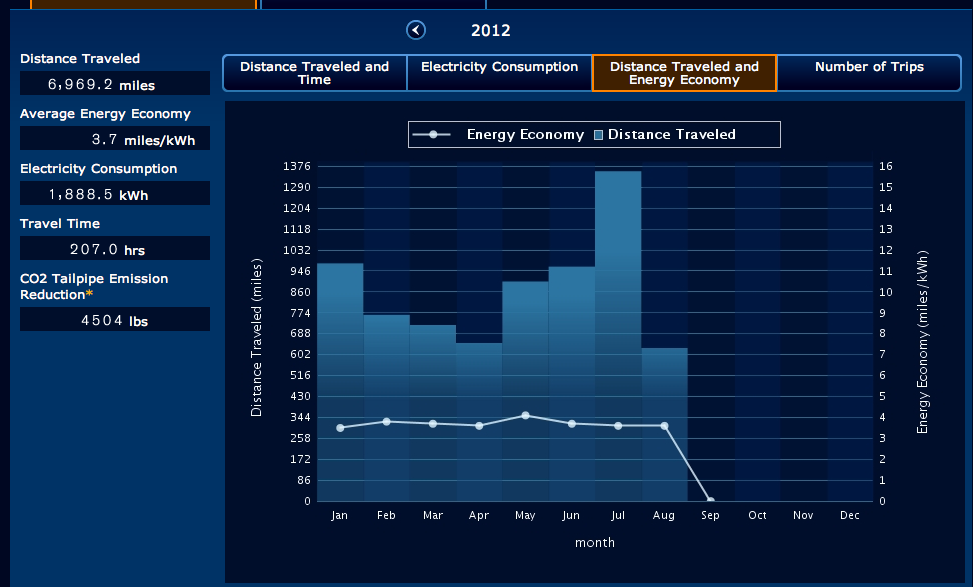
We did around 11,000 miles in the Nissan Leaf in the last year, but estimate that about a third of our charging was at work, as Laurel's commute is far enough to be an easy one way run, but requires a charge to get home again up the hill (we live at 2400ft, and she works at sea level!). She can take the car pool lane with the "white sticker" that pure electric cars get, which saves a lot of time, but running at high speed on the freeway uses a lot more power than around town. When I get to use the Leaf my commute is much closer and I don't bother charging it at work. Our long term average consumption is 3.7 miles/KWh, which is worse than most Leaf owners because of the freeway miles, hill climbing and "having fun". We don't pay for charging at work, and the marginal cost of electricity at home is zero because we are generating a negative net bill for the year, so we only use the "ECO" driving style if we are pushing the limits of its range on an unusual trip. The Leaf is the first car we pick for drives in its range, it's entertaining to drive as well as having extremely low running costs. All it needs for maintenance is tires, there is no engine oil to change, and the brakes wear very slowly due to electric regeneration. Here's the year so far as recorded by the Leaf's "Carwings" system.


The PG&E tariff we are on is called E6 Net Energy Metering, it has three rates for the summer, and two rates in the winter. The rules and rates are described in these documents at the PG&E web site: Rules http://www.pge.com/tariffs/tm2/pdf/ELEC_SCHEDS_NEM.pdf and Rates http://www.pge.com/tariffs/tm2/pdf/ELEC_SCHEDS_E-6.pdf
The rate that PG&E will pay us for any extra KWh we generate is about 3 cents/KWh as described in this document http://www.pge.com/includes/docs/pdfs/shared/solar/AB920_RateTable.pdf
Our base overnight rate that we pay is around 10 cents/KWh, the afternoon rate is around 28 cents/KWh, this is why we can generate hundreds of dollars in a negative bill while using hundreds of KWh.

Our solar setup is in two arrays that I described on my blog before, the total summer peak output is about 10KW, and we get up to 70KWh per day. In the winter this drops to about 40KWh per day, and clouds and rainy days greatly reduce the output. We're in a sunny spot on top of the mountains, and the monthly output from the 6.5KW array is shown in the plots below since we turned it on in April 2011. The other array adds about half this amount. Our annual true-up period runs from the beginning of September to the end of August.


PG&E send us a bill every month for about $11 of connection fees and taxes, and the current running total. Our final bill for the last year is shown below. Solar costs were described in a previous post.


Thursday, September 22, 2011

The economics of Nissan Leaf ownership

[Updated December 2012] We got our @NissanLeaf at the end of June 2011, and are very happy with it. It's fun to drive and is our first choice for any journey within range. Since the car is nearly silent and has over 200 lb-ft of torque, I often use full power for acceleration away from the lights, which quietly leaves the other cars behind. The low noise level is also great for listening to speech or music, and the steering wheel controls and bluetooth integration with my iPhone works well for phone calls and iPod or Pandora.

Laurel usually takes it for her 66 mile round trip commute, and if not, I take it on my 20 miles round trip commute, and any shopping trips at the weekend. So far we have averaged about 1000 miles per month, mostly mountain roads and freeways, which is the worst case for electrical consumption. The Leaf collects its milage and power use, and we can go back to look at the activity.

The record shows 1003 miles at 3.8 miles/KWh and a total of 264.6 KWh. We pay 10c/KWh, so if we had charged at home that's $26.46. Since we charge at work for free it's more like $15. We have grid-tied solar power and time of use metering for a cheap overnight rate. The meter runs backwards during the day at a higher price, and the Leaf has a charging delay timer so that we can plug it in when we get home, then it starts charging when the cheapest rate starts at 9pm.

1003 miles in the cars we would normally drive, which get about 20mpg, uses 50 gallons of premium gas at about $4.10 and about $206. So we actually saved $180 in August 2011.

If Laurel drives every day, 22 work days a month at 66 miles is 1452 miles, she tops up the charge at work each day and gets about 4 miles/KWh on that route so that's under a dollar a day. Our gas cost would be $298, so she could be saving about $280/month. That takes a big chunk out of the cost of buying the car in the first place. On top of that, the servicing costs are minimal, no engine oil changes, no gearbox, and the brakes last longer because the regenerative braking system takes a lot of the load. We have had to buy a new tire after popping it on a pothole, that was about $150, installed, but could happen to any car. We could have saved on gas costs by buying a hybrid, but they are less fun to drive and you are still paying to maintain a gas engine and a very complex transmission.

The icing on the cake is our white (for pure electric) car pool lane stickers, so Laurel can take the freeway in rush hour and zip silently past all the Prius drivers whose yellow (for hybrid) stickers no longer get them in the car pool lane. It took a total of ten weeks to get the license plates, then apply and get the white stickers.

So the value proposition for the Leaf is that it is much more fun to drive than a high mpg economy car like a Prius, gets you in the car pool lane (if you live in California), and the purchase cost is offset by ultra-low running costs if you use it regularly.

We aren't alone in figuring out that this is a good deal. At last count (end of 2012) there are more than ten Nissan Leaf owners at Netflix, along with several Volts (the latest version gets a green carpool lane sticker) and several Teslas. At Informatica, Laurel is among several Leafs and Volts sharing the chargers.

We leased our car on a three year 36,000 mile plan. We included the home charger installation in the payment (about $2K), put down a $2K initial payment, got a $7500 federal rebate bundled into the deal. Actual payment including taxes as one of the first Leaf owners was over $500/month, the current deals are much lower than this and Nissan is about to release the cost reduced US built Leaf in January 2013. We got a $2500 state rebate paid directly to us after signing up for it which covers the initial payment. We leased because we think that in three years time there may be big advances in electric car technology, we could decide to keep the Leaf, or give it back and get a the pick of the 2014 models.

For much more discussion about the car, the My Nissan Leaf forum is quite active. One thing I found there is that upgraded springs and dampers are available, since we do a lot of mountain driving, we upgraded the suspension to be stiffer and better damped than stock.

The first question everyone asks is how far will the Leaf go, and the answer is between 60 and 100 miles per charge, but it depends on where you live and how hard you drive. The usable capacity of the battery pack is about 21KWh, the actual spec is 24KWh, so there is a little bit of extra capacity beyond it's "I'm empty" point. if you drive a lot of freeways at speed and climb mountains like we do, 3-4 miles/KWh gets you 60-80 miles. In a flat urban environment 4-5 miles/KWh is quite possible to get 80-100 miles.

Since we live at the top of a mountain (2400ft) and work near sea level, it's a good idea to charge the car to 80% full at home, and 100% full at work. This way there is regenerative braking for the initial downhill run, which is free power and also saves the brake pads.

Our "carwings" summary page for August 2011 is shown below.