This is a very nice embeddable player from iJigg, below is Continuum from my friends in Fractal, and also Smuggled Mutation by Estradasphere, which is from Palace of Mirrors, one of my most-played CDs in recent history. Its so varied and well played its impossible to get bored by it.
Wednesday, February 07, 2007


Fractal on iJigg
Another music website, where users tag and vote for songs they like - kind of Digg for music. Worth a try, so I created an account and uploaded Fractal's title track from their first CD - Continuum.
What do you think?
Adrian
What do you think?
Adrian
New Joost Beta
They just released a new build, it fixes some problems and has some minor user interface enhancements. I left it running for a while and now I'm starting to run out of content that I want to watch... There are about 30 channels for beta testing. probably the most demanding are live music videos, Joost has fine sound quality and keeps up with very rapid on-screen action better than I would expect in full-screen mode on my Dell laptop. It becomes a bit more pixellated when its working hard to keep up, and the sound glitches to repeat a sub-second fragment now and again if it gets behind due to network slowdowns. On low action images, its very nice and clear.
In comparison, I've noticed that on my Slingbox TiVo, it does constant pitch sound stretching to slow down the display at the start of a show, thats how it sneakily builds up a buffer without making you wait.
The Joost folks are promising new content, an OSX version and an expansion of the beta program soon. I've had a few comments requesting beta invites, and I haven't had any to give. If and when I have any spare invites, I'll post it, so hold your comments...
In comparison, I've noticed that on my Slingbox TiVo, it does constant pitch sound stretching to slow down the display at the start of a show, thats how it sneakily builds up a buffer without making you wait.
The Joost folks are promising new content, an OSX version and an expansion of the beta program soon. I've had a few comments requesting beta invites, and I haven't had any to give. If and when I have any spare invites, I'll post it, so hold your comments...
Saturday, February 03, 2007
You can help search for Jim Gray
I met Jim last year when he gave a talk at eBay. His sailboat went missing, and a lot of people have collaborated to allow up to date satellite images to be posted on the web for anyone to take a look at and see if they can see anything that might be his boat.
My (ex-Sun DE) friend Geoff Arnold now works at Amazon, he blogged that they have configured a web service called Mechanical Turk to support parcelling out the work of looking at images. If you already have an Amazon.com account, then sign up for the service takes a couple of clicks.
I hunted through images for a while, and found a cargo ship, that's all :-(
Geoff's blog
Werner's blog
Search for Jim
Please take a look yourself and pass the Mechanical Turk search for Jim URL on...
My (ex-Sun DE) friend Geoff Arnold now works at Amazon, he blogged that they have configured a web service called Mechanical Turk to support parcelling out the work of looking at images. If you already have an Amazon.com account, then sign up for the service takes a couple of clicks.
I hunted through images for a while, and found a cargo ship, that's all :-(
Geoff's blog
Werner's blog
Search for Jim
Please take a look yourself and pass the Mechanical Turk search for Jim URL on...
Friday, February 02, 2007
Who needs a custom built Myphone?
The mainstream phone manufacturers are looking for hits in the mass market, and looking for large niches to broaden their market. However if you take a "long tail" viewpoint, everyone wants a slightly different phone, and many people have phones that are the least bad one they could find.
How about phones for people with poor eyesight? If you are over 50, can you read the small print on your phone's screen without reading glasses? I have a friend who has a medical condition that causes very poor eyesight, and sets her 17" laptop screen resolution very low so she can read it. She would like a phone that has just the applications she needs, big easy to find icons for them, and big fonts on a large screen for the address list and other applications. Hard to find in the shops, but easy to custom build.
How about phones for people with poor eyesight? If you are over 50, can you read the small print on your phone's screen without reading glasses? I have a friend who has a medical condition that causes very poor eyesight, and sets her 17" laptop screen resolution very low so she can read it. She would like a phone that has just the applications she needs, big easy to find icons for them, and big fonts on a large screen for the address list and other applications. Hard to find in the shops, but easy to custom build.
Thursday, February 01, 2007
Making a case for Myphone

I mean that in both senses of the phrase "making a case". I have produced a lump of plastic, and I have good reasons why I want to build my phone.
Here are the first parts I made, two copies of an LCD bezel with a rounded outside surface and a cutout to locate the LCD. The standing part is as it was made in the 3D printer, sideways on to get a smoother finish, and with additional "support material" that holds everything in place while the "model material" sets. The part lying flat is the same, but is face down and has the support material removed. The size is about 5" by 3" and the bezel is 0.1" thick. It took about 7 hours to print the pair of bezels, each contains 0.6 cubic inches of model material and the total including support material was about 1 cubic inch. The bezels cost $10 each to make at Techshop in Menlo Park ($100/month for membership, $10/cu inch to use the 3D printer).
This experiment went quite well, and the next step was to extend the design to form a complete top and bottom case that fit together. This was kicked off using black rather than white plastic, and lying flat, face down. This prints more quickly, but uses more support material to create the base. The base will give the phone a textured surface, which can be made shiny by dipping in acetone, and I'm hoping it will look cool, like a carbon fibre finish. Pictures of the design, cad files, and a photo of the 3D printer in action can be found at the SVHMPC Wiki, I'm updating them as work progresses. The case walls are thicker than they need to be, so the final design will use less plastic and cost less than the $40 I was charged to make this complete case.
The purpose of this build is to figure out where to put the contents, so I can mold support brackets into the design and make an attempt at a working prototype.
Why am I doing this? Some of us are attending the Emerging Telephony conference in March, and I want to have something to show. Also its fun to make things, fun to hang out at Techshop, I'm learning a lot from the 3D printer instructor, and in the end I will have a phone that evolves rather than being thrown away every few years. If I want more memory, a bigger LCD, or different trade offs in features/size/battery life, I don't have to start from scratch or accept someone else's set of compromises. That's why I call it my phone.
Friday, January 26, 2007
myPhone will be a TuxPhone
There is lots of interest and activity in the Silicon Valley Homebrew Mobile Phone Club right now centered around building a phone with a large touch screen. I'm calling it "myPhone", and TuxPhone is the generic name for the open software and hardware components we are using. The hardware design is based on components that are openly available with freely available spec sheets, we will make our schematics, design details and cad files freely available, and its quite likely that no two phones will be built the same way. If you want it thinner and lighter, go for fewer features, a smaller battery and tweak the cad file before making the case.
The size is driven primarily by the screen, and we've settled on the screen that is used by the Sony PSP, with a touchscreen overlay added. Its a 4.3" diagonal, and is widely available, low cost. We will include a standard GSM/EDGE module, so I can just pop the SIM card from my Treo into it, and we can add GPS, WiFi, Bluetooth, Accelerometer, SDcards or hard disks, whatever custom mix we feel like. The CPU and other parts will be based on Gumstix modules.
The size is driven primarily by the screen, and we've settled on the screen that is used by the Sony PSP, with a touchscreen overlay added. Its a 4.3" diagonal, and is widely available, low cost. We will include a standard GSM/EDGE module, so I can just pop the SIM card from my Treo into it, and we can add GPS, WiFi, Bluetooth, Accelerometer, SDcards or hard disks, whatever custom mix we feel like. The CPU and other parts will be based on Gumstix modules.
Friday, January 19, 2007
More on Open Phones
Thanks to a comment on my previous open phone post, I am reminded that I forgot to mention OpenMoko. This is a neat looking touch screen Linux phone that should be available in February 2007. I haven't seen one yet, although I have played with the Greenphone and I know someone who has ordered and received a Greenphone, so they are ahead by a couple of months.
In the homebrew mobile club, we are talking about making something with a physically bigger (perhaps 3.7" VGA) touch screen than the OpenMoko (2.8" VGA) or Greenphone (smaller QVGA), big enough to show a more usable keyboard. The existence of multiple open phone projects is great, since the nature of the open source community is that we can all share and reuse code for device drivers, user interface components and applications. We aren't building from scratch every time we want a new feature. In the meantime several of us will have Greenphone's, OpenMoko's and TuxPhone's to play with.
The big screen is pretty much the most expensive part. I like the concept of building a phone, keeping the screen and CPU for a long time, but do upgrades like replacing the GSM modem with a 3G one by performing electronic surgery inside the case.
In the homebrew mobile club, we are talking about making something with a physically bigger (perhaps 3.7" VGA) touch screen than the OpenMoko (2.8" VGA) or Greenphone (smaller QVGA), big enough to show a more usable keyboard. The existence of multiple open phone projects is great, since the nature of the open source community is that we can all share and reuse code for device drivers, user interface components and applications. We aren't building from scratch every time we want a new feature. In the meantime several of us will have Greenphone's, OpenMoko's and TuxPhone's to play with.
The big screen is pretty much the most expensive part. I like the concept of building a phone, keeping the screen and CPU for a long time, but do upgrades like replacing the GSM modem with a 3G one by performing electronic surgery inside the case.
Thursday, January 18, 2007
Joost and The Venice Project Beta Testing
I signed up for TVP's beta program a month or two ago, and got accepted recently, so I've been playing with it. A few days ago they launched under the name Joost, which I find amusing since I have a very good Dutch friend called Joost (pronounced yoast) and I'm not sure if I'm supposed to say it as yoast or juiced....
I've had a TiVo for years now, and Joost has a very nice user interface that works for me like a TiVo that I can run anywhere, and which has tens of terabytes of stored programs, not just the 30GB or whatever that I have inside my TiVo. The other thing that is better than TiVo is the finding experience. I was able to type "Lotus" into a search box, and find two episodes from "5th Gear" where they were track testing my favorite car. The content is largely European TV at present, and they have enough programs to keep beta testers happy for a while, but are going to need a lot more as the program launches.
The display quality is good, and there is a short delay when a program is first selected, especially if its one of the more obscure programs. The networking is something like a securely encrypted in-order bittorrent. You don't have to wait for the whole program to load before you start watching it.
I posted last year on disruptive innovation as it applies to the moving pictures industry, discussing the concept of a maturity model for innovation, evolution from the cinema to thepiratebay, and a more abstract maturity model. In the final part I made this statement:
Based on my own maturity model, Joost is nicely setup to be the end game for this market. That doesn't mean that we stop going to the cinema or watching YouTube, just that Joost could end up being "bittorrent for the masses", and be an order of magnitude bigger than everything else.
I've had a TiVo for years now, and Joost has a very nice user interface that works for me like a TiVo that I can run anywhere, and which has tens of terabytes of stored programs, not just the 30GB or whatever that I have inside my TiVo. The other thing that is better than TiVo is the finding experience. I was able to type "Lotus" into a search box, and find two episodes from "5th Gear" where they were track testing my favorite car. The content is largely European TV at present, and they have enough programs to keep beta testers happy for a while, but are going to need a lot more as the program launches.
The display quality is good, and there is a short delay when a program is first selected, especially if its one of the more obscure programs. The networking is something like a securely encrypted in-order bittorrent. You don't have to wait for the whole program to load before you start watching it.
I posted last year on disruptive innovation as it applies to the moving pictures industry, discussing the concept of a maturity model for innovation, evolution from the cinema to thepiratebay, and a more abstract maturity model. In the final part I made this statement:
The final phase in the evolution of a market occurs as the cost of replication and distribution of the product approaches zero. There is no end user cost to use the Internet to download a movie. A central utility such as YouTube can use a mixture of advertising and premium services (for a minority of power users) to offset their own costs. Peer to peer systems distribute the load so that there is no central site and no incremental cost in the system. The only service that is needed is some kind of search, so that peers can find each other's content to exchange it.I was talking about how bittorrent based video is inevitably going to dominate over centralized services like YouTube, and there have been reports that most of the traffic on the internet is bittorrent. The inconvenience of bittorrent is that it is basically an overnight batch job to get a program. Joost fixes the problems of bittorrent, while staying as close as possible to free distribution. Joost inserts a small number of short adverts that the Joost client figures out how to target to your interests. These are intended to be enough to pay for the central seeding servers, and to pay the content owners so good programs become available, without becoming intrusive enough to switch off the users.
Based on my own maturity model, Joost is nicely setup to be the end game for this market. That doesn't mean that we stop going to the cinema or watching YouTube, just that Joost could end up being "bittorrent for the masses", and be an order of magnitude bigger than everything else.
Tuesday, January 16, 2007
Template Update
I just realised that my blog wasn't displaying properly in Internet Explorer. I couldn't figure out why, so I upgraded to a fresh new Blogger.com template that has a lot more configurability, and dropped the ads etc back into it. The formatting is still a bit off, and it looks better in Flock/FireFox but at least the basic blocks are all in the right place now.
The archive of old posts is also easier to navigate with the new template.
The archive of old posts is also easier to navigate with the new template.
Build your own phone, any way you want it!
As an antidote to all the grumbling about the lack of an open developers approach to the Apple iPhone I'm going to talk about some projects that are building open phone platforms.
I'm a member of the Silicon Valley Homebrew Mobile Phone Club, and there are several projects in existence to create a free, open source, software stack and applications for mobile phones. The hardware parts are available off the shelf, so you can buy a complete open phone or use whatever parts you like. All you need is an enclosure, and you are on your way to whatever spec you wanted, with whatever applications you wanted.
Actually, if someone out there knows Autocad and wants to help design some enclosures, the assistance would be appreciated. The SVHMPC often meets at Techshop, where they have a 3D printer that can make anything that can be described by a CAD file in ABS plastic.
The phones use off the shelf GSM modems, that take a SIM card and deal with the network. They operate like any unlocked phone would work, and the GSM modem module prevents anything bad from happening to the network. The command set looks a lot like the old hayes modem AT codes, and Linux device drivers exist to manage some of the common ones. Some of the GSM modems include GPS location services as well, most of them are based on the relatively slow GPRS/EDGE standards for Internet connections.
My own ideal phone starts with a 3.7" VGA resolution touch screen and includes WiFi, bluetooth GPS and a 3G network, but I may have to put up with GPRS for now. The CPU is based on 400MHz ARM chips from Gumstix, and the parts list from the OpenCell project gives you some idea of what's available.
Its going to cost more than an iPhone, won't be as thin, and as cute, but I will be able to make it do whatever I want, and it will be runing as much of the standard Linux 2.6 distribution as I feel like.
I built my first three home computers up from bare PCBs, I still have my soldering iron, and I'm not afraid to use it :-)
I'm a member of the Silicon Valley Homebrew Mobile Phone Club, and there are several projects in existence to create a free, open source, software stack and applications for mobile phones. The hardware parts are available off the shelf, so you can buy a complete open phone or use whatever parts you like. All you need is an enclosure, and you are on your way to whatever spec you wanted, with whatever applications you wanted.
Actually, if someone out there knows Autocad and wants to help design some enclosures, the assistance would be appreciated. The SVHMPC often meets at Techshop, where they have a 3D printer that can make anything that can be described by a CAD file in ABS plastic.
The phones use off the shelf GSM modems, that take a SIM card and deal with the network. They operate like any unlocked phone would work, and the GSM modem module prevents anything bad from happening to the network. The command set looks a lot like the old hayes modem AT codes, and Linux device drivers exist to manage some of the common ones. Some of the GSM modems include GPS location services as well, most of them are based on the relatively slow GPRS/EDGE standards for Internet connections.
My own ideal phone starts with a 3.7" VGA resolution touch screen and includes WiFi, bluetooth GPS and a 3G network, but I may have to put up with GPRS for now. The CPU is based on 400MHz ARM chips from Gumstix, and the parts list from the OpenCell project gives you some idea of what's available.
Its going to cost more than an iPhone, won't be as thin, and as cute, but I will be able to make it do whatever I want, and it will be runing as much of the standard Linux 2.6 distribution as I feel like.
I built my first three home computers up from bare PCBs, I still have my soldering iron, and I'm not afraid to use it :-)
Monday, January 15, 2007
What the iPhone doesn't do (yet) and thoughts on why not.
There has been a lot of commentary, complaints and opinions on the iPhone. I haven't seen much discussion of its features and strategy from the perspective of the realities of product development. In my opinion, what Apple have done is the right set of strategic and tactical moves for the first product in a new family. What was announced and shown is not the final feature set for the initial device and it does not include the full vision of the product.
Lets look at the timing of the announcement. As a new entrant in the mobile phone marketplace, the correct strategy is to pre-announce. There is no existing product from Apple to cannibalize, and there is only partial overlap with the iPod market. The announcement was made after the holiday shopping season, and the timing is setup to get a volume ramp in place for the 2007 holiday shopping season. The initial launch is based on the minimum marketable features (MMF) required to address the Apple oriented consumer marketplace. Rather than wait until the full feature set is ready or create low quality solutions for a wide feature set, the Apple strategy is to develop a small number of features to an extremely high level of quality and integration, and focus on the needs of their core market of existing OSX and iPod users.
Lets look at disclosure related issues. For a phone to be released as a product it has to go through FCC testing that takes a month or two, and the FCC process is relatively open. All the new phones are scooped by Engadget Mobile before they turn up in stores. For the big splash product announcement, it needed to be scheduled before Apple turns over an iPhone to the FCC test process. In order to keep details on the product quiet for as long as possible, it is also much easier to do the initial launch before completing negotiations with key third party application developers like Adobe and Microsoft. I've heard that there is no Adobe Flash support in the device at present, and there is a clear need to support Microsoft Office at some point in the future. These omissions are easily fixed, its just a matter of time.
New models in the iPod range are announced when they are basically in stock in the stores. If you take the iPhone package, and remove the phone parts, keeping the iTunes music and video functionality, and WiFi/web connectivity, you are left with a very nice looking wide-screen networked iPod. Its main issue would be the relatively small capacity flash, so that could be increased, or a hard disk could possibly be crammed into the package. I would not expect anything like this to be announced until it is completely ready and in-stock, but if it exists, it could end up being released this summer around the same time as the iPhone actually ships. Since it isn't a phone, its outside the Cingular agreement, but adding a WiFi only VOIP client like iChat or Skype would create a product that competes with the Sony Mylo.
During the demo's no-one tried to show the iPhone's camera, this indicates to me that it isn't finished, and I hear elsewhere that they are still working on video capture. For use as a video-phone, the camera is on the wrong side, you can't see the display while you are on-camera. This makes it seem less likely that a full iChat function will be included in the initial package.
Apple is getting a lot of criticism for its locked down and controlled approach to third party software on the iPhone, and lack of a developers program. Developer support falls outside the minimum marketable features required for initial launch into the consumer marketplace. By taking full control of the product, Apple can make sure that very high quality standards are in place, and that applications integrate with the iPhone experience. The reality of product development also makes it hard to build a stable developer API until the product is finished, so I fully expect a phased developer program. The initial phase included applications like Google Maps and Cingular Visual Voicemail from development partners (and I expect some kind of GPS location service to appear in the product soon - perhaps even in the initial release). The second phase will be a closed private developer program including big partners like Microsoft and Adobe. The third phase will start to open up to the Apple developer community, with stable public APIs and developer tools. Extensibility is a MMF for the professional/consumer (prosumer) and enterprise marketplaces, along with Microsoft Office support. This may take a year or so to arrive, its inevitable, but I can see why its not a feature of the initial product launch.
There has also been a lot of grumbling about Cingular and the lack of 3G service. Apple have dropped hints that they will support 3G sooner rather than later. My guess is that 3G is considered an MMF for the European and Asian markets, so I wouldn't be surprised if the models launched in those markets in late 2007 and 2008 included 3G support, and as Cingular's own 3G network continues to roll out over the USA the timing would make sense here as well. The real alternative to Cingular for Apple would be to setup their own Mobile Virtual Network Operator (MVNO) like Helio or Virgin Mobile. This is a big complicated thing to do without any experience, so my guess is that they decided that the highest priority was to get the product launched with a big network partner like Cingular, and to decide later on whether it is worth creating an MVNO for a less compromised product. So when the exclusivity arrangement with Cingular expires, they may well focus on their own MVNO services.
So thats my opinion, as someone who has developed products and strategies in the past and understands the compromises, but with no inside information on their actual plans. My own plan is to avoid the initial release, and see what the product looks like for the Xmas 2007 shopping season.
Lets look at the timing of the announcement. As a new entrant in the mobile phone marketplace, the correct strategy is to pre-announce. There is no existing product from Apple to cannibalize, and there is only partial overlap with the iPod market. The announcement was made after the holiday shopping season, and the timing is setup to get a volume ramp in place for the 2007 holiday shopping season. The initial launch is based on the minimum marketable features (MMF) required to address the Apple oriented consumer marketplace. Rather than wait until the full feature set is ready or create low quality solutions for a wide feature set, the Apple strategy is to develop a small number of features to an extremely high level of quality and integration, and focus on the needs of their core market of existing OSX and iPod users.
Lets look at disclosure related issues. For a phone to be released as a product it has to go through FCC testing that takes a month or two, and the FCC process is relatively open. All the new phones are scooped by Engadget Mobile before they turn up in stores. For the big splash product announcement, it needed to be scheduled before Apple turns over an iPhone to the FCC test process. In order to keep details on the product quiet for as long as possible, it is also much easier to do the initial launch before completing negotiations with key third party application developers like Adobe and Microsoft. I've heard that there is no Adobe Flash support in the device at present, and there is a clear need to support Microsoft Office at some point in the future. These omissions are easily fixed, its just a matter of time.
New models in the iPod range are announced when they are basically in stock in the stores. If you take the iPhone package, and remove the phone parts, keeping the iTunes music and video functionality, and WiFi/web connectivity, you are left with a very nice looking wide-screen networked iPod. Its main issue would be the relatively small capacity flash, so that could be increased, or a hard disk could possibly be crammed into the package. I would not expect anything like this to be announced until it is completely ready and in-stock, but if it exists, it could end up being released this summer around the same time as the iPhone actually ships. Since it isn't a phone, its outside the Cingular agreement, but adding a WiFi only VOIP client like iChat or Skype would create a product that competes with the Sony Mylo.
During the demo's no-one tried to show the iPhone's camera, this indicates to me that it isn't finished, and I hear elsewhere that they are still working on video capture. For use as a video-phone, the camera is on the wrong side, you can't see the display while you are on-camera. This makes it seem less likely that a full iChat function will be included in the initial package.
Apple is getting a lot of criticism for its locked down and controlled approach to third party software on the iPhone, and lack of a developers program. Developer support falls outside the minimum marketable features required for initial launch into the consumer marketplace. By taking full control of the product, Apple can make sure that very high quality standards are in place, and that applications integrate with the iPhone experience. The reality of product development also makes it hard to build a stable developer API until the product is finished, so I fully expect a phased developer program. The initial phase included applications like Google Maps and Cingular Visual Voicemail from development partners (and I expect some kind of GPS location service to appear in the product soon - perhaps even in the initial release). The second phase will be a closed private developer program including big partners like Microsoft and Adobe. The third phase will start to open up to the Apple developer community, with stable public APIs and developer tools. Extensibility is a MMF for the professional/consumer (prosumer) and enterprise marketplaces, along with Microsoft Office support. This may take a year or so to arrive, its inevitable, but I can see why its not a feature of the initial product launch.
There has also been a lot of grumbling about Cingular and the lack of 3G service. Apple have dropped hints that they will support 3G sooner rather than later. My guess is that 3G is considered an MMF for the European and Asian markets, so I wouldn't be surprised if the models launched in those markets in late 2007 and 2008 included 3G support, and as Cingular's own 3G network continues to roll out over the USA the timing would make sense here as well. The real alternative to Cingular for Apple would be to setup their own Mobile Virtual Network Operator (MVNO) like Helio or Virgin Mobile. This is a big complicated thing to do without any experience, so my guess is that they decided that the highest priority was to get the product launched with a big network partner like Cingular, and to decide later on whether it is worth creating an MVNO for a less compromised product. So when the exclusivity arrangement with Cingular expires, they may well focus on their own MVNO services.
So thats my opinion, as someone who has developed products and strategies in the past and understands the compromises, but with no inside information on their actual plans. My own plan is to avoid the initial release, and see what the product looks like for the Xmas 2007 shopping season.
iPhone and Treo at MacWorld
 I went to MacWorld to check out the Apple iPhone. I think that it is even more impressive in person than I was expecting. Its smaller and much thinner than I imagined from looking at pictures, and watching the live on-stage demos made it clear just how much of a step forward in usability this is for a mobile device.
I took the picture above using my Treo650 of someone else taking a picture with a Treo650, so the size can easily be compared. I was embarrased to get the Treo out anywhere near the iPhone, it just felt wrong. The overall width and length of the device is similar, but the Treo is about twice as thick. I tried to take a picture edge-ways to show how thin the iPhone is, but the Treo camera is a crappy low resolution one and the iPhone is so thin it effectively disappeared in the photo.
Tuesday, January 09, 2007
Apple iPhone Unanswered Questions...
Like everyone else, I think it looks great. The big difference between Apple and other vendors for just about everything they make is craftsmanship, everything else looks sloppy in design and execution in comparison.
So the questions, they really are around whether this is really a pocket OSX machine or a locked down phone that happens to use some parts of OSX.
Anyway, next year's Xmas present request list will have one of these on it!
[Update...]
As an existing Treo650 user, the discussion on the iPhone at TreoCentral is very interesting. They imply that the CPU is an ARM architecture with an additional graphics processor, and that the iPhone is closed and controlled so you can't add applications to it. We'll see how long that lasts, either Apple will open it up or the hackers will have a lot of fun working out how to crack the design, just like they did for the games consoles, TiVo etc.
So the questions, they really are around whether this is really a pocket OSX machine or a locked down phone that happens to use some parts of OSX.
- What CPU does it use? Can it run unmodified OSX applications, or do they have to be downsized and ported to a new CPU (Xscale/ARM is what Treo's use)
- How much memory is there for running applications? The 8GB Flash is basically filesystem space, so there must be some RAM as well.
- Is it open for more applications to be loaded? For example Firefox, Skype, Slingplayer, OSX Terminal, whatever..... or is it locked down?
- What is the model for developers to extend the platform?
Anyway, next year's Xmas present request list will have one of these on it!
[Update...]
As an existing Treo650 user, the discussion on the iPhone at TreoCentral is very interesting. They imply that the CPU is an ARM architecture with an additional graphics processor, and that the iPhone is closed and controlled so you can't add applications to it. We'll see how long that lasts, either Apple will open it up or the hackers will have a lot of fun working out how to crack the design, just like they did for the games consoles, TiVo etc.
Sunday, January 07, 2007
Going Solar? Get a weather station...
There's nothing line a 36 hour power outage (a tree fell and took the power lines with it) to make you think about where your energy comes from. We could get a generator, but it would only be used for a few days a year. If we get Solar power, it pays for itself over time and we would get daytime power at least....
We have a very sunny high altitude microclimate, on top of the Santa Cruz mountains with a south facing roof. It seems ideal, but the economics are quite dependent on how much Sun we actually get. We called up some local solar power companies to get an idea of what would be involved, but in the short term we decided that it would be good to measure our local weather.
I've been using the Weather Underground web site for a while, to track actual local conditions such as wind speed at a station a few miles away. This site contains all you need to know about setting up your own station, and there is plenty of low cost hardware and software to do it.
I think the amount of technology available for the price is amazing. I picked the Oregon Scientific WMR100 wireless weather station. It comes with a full set of sensors for temperature, humidity, barometric pressure, rainfall, wind speed and direction, that connect to the base station via wireless. It has a USB connection for uploading to a PC. List price is over $200, but I bought it on eBay for $129.99+18 shipping, which was the best overall deal at the time.
I plan to add the optional UV sensor to get an indication of Sunlight (the UV sensor for this model is not yet available, I got an answer that it should be out in a couple of months), and monitor two temperature sensors, one in the shade, and one in full sunlight. I should be able to figure out which days are clear and sunny, and for how long.
[Update]
It arrived, I corrected a few details about the product features above, and I've assembled it and got the sensors to connect over the wireless, ready to install outside. Its nicely made, everything seems to work fine.
We have a very sunny high altitude microclimate, on top of the Santa Cruz mountains with a south facing roof. It seems ideal, but the economics are quite dependent on how much Sun we actually get. We called up some local solar power companies to get an idea of what would be involved, but in the short term we decided that it would be good to measure our local weather.
I've been using the Weather Underground web site for a while, to track actual local conditions such as wind speed at a station a few miles away. This site contains all you need to know about setting up your own station, and there is plenty of low cost hardware and software to do it.
I think the amount of technology available for the price is amazing. I picked the Oregon Scientific WMR100 wireless weather station. It comes with a full set of sensors for temperature, humidity, barometric pressure, rainfall, wind speed and direction, that connect to the base station via wireless. It has a USB connection for uploading to a PC. List price is over $200, but I bought it on eBay for $129.99+18 shipping, which was the best overall deal at the time.
I plan to add the optional UV sensor to get an indication of Sunlight (the UV sensor for this model is not yet available, I got an answer that it should be out in a couple of months), and monitor two temperature sensors, one in the shade, and one in full sunlight. I should be able to figure out which days are clear and sunny, and for how long.
[Update]
It arrived, I corrected a few details about the product features above, and I've assembled it and got the sensors to connect over the wireless, ready to install outside. Its nicely made, everything seems to work fine.
Slingbox-ing my TiVo
As I mentioned before, we got a Slingbox AV this Xmas, and I'm quite impressed. It was easy to setup, has been no trouble since, and now we can watch and control our TiVo from anywhere. The main use we have is to watch programs we have saved on our TiVo from anywhere in the house, and it runs a full TV resolution feed that uses a few Mbit/s to support this on our WiFi based laptop's. When running on a work PC laptop (Dell Inspiron with XP) the performance was very smooth, however on my three year old Apple Powerbook G4 I'm down on CPU power and running a beta-version of the Sling player that seems to need some more tuning. If I kill just about everything else on the Mac, it plays fairly well, but the picture keeps stalling if anything else is running.
I'm hoping that they will do some more tuning to fix this in the final release for the Mac...
I'm hoping that they will do some more tuning to fix this in the final release for the Mac...
Wednesday, December 27, 2006
Skype 3.0.0.190 is now in general release for Windows, amongst all the changes mentioned in the Skype Garage post is this little gem:
This adresses an interesting issue. Unlike most network addressing schemes, skype connects to a username, and there is nothing to stop a user running skype on many machines as the same user. When app2app messaging connects to a user, you get an array of streams that connect you to all the endpoints for that user.
However, in the past you could not make a connection to yourself, and now you can. So if you connect to your own username you will get back an array of streams to your other instances. This could become quite useful for keeping all kinds of things synchronized across multiple machines.
change: API: application can connect to oneself
This adresses an interesting issue. Unlike most network addressing schemes, skype connects to a username, and there is nothing to stop a user running skype on many machines as the same user. When app2app messaging connects to a user, you get an array of streams that connect you to all the endpoints for that user.
However, in the past you could not make a connection to yourself, and now you can. So if you connect to your own username you will get back an array of streams to your other instances. This could become quite useful for keeping all kinds of things synchronized across multiple machines.
Saturday, November 25, 2006
Processing vxstat to read into R
I got bored with my iostat data, and found some interesting looking vxstat logs to browse with the Cockcroft Headroom Plot. To get them into a regular format I wrote a short Awk script that is shown below. It skips the first record, adds a custom header and drops the time field into the first column.
It turns a file that looks like this:
into
This can easily be read into R and plotted using
One of the files I tried was quite long, half a million lines. It loaded into R in fifteen seconds, and the subsequent analysis operations didn't take too long. Try that with a spreadsheet... :-)
# process vxstat file into regular csv format
BEGIN { skipping=1; printf("time,vol,reads,writes,breads,bwrites,tread,twrite\n"); }
NR < 4 {next}   # skip header
NF > 0 && skipping==1 {next} # skip first record of totals since boot
NF == 0 {skipping=0}
NF == 5 {time=$0}
NF == 8 {printf("%s,%s,%s,%s,%s,%s,%s,%s\n",time,$2,$3,$4,$5,$6,$7,$8);}
It turns a file that looks like this:
                        OPERATIONS           BLOCKS        AVG TIME(ms)
TYP NAME              READ     WRITE      READ     WRITE   READ  WRITE

Mon May 01 19:00:01 2000
vol home             88159    346799  17990732   3680604   13.7   15.6
vol local            64308    103869   3848746    410899    6.0   22.0
vol orahome          80240    208372  18931823    886870   11.9   21.1
vol rootvol         336544    537741  21325442   8566302    4.8  323.1
vol swapvol          32857       339   4199304     58160   13.8   22.5
vol usr             396221    174834  11766646   2872832    3.5  547.6
vol var             316340   1688518  25138480  19275428   11.1   53.7

Mon May 01 19:00:31 2000
vol home                 1        28         4       129   10.0   34.3
vol local                0         2         0         8    0.0  330.0
vol orahome              4        20        24        88   10.0   84.0
vol rootvol              0        80         0       720    0.0    9.4
vol swapvol              0         0         0         0    0.0    0.0
vol usr                  0         1         0        16    0.0   20.0
vol var                  4       235        54      2498   15.0   13.7

... and so on
into
% awk -f vx.awk < vxstat.out
time,vol,reads,writes,breads,bwrites,tread,twrite
Mon May 01 19:00:31 2000,home,1,28,4,129,10.0,34.3
Mon May 01 19:00:31 2000,local,0,2,0,8,0.0,330.0
Mon May 01 19:00:31 2000,orahome,4,20,24,88,10.0,84.0
Mon May 01 19:00:31 2000,rootvol,0,80,0,720,0.0,9.4
Mon May 01 19:00:31 2000,swapvol,0,0,0,0,0.0,0.0
Mon May 01 19:00:31 2000,usr,0,1,0,16,0.0,20.0
Mon May 01 19:00:31 2000,var,4,235,54,2498,15.0,13.7
... and so on
This can easily be read into R and plotted using
> vx <- read.csv("~/vxstat.csv", header=T)
> vxhome <- vx[vx$vol=="home",]
> chp(vxhome$reads,vxhome$treads)
One of the files I tried was quite long, half a million lines. It loaded into R in fifteen seconds, and the subsequent analysis operations didn't take too long. Try that with a spreadsheet... :-)
Slingbox for Xmas
What new toys can we get this Xmas? I already have the stuff I need. I'd like a phone with Wifi and 3G network speeds and a touch screen, but my Treo 650 is OK until something better comes along. I'm curious to see what Apple may come up with next year, in the much rumoured iPhone.
I've had a Tivo since 1999, and I'd like to be able to view the programs elsewhere in the house or further afield. The Slingbox does this, lets me control the Tivo remotely and stream the programs to a Windows or OSX laptop. The Slingbox AV was $179 list price on their web site, but I had a look on shopping.com and found it for sale from an out of state vendor for $140 with free shipping and no tax. So that's going to be the new toy this Xmas....
I've had a Tivo since 1999, and I'd like to be able to view the programs elsewhere in the house or further afield. The Slingbox does this, lets me control the Tivo remotely and stream the programs to a Windows or OSX laptop. The Slingbox AV was $179 list price on their web site, but I had a look on shopping.com and found it for sale from an out of state vendor for $140 with free shipping and no tax. So that's going to be the new toy this Xmas....
Thursday, November 23, 2006
Cockcroft Headroom Plot - Part 3 - Histogram Fixes
I found that I had some scaling issues with the histograms that needed fixing. Ultimately this made the code look a lot more complex, but it now deals with scaling the plot and the histogram with a fixed zero origin on both axes. I think its important to maintain the zero origin for a throughput vs. response time plot.
The tricky part is that the main plot is automatically oversized from its data range by a few percent, and the units used in the histogram are completely different. A histogram with 6 bars is scaled to have the bars at unit intervals and is 6 wide plus the width of the bars etc. After lots of trial and error, I made the main plot use the maximum bucket size of the histogram as its max value, and artificially offset the histograms by what looks like about the right amount. The plot below uses fixed data as a test. You can see that the first bar includes two points, thats due to the particular algorithm used by R. Some alternative histogram algorithms are available, but this one seems to be most appropriate to throughput/response time data.
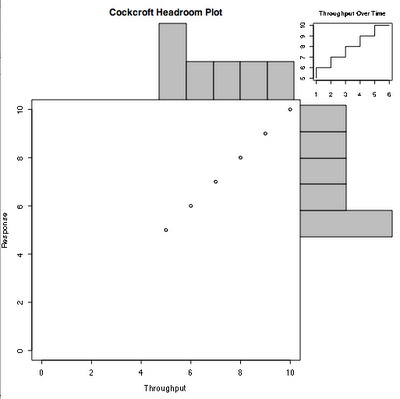
The updated code follows.
The tricky part is that the main plot is automatically oversized from its data range by a few percent, and the units used in the histogram are completely different. A histogram with 6 bars is scaled to have the bars at unit intervals and is 6 wide plus the width of the bars etc. After lots of trial and error, I made the main plot use the maximum bucket size of the histogram as its max value, and artificially offset the histograms by what looks like about the right amount. The plot below uses fixed data as a test. You can see that the first bar includes two points, thats due to the particular algorithm used by R. Some alternative histogram algorithms are available, but this one seems to be most appropriate to throughput/response time data.
> chp(5:10,5:10)

The updated code follows.
chp <- function(x,y,xl="Throughput",yl="Response",tl="Throughput Over Time",
ml="Cockcroft Headroom Plot") {
       xhist <- hist(x,plot=FALSE)
       yhist <- hist(y, plot=FALSE)
       xbf <- xhist$breaks[1]                          # first
       ybf <- yhist$breaks[1]                          # first
       xbl <- xhist$breaks[length(xhist$breaks)]       # last
       ybl <- yhist$breaks[length(yhist$breaks)]       # last
       xcl <- length(xhist$counts)                     # count length
       ycl <- length(yhist$counts)                     # count length
       xrange <- c(0,xbl)
       yrange <- c(0,ybl)
       nf <- layout(matrix(c(2,4,1,3),2,2,byrow=TRUE), c(3,1), c(1,3), TRUE)
       layout.show(nf)
       par(mar=c(5,4,0,0))
       plot(x, y, xlim=xrange, ylim=yrange, xlab=xl, ylab=yl)
       par(mar=c(0,4,3,0))
       barplot(xhist$counts, axes=FALSE,
               xlim=c(xcl*0.03-xbf/((xbl-xbf)/(xcl-0.5)),xcl*0.97),
               ylim=c(0, max(xhist$counts)), space=0, main=ml)
       par(mar=c(5,0,0,1))
       barplot(yhist$counts, axes=FALSE, xlim=c(0,max(yhist$counts)),
               ylim=c(ycl*0.03-ybf/((ybl-ybf)/(ycl-0.5)),ycl*0.97),
               space=0, horiz=TRUE)
       par(mar=c(2.5,1.7,3,1))
       plot(x, main=tl, cex.axis=0.8, cex.main=0.8, type="S")
}
Subscribe to:
Posts (Atom)