Saturday, March 12, 2011

How not to build a Private Cloud

It's all $, FUD, and internal politics. An MBO Cloud is what you get when the CEO tells the CIO to "figure out that cloud thing" (Management By Objective - i.e. the CIO bonus depends on it).

There is no technical reason for private cloud to exist.

[update: to clarify, that doesn't mean that I'm against private clouds or don't think they exist, because $, FUD and internal politics are a fact of life that constrain what can be done. Change also takes time and you have to "go to war with the army you have". However, this post is about what happens if your organization reallocates the $, isn't afraid, and has effectively no internal politics getting in the way.

This post was written in the middle of a debate on twitter between @adrianco @reillyusa @beaker and others including key insights from @swardley.

You should also read Christian Reilly's follow-up post "The Hollywood Culture" http://bit.ly/ePsisJ and many thanks to @bernardgolden for pointing out the excellent Business Week cover story on Cloud Computing http://ow.ly/4dm07 - after reading it I was amazed how well it aligned with what I write here - then I saw that it was by Ashlee Vance, one of the most clueful journalists around.

Netflix ITops Security Architect Bill Burns also wrote a very interesting post on the security challenges of cloud, we've been working together and he's on the interview team for the "Global Cloud Security Architect" I mention below.]

Too big for public cloud? You should *be* a public cloud.

Organizations who run infrastructure at the scale of tens to hundreds of thousands of instances have created cloud based models and opened them up to other organizations as public clouds. Amazon, Google, Microsoft are the clearest examples, they have expertise in software architecture, which is why they dominate the API definition. Telcos and hosting companies are adopting this model to provide additional public cloud capacity, using clones and variants of the API. Other organizations at this scale are already figuring out how to expose their capacity to their customers, partners and supply chain. The task you take on is to simultaneously hire the best people to run your cloud (competing with Amazon, Google etc.), and run it at low cost, which is why you need to be at huge scale and you need to decide that running infrastructure is a core competency of your business. Netflix is too small, doesn't regard infrastructure as core, and doesn't want to hire a bunch of ITops people.

It costs too much to port our apps? Your $ are mis-allocated.

What does it cost to build a private cloud, and how long does it take, and how many consultants and top tier ITops staff do you have to hire? Sounds like a nice empire building opportunity for the CIO. The alternative is to allocate that money to the development organization, hire more developers and rewrite your legacy apps to run on the public cloud, and give the development VP the budget to run public cloud directly. The payback is more incremental and manageable, but this is effectively a re-org of your business to move a large chunk of budget and headcount around. This is what happened at Netflix. It probably takes an act-of-CEO at most companies, the barriers are mostly political. Yes it will take time, but so will bringing up a private cloud.

Replace your apps with Saas offerings.

Many internal apps can be replaced by cloud services, we just outsourced our internal help desk and incident management software. No-one I know does payroll in-house. This is uncontroversial and is happening.

We can't put confidential data in a public cloud? This is just FUD.

The enterprise vendors are desperate to sell private clouds, so they are sowing this fear, uncertainty and doubt in their customer base to slow down adoption of public clouds. The reality is that many companies are already putting confidential data in public clouds. I asked the question "when will someone using PCI level 1 be in production on AWS" at a Cloud Connect panel, and was told that it is already being done, and Terremark pointed out that they host H&R Block's tax business. There are several models of public cloud with different SLA, cost and operational models that can support confidential data securely. There is also an argument that datacenter security is not as strong as people would like to think, and that the large cloud vendors can do a better job than most enterprises at keeping the infrastructure secure. At Netflix, we are about to transition to a global cloud based business, we are currently hiring a "Cloud Security Architect" who understands compliance rules like PCI (the credit card standard) on a global basis (we didn't need global expertise before). Part of their job is going to be to implement this.

There is no way my execs will sign off on this! Do they care about being competitive?

The biggest champion at Netflix for doing public cloud and doing it "properly" with an optimized architecture was our CEO Reed Hastings. He personally argued that we should try to do NoSQL rather than MySQL to push the envelope. Why? Because the bigger risk for Netflix was that we wouldn't scale and have the agility to compete. He was right, we have grown faster than our ability to build datacenters, and we have the agility we need to outrun our competition. Netflix has never had a CIO in the first place, we do have an excellent VP of operations though, and there is plenty to do running the CDN's and Saas vendors that support Enterprise IT.

Will private clouds be successful? I think there will be a few train wrecks.

The train wrecks will come as ITops discover that it's much harder and more expensive than they thought, and takes a lot longer than expected to build a private cloud. Meanwhile their developer organization won't be waiting for them, and will increasingly turn to public clouds to get their jobs done. We could argue about definitions but there are private clouds that are effectively the back ends for specialized large scale ecosystems like engineering companies that have to interface to the things that build stuff, or operate in places where there is no effective connection into the public clouds. For example, on board a ship that has limited external bandwidth, or to support a third world construction project. My take is that these will be indistinguishable from specialized Saas offerings within a supply chain ecosystem.

How not to build a public cloud - The Netflix Way

Re-org your company to give budget and headcount to the developers, let them run the public cloud operations
Ignore the FUD, best practices and patterns for compliance and security already exist and are audit-able
Get the CEO to give the CIO a different MBO, to shrink their datacenter.

Good luck with that :-)

Wednesday, March 02, 2011

Maslow's Hierarchy of NoSQL Reads (and Writes)

I tried out Prezi to create this presentation, it was more fun to create than powerpoint but has a few limitations. I would like better drawing tools. The talk itself puts some of the main NoSQL solutions into context.


Wednesday, February 16, 2011

Solar Power - More panels on the garage roof

The SolarCity installation team arrives.


Product specification on a panel, 210W peak output, Silicon by Kyocera made in Mexico.


Fronius inverter installed inside the garage, wired to the distribution panel shown next to it.

Mounting rails on the garage roof.

Closeup of how the rails mount on the shingles.

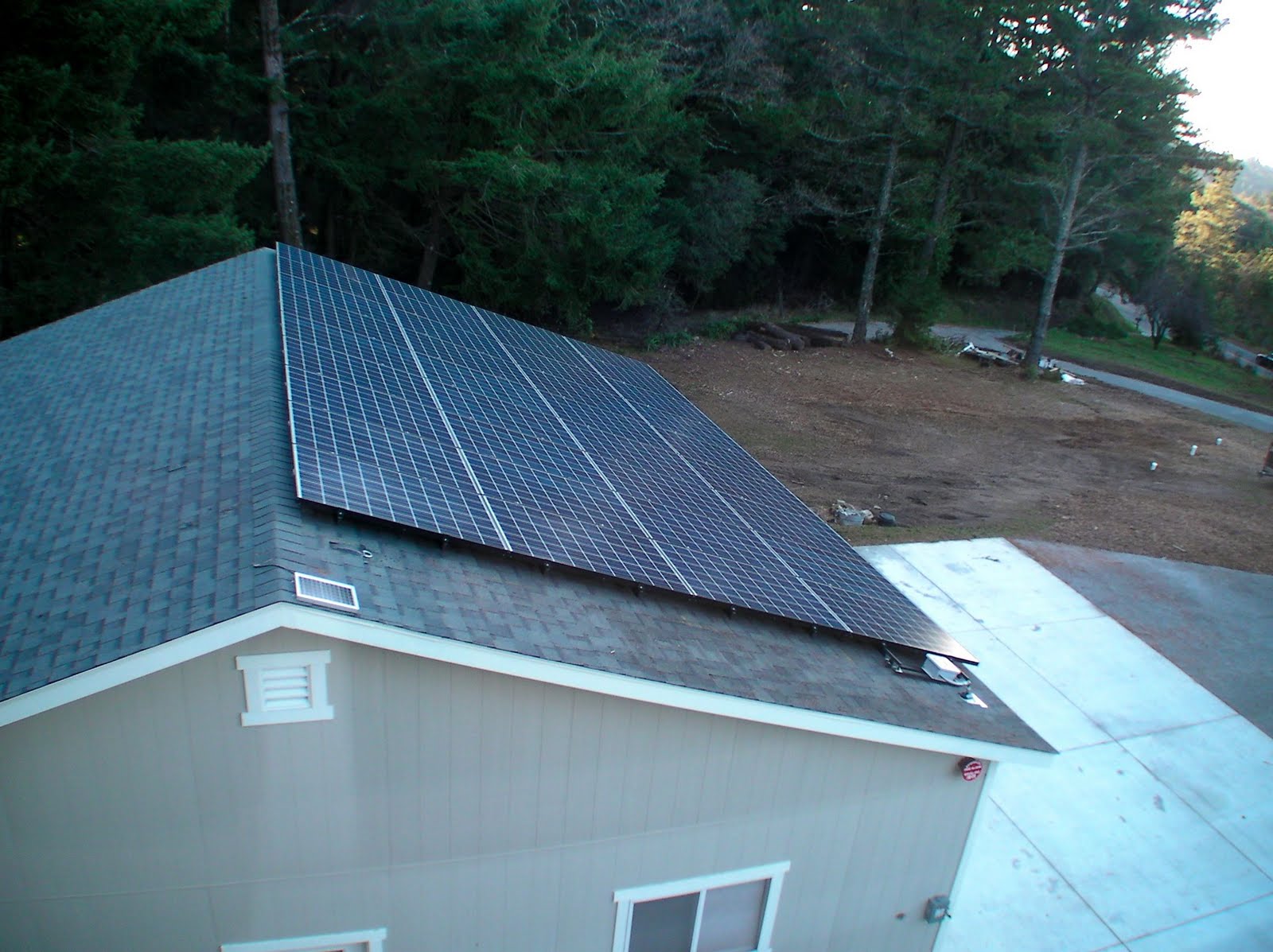
All the panels in place, four rows of nine panels, 36 x 210W = 7560W DC, after the inverter this works out to about 6.5KW delivered AC power.

View from the front of the garage early in the morning.

It's all wired in, we are waiting for inspection and approval before we can turn it on. The same monitoring system is used as was installed for my previous solar installation on the house roof. This time we leased the panels, there are several options, from no money down to buying the whole thing up front. I've opted for an initial payment of $10K, and $90/month fixed for the duration of the lease (20 years). I don't pay anything until its turned on.

We currently generate about two thirds of our usage of electricity. The extra panels should triple the generated capacity, so we will generate about twice what we use in the short term. That evens out when we start charging a Nissan Leaf (delivery due in April), and change out our propane furnace for a heat pump and air conditioner (hopefully in time to cool us this summer).

A useful side effect is that the garage itself will be a lot cooler inside during the summer, as the panels shade the roof.

Monday, December 27, 2010

Solar Power - More panels and Nissan Leaf

Solar City will triple our solar power output in February, and we just ordered a Leaf, which they say is deliverable in the April-July timeframe.

We are adding 6.5KW of net delivered AC capacity (gross is about 7.5KW DC) to the garage roof. This time we are leasing it, and there are several options for how much downpayment vs. recurring payment to make.

There was a power cut last night for about two hours, and the automatic generator that runs off our propane tank kicked in after about 20 seconds. When the power came back, there wasn't a glitch, everything kept running. That was the first real test. We have a Generac 17KW unit that powers most of the house. With hindsight, it would have been better to get the 20KW generator that can power a whole 200Amp distribution panel rather than routing individual circuits. The extra cost would be offset by a simpler installation. We hope to replace the propane furnace with a heat pump at some point, then the generator will be the only thing running on propane, and since our solar system is grid-tied, it needs to work well to keep an all electric house going.

We were originally looking a geothermal heat pumps, but the extra cost of digging wells to get a more efficient heat pump is not cost effective versus adding extra solar panels to make up the difference. In climates where it is colder and there is less solar irradiance available, it makes more sense to use geothermal.

During 2010 we generated about 60% of the electricity we consumed, and also greatly reduced our propane consumption by switching appliances from propane to electric. In 2011 we should be almost 100% solar powered electric, and reduce our gasoline usage as well.

Wednesday, November 17, 2010

NoSQL Netflix Use Case Comparison for Translattice

[There is some discussion of this posting with comments by Michael at Slashdot]
Michael Lyle @mplyle CTO of Translattice kindly provided a set of answers that I have interspersed with the questions below. Translattice isn't technically a NoSQL system, but it isn't a conventional database either. It's a distributed relational SQL database that supports eventual consistency, as Michael puts it:
These answers are for the Translattice Application Platform (TAP)'s database component. Unlike other stores that have answered this question set, TAP contains a relational database that scales out over identical nodes. TAP further allows applications written to the J2EE platform to scale out across the same collection of nodes.
The original set of questions are posted here. Each respondent will get their own blog post with answers, when there are enough to be interesting, I will write some summary comparisons.

If you have answers or would like to suggest additional questions, comment here, tweet me @adrianco or blog it yourself.

Use Case Scenario for Comparison Across NoSQL Contenders
While each NoSQL contender has different strengths and will be used for different things, we need a basis for comparison across them, so that we understand the differences in behavior. Here is a sample scenario that I am publishing to put to each vendor to get their answers and will post the results here. The example is non-trivial and is based on a simplified Netflix related scenario that is applicable to any web service that reliably collects data from users via an API. I assume that is running on AWS and use that terminology, but the concepts are generic.

Use Case
A TV based device calls the API to add a movie to its favorites list (like the Netflix instant queue, but I have simplified the concept here), then reads back the entire list to ensure it is showing the current state. The API does not use cookies, and the load balancer (Amazon Elastic Load Balancer) is round robin, so the second request goes to a different API server, that happens to be in a different Amazon Availability Zone, and needs to respond with the modified list.

Favorites Storage
Favorites store is implemented using a NoSQL mechanism that persistently stores a single key=user value=movielist record on writes, and returns the movielist on reads.

Question 1: Availability Zones
When an API reads and writes to a queue store using the NoSQL mechanism, is the traffic routing Availability Zone aware? Are reads satisfied locally, or spread over all zones, is the initial write local or spread over the zones, is the write replication zone aware so data is replicated to more than one zone?
In the Translattice Application Platform, data in relational tables is transparently sharded behind the scenes by the data store. These shards are stored redundantly across the nodes. Reads are satisfied with the most local copy of data available on the network, unless that resource is currently overloaded in which case the system may fall back to reads from more distant locations.

When it comes to writes, applications have the choice on the durability and isolation levels for changes. Each transaction may be made in a fully synchronous, serializable isolation level, or may be made in a locked eventually consistent mode that provides ACID serializable semantics except that durability may be sacrificed if an availability zone fails. A further asynchronous mode allows potentially conflicting changes to be made and allows a user-provided reconciliation function to decide which change "wins". A final commit requires a majority of nodes storing a shard to be available; in the case of the fully synchronous mode this would delay or prevent the return of success if a critical subset of the cluster fails.

Policy mechanisms in the system allow administrators to specify how physical and cloud database instances correspond to administratively-relevant zones. An administrator can choose to require, for instance, that each piece of information is replicated to at least three database nodes across a total of two availability zones. An administrator may also use these mechanisms to require that particular tables or portions of tables must or must not be stored in a given zone (for instance, to meet compliance or security requirements). Within the constraints set by policy, the system tracks usage patterns and places information in the most efficient locations.

Question 2: Partitioned Behavior with Two Zones
If the connection between two zones fails, and a partition occurs so that external traffic coming into and staying within a zone continues to work, but traffic between zones is lost, what happens? In particular, which of these outcomes does the NoSQL service support?
  • one zone decides that it is still working for reads and writes but half the size, and the other zone decide it is offline
  • both zones continue to satisfy reads, but refuse writes until repaired
  • data that has a master copy in the good zone supports read and write, slave copies stop for both read and write
  • both zones continue to accept writes, and attempt to reconcile any inconsistency on repair
Assuming that the SQL transaction in question is running in the fully synchronous or eventually consistent locked mode, writes will only be allowed in one of the two zones. Reads will continue in both zones, but will only be able to satisfy requests for which at least one replica of the requested data exists in the local zone (policy can be specified to ensure that this is always the case). In the eventually consistent mode, multiple partitioned portions of the system can accept writes and reconcile later. Essentially, any of the above desired modes can be used on a transaction-by-transaction basis depending on application and performance requirements.
Question 3: Appending a movie to the favorites list
If an update is performed by read-modify-write of the entire list, what mechanisms can be used to avoid race conditions? If multiple attribute/values are supported for a key, can an additional value be written directly without reading first? What limits exist on the size of the value or number of attribute/values, and are queries by attribute/value supported?
Because fully relational primitives are provided, there can easily be one row in the database per favorite. Read-modify-write of the whole list is not required, and the only practical limits are application-defined.

Any SQL queries are supported against the store, and are transformed by the query planner into an efficient plan to execute the query across the distributed system. Of course, how efficient a query is to execute will depend on the structure of the data and the indexes that an administrator has created. We think this allows for considerable flexibility and business agility as the exact access methods that will be used on the data do not need to be fully determined in advance.
Question 4: Handling Silent Data Corruption
When the storage or network subsystem corrupts data without raising an error, does the NoSQL service detect and correct this? When is it detected and corrected, on write, on read or asynchronously?
Network activity is protected by cryptographic hash authentication, which provides integrity verification as a side benefit. Distributed transactions also take place through a global consensus protocol that uses hashes to ensure that checkpoints are in a consistent state (this is also how the system maintains transactional integrity and consistency when changes cross many shards). Significant portions of the on-disk data are also presently protected by checksums and allow the database to "fail" a disk if corrupt data is read.
Question 5: Backup and Restore
Without stopping incoming requests, how can a point in time backup of the entire dataset be performed? What is the performance and availability impact during the backup? For cases such as roll-back after a buggy application code push, how is a known good version of the dataset restored, how is it made consistent, and what is the performance and availability impact during the restore? Are there any scalability limits on the backed up dataset size, what's the biggest you have seen?
A good portion of this relational database's consistency model is implemented through a distributed multi-version concurrency control (MVCC) system. Tuples that are in-use are preserved as the database autovacuum process will not remove tuples until it is guaranteed that no one could be looking at them anymore. This allows a consistent version of the tables as of a point in time to be viewed from within a transaction; so BEGIN TRANSACTION; SELECT ... [or COPY FROM, to backup] ; COMMIT; works. We provide mechanisms to allow database dumps to occur via this type of mechanism.
In the future we are likely to use this mechanism to allow quick snapshots of the entire database and rollbacks to previous snapshot versions (as well as to allow the use of snapshots to stage development versions of application code without affecting production state).

Tuesday, November 09, 2010

NoSQL Netflix Use Case Comparison for Riak

Justin Sheehy @justinsheehy of Basho kindly provided a set of answers that I have interspersed with the questions below.

The original set of questions are posted here. Each NoSQL contender will get their own blog post with answers, when there are enough to be interesting, I will write some summary comparisons.

If you have answers or would like to suggest additional questions, comment here, tweet me @adrianco or blog it yourself.

Use Case Scenario for Comparison Across NoSQL Contenders
While each NoSQL contender has different strengths and will be used for different things, we need a basis for comparison across them, so that we understand the differences in behavior. Here is a sample scenario that I am publishing to put to each vendor to get their answers and will post the results here. The example is non-trivial and is based on a simplified Netflix related scenario that is applicable to any web service that reliably collects data from users via an API. I assume that is running on AWS and use that terminology, but the concepts are generic.

Use Case
A TV based device calls the API to add a movie to its favorites list (like the Netflix instant queue, but I have simplified the concept here), then reads back the entire list to ensure it is showing the current state. The API does not use cookies, and the load balancer (Amazon Elastic Load Balancer) is round robin, so the second request goes to a different API server, that happens to be in a different Amazon Availability Zone, and needs to respond with the modified list.

Favorites Storage
Favorites store is implemented using a NoSQL mechanism that persistently stores a single key=user value=movielist record on writes, and returns the movielist on reads.

Question 1: Availability Zones
When an API reads and writes to a queue store using the NoSQL mechanism, is the traffic routing Availability Zone aware? Are reads satisfied locally, or spread over all zones, is the initial write local or spread over the zones, is the write replication zone aware so data is replicated to more than one zone?

There are two possibilities with Riak. The first would be to spread a single Riak cluster across all three zones, for example one node in each of three zones. In this case, a single replica of each item would exist in each zone. Whether or not a response needed to wait on cross-zone traffic to complete would depend on the consistency level in the individual request. The second option would require Riak EnterpriseDS, and involves placing a complete cluster in each zone and configuring them to perform inter-cluster replication. This has multiple advantages. Every request would be satisfied entirely locally, and would be independent of latency or availability characteristics across zone boundaries. Another benefit is that (unlike either the first scenario or some other solutions that spread clusters and quorums over a long haul) read requests would not generate any cross-zone traffic at all. For an application with a high percentage of reads, this can make a large difference.

Question 2: Partitioned Behavior with Two Zones
If the connection between two zones fails, and a partition occurs so that external traffic coming into and staying within a zone continues to work, but traffic between zones is lost, what happens? In particular, which of these outcomes does the NoSQL service support?
  • one zone decides that it is still working for reads and writes but half the size, and the other zone decide it is offline
  • both zones continue to satisfy reads, but refuse writes until repaired
  • data that has a master copy in the good zone supports read and write, slave copies stop for both read and write
  • both zones continue to accept writes, and attempt to reconcile any inconsistency on repair

As write-availability is a central goal achieved in Riak, the fourth option will be the observed behavior. This is the case regardless of the strategy chosen for Question 1. In the first strategy, local nodes other than the canonical homes for given data will accept the writes instead, using the hinted-handoff technique. In the second strategy, the local cluster will accept the write, those changes will be replayed across the replication link when the zones are reconnected. In all cases, vector clocks provide a clean way of resolving most inconsistency, and various reconciliation models are available to the user for those cases which cannot be syntactically resolved.


For more information on vector clocks in Riak, see:


http://blog.basho.com/2010/01/29/why-vector-clocks-are-easy/

and

http://blog.basho.com/2010/04/05/why-vector-clocks-are-hard/


Question 3: Appending a movie to the favorites list
If an update is performed by read-modify-write of the entire list, what mechanisms can be used to avoid race conditions? If multiple attribute/values are supported for a key, can an additional value be written directly without reading first? What limits exist on the size of the value or number of attribute/values, and are queries by attribute/value supported?

Riak will use vector clocks to recognize causality in race conditions. In the case of two overlapping writes to the same value, Riak will retain both unless explicitly requested to simply overwrite with the last value received. If one client changes A to B and another changes A to C, then (unless told to overwrite) Riak will return both B and C to the client. When that client then modifies the object again, the single descendant "D" that they created will be the new value. For applications such as sets which are mostly added to and rarely deleted from, the application code to perform this reconciliation is trivial and in some cases is simply a set union operation. This would look a bit like this in terms of vector clock ancestry:

http://dl.dropbox.com/u/751099/ndiag1.png


Riak allows values to be of any arbitrary content type, but if the content is in JSON then a JavaScript map/reduce request can be used to query by attribute/value.

Question 4: Handling Silent Data Corruption
When the storage or network subsystem corrupts data without raising an error, does the NoSQL service detect and correct this? When is it detected and corrected, on write, on read or asynchronously?

Many layers of Riak perform consistency checking, including CRC checking in the persistence engine and object equality in the distributed state machines handling requests. In most cases where corruption can be detected in a given replica of some item, that replica will immediately but asynchronously be fixed via read-repair.

Question 5: Backup and Restore
Without stopping incoming requests, how can a point in time backup of the entire dataset be performed? What is the performance and availability impact during the backup? For cases such as roll-back after a buggy application code push, how is a known good version of the dataset restored, how is it made consistent, and what is the performance and availability impact during the restore? Are there any scalability limits on the backed up dataset size, what's the biggest you have seen?

There are two approaches to back up Riak systems: per-node or whole-cluster. Backing up per-node is the easiest option for many people, and is quite simple. Due to bitcask (the default storage engine) performing writes in an append-only fashion and never re-opening any file for writing once closed, Riak nodes can easily be backed up via the filesystem backup method of your choice. Simply replacing the content of the data directory will reset a node's stored content to what it held at the time. Alternately, a command line backup command is available which will write out a backup of all data on the cluster. This is fairly network and disk intensive and requires somewhere to put a whole-cluster backup, but is very useful for prototyping situations which are not holding enormous amounts of data.


Monday, November 01, 2010

Are we ready for spotcloud yet?

Launched today by Enomaly (@ruv) Spotcloud is a "Cloud Capacity Clearinghouse and Marketplace". There was a lot of discussion on twitter about whether this is really new, and previous attempts to do something similar.

My background in this is that I was working at Sun in 2003/2004 when we were thinking about a marketplace for public grid computing capacity, I was chief architect for Shahin Khan's High Performance Technical Computing group at the time, and we "owned" Grid for Sun. We were both RIFd in the summer of 2004, but some of our projects stayed alive, and @ruv mentioned some of these ideas from Sun surfacing in 2005.

I moved to eBay, and one idea that I tried to get eBay interested in at the time was building a marketplace for compute capacity. The problem was that eBay is a retail product focused company, and had no product managers looking at digitally delivered products. I couldn't find a marketplace manager who understood what I was proposing and thought it might be worth working on. In practice, it was too early, but Amazon had the vision to build a cloud at this time, and eBay could have done the same if it wanted to create a market, rather than make existing markets more efficient.

In 2006 (while I was working at eBay Research Labs) I wrote a blog post about a maturity model for innovation. The key point is:

"the evolution of a marketplace goes from competing on the basis of technology, to competing on service, to competing as a utility, to competing for free. In each step of the evolution, competitors shake out over time and a dominant brand emerges.

To use this as a maturity model, take a market and figure out whether the primary competition is on the basis of technology, service, utility or search"
Today the cloud marketplace is somewhere between the service and utility phases. Each individual cloud has their own specific services and service interfaces, and they have not turned into a standard commodity yet, so we do not have the basis for competition purely on the basis of a Utility (i.e. on service quality - uptime, not on service features).

From this point of view, it is still too early for Spotcloud to take off. Cloud's problem is not "finding generic capacity at low cost" (the cloud utility search problem), the cloud marketplace is still evolving it's differentiated service interfaces towards a common set of functionality and standards. Spotcloud is starting out based on Enomaly's interfaces, and say they will add others, while the market leader is Amazon, who have already implemented their own spot pricing model.

One thing I did learn at eBay, is how hard it is to manage marketplaces. One unfortunate measure of success is that it attracts people whose aim is to make money by manipulating the market rather than contributing to it. There are a lot of non-intuitive details that you have to get right for a marketplace to scale and be robust enough to build and maintain trust, while also having very low "friction" so that it attracts and retains buyers and sellers.

So one way to tell that the marketplace for cloud capacity is viable is when you see eBay entering that marketplace :-)


Sunday, October 31, 2010

NoSQL Netflix Use Case Comparison for MongoDB

Roger Bodamer @rogerb from 10gen.com kindly provided a set of answers for MongoDB that I have interspersed with the questions below. The original set of questions are posted here. Each NoSQL contender will get their own blog post with answers, when there are enough to be interesting, I will write some summary comparisons. If you have answers or would like to suggest additional questions, comment here, tweet me @adrianco or blog it yourself.

Use Case Scenario for Comparison Across NoSQL Contenders
While each NoSQL contender has different strengths and will be used for different things, we need a basis for comparison across them, so that we understand the differences in behavior. Here is a sample scenario that I am publishing to put to each vendor to get their answers and will post the results here. The example is non-trivial and is based on a simplified Netflix related scenario that is applicable to any web service that reliably collects data from users via an API. I assume that is running on AWS and use that terminology, but the concepts are generic.

Use Case
A TV based device calls the API to add a movie to its favorites list (like the Netflix instant queue, but I have simplified the concept here), then reads back the entire list to ensure it is showing the current state. The API does not use cookies, and the load balancer (Amazon Elastic Load Balancer) is round robin, so the second request goes to a different API server, that happens to be in a different Amazon Availability Zone, and needs to respond with the modified list.

Favorites Storage
Favorites store is implemented using a NoSQL mechanism that persistently stores a single key=user value=movielist record on writes, and returns the movielist on reads.

Question 1: Availability Zones
When an API reads and writes to a queue store using the NoSQL mechanism, is the traffic routing Availability Zone aware? Are reads satisfied locally, or spread over all zones, is the initial write local or spread over the zones, is the write replication zone aware so data is replicated to more than one zone?

Let's assume for discussion purposes that we are using MongoDB across three availability zones in a region. We would have a replica set member in each of the three zones. One member will be elected primary at a given point in time.


All writes will be sent to the primary, and then propagate to secondaries from there. Thus, writes are often inter-zone. However availability zones are fairly low latency (I assume the context here is EC2).


Reads can be either to the primary, if immediate/strong consistency semantics are desired, or to the local zone member, if eventually consistent read semantics are acceptable.


Question 2: Partitioned Behavior with Two Zones
If the connection between two zones fails, and a partition occurs so that external traffic coming into and staying within a zone continues to work, but traffic between zones is lost, what happens? In particular, which of these outcomes does the NoSQL service support?
  • one zone decides that it is still working for reads and writes but half the size, and the other zone decide it is offline
  • both zones continue to satisfy reads, but refuse writes until repaired
  • data that has a master copy in the good zone supports read and write, slave copies stop for both read and write
  • both zones continue to accept writes, and attempt to reconcile any inconsistency on repair
Let's assume again we are using three zones - we could use two but three is more interesting. To be primary in a replica set, the primary must be visible to a majority of the members of the set: in this case, two thirds of the members, or two thirds of the zones. If one zone is partitioned from the other two, what will happen is: a member in the 2 zone side of the partition will become primary, if not already. It will be available for reads and writes.

The minority partition will not service writes. Eventually consistent reads are still possible in the minority partition.

Once the partition heals, the servers automatically reconcile.

http://www.mongodb.org/display/DOCS/Replica+Set+Design+Concepts
Question 3: Appending a movie to the favorites list
If an update is performed by read-modify-write of the entire list, what mechanisms can be used to avoid race conditions?

MongoDB supports atomic operations on single documents via both its $ operators ($set, $inc) and also by compare-and-swap operations. In MongoDB one could model the list as a document per favorite, or, put all the favorites in a single BSON object. In both cases atomic operations free of race conditions are possible. http://www.mongodb.org/display/DOCS/Atomic+Operations


This is why mongodb elects a node primary: to facilitate these atomic operations for use cases where these semantics are required.


If multiple attribute/values are supported for a key, can an additional value be written directly without reading first?
Yes.
What limits exist on the size of the value or number of attribute/values?

A single BSON document must be under the limit -- currently that limit is 8MB. If larger than this, one should consider modeling as multiple documents during schema design.

and are queries by attribute/value supported?

Yes. For performance, MongoDB supports secondary (composite) indices.


Question 4: Handling Silent Data Corruption
When the storage or network subsystem corrupts data without raising an error, does the NoSQL service detect and correct this? When is it detected and corrected, on write, on read or asynchronously?

The general assumption is that the storage system is reliable. Thus, one would normally use a RAID with mirroring, or a service like EBS which has intrinsic mirroring.


However, the BSON format has a reasonable amount of structure to it. It is highly probable, although not certain, that a corrupt object would be detected and an error reported. This could then be correct with a database repair operation.


Note: the above assumes an actual storage system fault. Another case of interest is simply a hard crash of the server. MongoDB 1.6 requires a --repair after this. MongoDB v1.8 (pending) is crash-safe in its storage engine via journaling.


Question 5: Backup and Restore
Without stopping incoming requests, how can a point in time backup of the entire dataset be performed? What is the performance and availability impact during the backup?

The most used method is to have a replica which is used for backups only; perhaps an inexpensive server or VM. This node can be taken offline at any time and any backup strategy used. Once re-enabled, it will catch back up. http://www.mongodb.org/display/DOCS/Backups


With something like EBS, quick snapshotting is possible using the fsync-and-lock command.


For cases such as roll-back after a buggy application code push, how is a known good version of the dataset restored, how is it made consistent, and what is the performance and availability impact during the restore? Are there any scalability limits on the backed up dataset size, what's the biggest you have seen?

One can stop the server(s), restore the old data file images, and restart.


MongoDB supports a slaveDelay option which allows one to force a replica to stay a certain number of hours behind realtime. This is a good way to maintain a rolling backup in case of someone "fat-fingering" a database operation.

Friday, October 29, 2010

NoSQL Netflix Use Case Comparison for Cassandra

Jonathan Ellis @spyced of Riptano kindly provided a set of answers that I have interspersed with the questions below.

The original set of questions are posted here. Each NoSQL contender will get their own blog post with answers, when there are enough to be interesting, I will write some summary comparisons.

If you have answers or would like to suggest additional questions, comment here, tweet me @adrianco or blog it yourself.

Use Case Scenario for Comparison Across NoSQL Contenders
While each NoSQL contender has different strengths and will be used for different things, we need a basis for comparison across them, so that we understand the differences in behavior. Here is a sample scenario that I am publishing to put to each vendor to get their answers and will post the results here. The example is non-trivial and is based on a simplified Netflix related scenario that is applicable to any web service that reliably collects data from users via an API. I assume that is running on AWS and use that terminology, but the concepts are generic.

Use Case
A TV based device calls the API to add a movie to its favorites list (like the Netflix instant queue, but I have simplified the concept here), then reads back the entire list to ensure it is showing the current state. The API does not use cookies, and the load balancer (Amazon Elastic Load Balancer) is round robin, so the second request goes to a different API server, that happens to be in a different Amazon Availability Zone, and needs to respond with the modified list.

Favorites Storage
Favorites store is implemented using a NoSQL mechanism that persistently stores a single key=user value=movielist record on writes, and returns the movielist on reads.
The most natural way to model per-user favorites in Cassandra is to have one row per user, keyed by the userid, whose column names are movie IDs. The combination of allowing dynamic column creation within a row and allowing very large rows (up to 2 billion columns in 0.7) means that you can treat a row as a list or map, which is a natural fit here. Performance will be excellent since columns can be added or modified without needing to read the row first. (This is one reason why thinking of Cassandra as a key/value store, even before we added secondary indexes, was not really correct.)

The best introduction to Cassandra data modeling is Max Grinev's series on
basics, translating SQL concepts, and idempotence.

Question 1: Availability Zones
When an API reads and writes to a queue store using the NoSQL mechanism, is the traffic routing Availability Zone aware? Are reads satisfied locally, or spread over all zones, is the initial write local or spread over the zones, is the write replication zone aware so data is replicated to more than one zone?
Briefly, both reads and writes have a ConsistencyLevel parameter controlling how many replicas across how many zones must reply for the request to succeed. Routing is aware of current response times as well as network topology, so given an appropriate ConsistencyLevel, reads can be routed around temporarily slow nodes.

On writes, the coordinator node (the one the client sent the request to) will send the write to all replicas; as soon as enough success messages come back to satisfy the desired consistency level, the coordinator will report success to the client.

For more on consistency levels, see
Ben Black's excellent presentation.
Question 2: Partitioned Behavior with Two Zones
If the connection between two zones fails, and a partition occurs so that external traffic coming into and staying within a zone continues to work, but traffic between zones is lost, what happens? In particular, which of these outcomes does the NoSQL service support?
  • one zone decides that it is still working for reads and writes but half the size, and the other zone decide it is offline
  • both zones continue to satisfy reads, but refuse writes until repaired
  • data that has a master copy in the good zone supports read and write, slave copies stop for both read and write
  • both zones continue to accept writes, and attempt to reconcile any inconsistency on repair
Cassandra has no 'master copy' for any piece of data; all copies are equal. The other behaviors are supported by different ConsistencyLevel values for reads (R) and writes (W):

R=QUORUM, W=QUORUM: One zone decides that it is still working for reads and writes, and the other zone decides it is offline
R=ONE, W=ALL: Both zones continue to satisfy reads, but refuse writes
R=ONE, W=ONE: Both zones continue to accept writes, and reconcile any inconsistencies when the partition heals

I would also note that reconciliation is timestamp-based at the column level, meaning that updates to different columns within a row will never conflict, but when writes have been allowed in two partitions to the same column, the highest timestamp will win. (This is another way Cassandra differs from key/value stores, which need more complex logic called vector clocks to be able to merge updates to different logical components of a value.)
Question 3: Appending a movie to the favorites list
If an update is performed by read-modify-write of the entire list, what mechanisms can be used to avoid race conditions? If multiple attribute/values are supported for a key, can an additional value be written directly without reading first? What limits exist on the size of the value or number of attribute/values, and are queries by attribute/value supported?
Cassandra's ColumnFamily model generally obviates the need for a read before a write, e.g., as above using movie IDs as column names. (If you wanted to allow duplicates in the list for some reason, you would generally use a UUID as the column name on insert instead of the movie ID.)

The maximum value size is 2GB although in practice we recommend using 8MB as a more practical maximum. Splitting a larger blob up across multiple columns is straightforward given the dynamic ColumnFamily design. The maximum row size is 2 billion columns. Queries by attribute value are supported with secondary indexes in 0.7.
Question 4: Handling Silent Data Corruption
When the storage or network subsystem corrupts data without raising an error, does the NoSQL service detect and correct this? When is it detected and corrected, on write, on read or asynchronously?
Cassandra handles repairing corruption the same way it does other data inconsistencies, with read repair and anti-entropy repair.
Question 5: Backup and Restore
Without stopping incoming requests, how can a point in time backup of the entire dataset be performed? What is the performance and availability impact during the backup? For cases such as roll-back after a buggy application code push, how is a known good version of the dataset restored, how is it made consistent, and what is the performance and availability impact during the restore? Are there any scalability limits on the backed up dataset size, what's the biggest you have seen?
Because Cassandra's data files are immutable once written, creating a point-in-time snapshot is as simple as hard-linking the current set of sstables on the filesystem. Performance impact is negligible since hard links are so lightweight. Rolling back simply consists of moving a set of snapshotted files into the live data directory. The snapshot is as consistent as your ConsistencyLevel makes it: any write visible to readers at a given ConsistencyLevel before the snapshot will be readable from the snapshot after restore. The only scalability problem with snapshot management is that past a few TB, it becomes impractical to try to manage snapshots centrally; most companies leave them distributed across the nodes that created them.

Wednesday, October 27, 2010

Comparing NoSQL Availability Models

let's risk feeding the CAP trolls, and try to get some insight into the differences between the many NoSQL contenders. I have circulated an earlier version of this to a few people and got at least one good response. If you have answers, or would like to suggest additional questions, comment here, tweet me @adrianco or blog it yourself.


Use Case Scenario for Comparison Across NoSQL Contenders
While each NoSQL contender has different strengths and will be used for different things, we need a basis for comparison across them, so that we understand the differences in behavior. Here is a sample scenario that I am publishing to put to each vendor to get their answers and will post the results here. The example is non-trivial and is based on a simplified Netflix related scenario that is applicable to any web service that reliably collects data from users via an API. I assume that is running on AWS and use that terminology, but the concepts are generic.

Use Case
A TV based device calls the API to add a movie to its favorites list (like the Netflix instant queue, but I have simplified the concept here), then reads back the entire list to ensure it is showing the current state. The API does not use cookies, and the load balancer (Amazon Elastic Load Balancer) is round robin, so the second request goes to a different API server, that happens to be in a different Amazon Availability Zone, and needs to respond with the modified list.

Favorites Storage
Favorites store is implemented using a NoSQL mechanism that persistently stores a single key=user value=movielist record on writes, and returns the movielist on reads.

Question 1: Availability Zones
When an API reads and writes to a queue store using the NoSQL mechanism, is the traffic routing Availability Zone aware? Are reads satisfied locally, or spread over all zones, is the initial write local or spread over the zones, is the write replication zone aware so data is replicated to more than one zone? 

Question 2: Partitioned Behavior with Two Zones
If the connection between two zones fails, and a partition occurs so that external traffic coming into and staying within a zone continues to work, but traffic between zones is lost, what happens? In particular, which of these outcomes does the NoSQL service support?
  • one zone decides that it is still working for reads and writes but half the size, and the other zone decide it is offline
  • both zones continue to satisfy reads, but refuse writes until repaired
  • data that has a master copy in the good zone supports read and write, slave copies stop for both read and write
  • both zones continue to accept writes, and attempt to reconcile any inconsistency on repair
Question 3: Appending a movie to the favorites list
If an update is performed by read-modify-write of the entire list, what mechanisms can be used to avoid race conditions? If multiple attribute/values are supported for a key, can an additional value be written directly without reading first? What limits exist on the size of the value or number of attribute/values, and are queries by attribute/value supported?

Question 4: Handling Silent Data Corruption
When the storage or network subsystem corrupts data without raising an error, does the NoSQL service detect and correct this? When is it detected and corrected, on write, on read or asynchronously?

Question 5: Backup and Restore
Without stopping incoming requests, how can a point in time backup of the entire dataset be performed? What is the performance and availability impact during the backup? For cases such as roll-back after a buggy application code push, how is a known good version of the dataset restored, how is it made consistent, and what is the performance and availability impact during the restore? Are there any scalability limits on the backed up dataset size, what's the biggest you have seen?

Sunday, October 10, 2010

Netflix in the Cloud

I'm presenting this talk on Thursday at the Cloud Computing Meetup, and again on Nov 3rd at QConSF. So far I have posted a "teaser" summary on slideshare. After QCon I will post the full slide deck [update: combined deck from both talks posted here].

The meetup is the "beta test" of the presentation. It's in Mountain View at "Hacker Dojo", and at the time of writing 437 people have signed up to attend. If everyone turns up it's going to be crazy and over-flowing trying to park and get in, so get there early.... I will focus the meetup talk more on the operational aspects of the cloud architecture, and migration techniques.

At QConSF, the presentation is in the "Architectures you've always wondered about" track, and I will spend more time talking about the software architecture.

Why give these talks? We aren't trying to sell cloud to CIOs, it's all about hiring, we are talking at engineer focused events in the Bay Area. Netflix is growing fast, pathfinding new technologies in the public cloud to support a very agile business model, and is trying to attract the best and brightest people. We use LinkedIn a lot when we search for positions, so feel free to connect to me if you think this could be interesting, or follow @adrianco on Twitter.

Wednesday, October 06, 2010

Time for some climate action on 10/10/10

organized by 350.org there are events all over the world. The significance of 350 is that it is the safe level of CO2 in the atmosphere. We are already at 390ppm, which is why the climate is changing and extreme weather events are becoming common. The level is going up by 2ppm a year at the moment and the changes needed to reverse this haven't started, so its going to go much higher and have increasingly worse effects.

Even if all you do is buy and start reading a copy of James Hansen's book Storms of my Grandchildren (you can get it instantly from the Kindle store) it will help.

Here is a useful discussion of "The Value of Coherence in Science" which is how you can tell what makes sense from what must be wrong. I'm a Physics graduate, and I was taught that science works by making predictions and testing them, and by eliminating incoherent propositions. i.e. if an argument contradicts itself it must be false. The denialist counter-arguments fail this test. To see why the denialist arguments are getting any air time at all, read Merchants of Doubt and Climate Cover Up.

For an example of incoherent and shoddy denialist work John Mashey has systematically deconstructed the Wegman Report which was presented to Congress as an impartial study when it was nothing of the sort.

Sunday, October 03, 2010

More solar power

We just signed up for almost 8KW on the garage roof. It's justified based on replacing our propane furnace with a heat pump that also gives us aIr conditioning, and also running an electric car (e.g. Nissan Leaf). We can use our existing monitoring system, but unlike last time, when we bought the system, we plan to lease it from Solar City this time. There Is a four month lead time, so we can pick the exact terms of the lease next February before it is installed. There are several options, zero down with a monthly charge that increases slightly each year, or options to pay various amounts up front with a fixed monthly payment. The monthly payments are all less than a typical electricity bill.

The goal for next year is to only use propane to run the backup generator (usually for a few days a year), and to make a dent in our petrol usage for the daily commute. We are on the Nissan Leaf list, but not in the first wave of owners. We should be able to get a test drive soon, I will report on any progress as it happens.

If you are interested in electric cars, look for Robert Llewellyn's Fully Charged video show on YouTube. He has been test driving everything and he's good fun to watch. You may recognize him as the actor who played Kryton in Red Dwarf.